

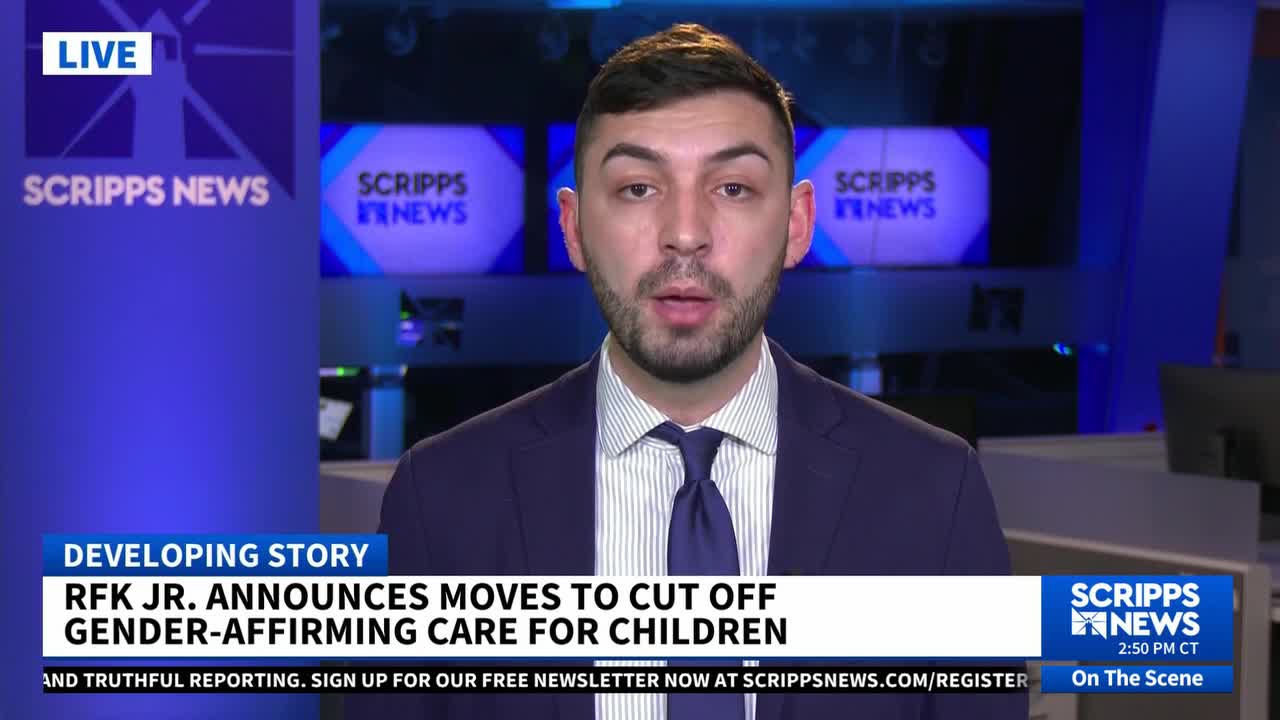


The Trump administration on Thursday announced a series of new rules and regulations that, if allowed to stand, would effectively prohibit American minors’ from accessing gender-affirming healthcare.
The move — announced by top Trump administration health officials including Secretary of Health and Human Services Robert F. Kennedy, Jr., Food and Drug Administration Commissioner Martin Makary, and Center for Medicaid and Medicare Services Administrator Mehment Oz, among others — represents the most far-reaching effort yet by the White House to crack down on an expansive and fluid understanding of gender identity.
“So-called gender-affirming care has afflicted lasting physical and psychological damage on vulnerable young people,” Kennedy said in remarks at HHS’s Washington headquarters. “This is not medicine, it’s malpractice.”
“Pushing transgender ideology in children is predatory, it’s wrong and it needs to stop,” echoed Makary.
Transgender people, LGBTQ+ advocates and major American medical groups quickly blasted the move.
“These rules are about putting politicians in people's doctor's offices. They're about replacing parents and physicians, medical professionals, with politicians who have their own agendas,” Brandon Wolf, national press secretary with the Human Rights Campaign, told Scripps News in an interview. “It is a shame to see that this administration is taking aim, once again, at transgender young people at a time when they are ignoring so many crises that are impacting Americans across the country.”
“At a time when families across the country are facing rising costs and other health challenges, our leading government health care agency opts to introduce regulations that focus disproportionate attention on denying care to a small population of adolescents,” echoed Susan J. Kressly, president of the American Academy of Pediatrics. “These rules help no one, do nothing to address health care costs, and unfairly stigmatize a population of young people.”
A series of new restrictions
Federal officials announced six new policies Thursday aimed at restricting minors’ access to transgender healthcare.
Two rules promulgated by CMS target federal funds for gender-affirming procedures and the institutions that provide them.
One prohibits federal Medicaid and Children’s Health Insurance Program (CHIP) dollars from being used to fund what are described as “sex-rejecting procedures.”
A second, broader policy bars hospitals from providing gender-affirming care as a condition of receiving Medicare and Medicaid funds. Nearly every American hospital receives such funding, and those federal dollars support at least half of all inpatient stays at more than 96% of hospitals, according to the American Hospital Association.
Both rules won’t take effect for at least 60 days, while they undergo a standard notice and comment period.
Additionally, Kennedy authored an HHS declaration that stated gender-affirming care procedures “do not meet professionally recognized standards of health care,” and suggested physicians performing them “would be deemed out of compliance” with such standards.
Adm. Brian Christine, HHS assistant secretary for health and head of the United States Public Health Service Commissioned Corps, also authored a formal public health message to American physicians and medical providers finding that “[c]urrent evidence does not support claims that puberty blockers, cross-sex hormones, and surgeries are safe and effective treatments for pediatric gender dysphoria.”
FDA officials also said they’d sent a series of warning letters to companies that manufacture chest binders, which can be used to help reduce the size and prominence of breasts, suggesting they were illegally marketing such devices to children.
And HHS’s Office for Civil Rights announced a reinterpretation of federal law clarifying that “gender dysphoria” – a medical diagnosis for those who feel their gender identity contradicts their sex assigned at birth – is not subject to some federal disability protections.
Trump administration officials pointed to an executive order signed by Trump during his first days in the White House that tasked health officials to propose new rules “protecting children from chemical and surgical mutilation” as justification for such actions. The order suggested such care represented a “stain on our Nation’s history, and it must end.”
Officials also cited a recent report commissioned by Kennedy and other top officials that synthesized scientific research into such care practices as giving them an evidentiary backing for the new rules.
The report concluded that the benefits of medical interventions were uncertain, but the risks – including loss of fertility and a potential future desire to “detransition” – outweighed the benefits.
In comments provided as a part of the peer review process, American Medical Association officials wrote the report’s claims “fall short of the standard of methodological rigor that should be considered a prerequisite for policy guidance in clinical care” and that it “does not apply any kind of rational scrutiny to potential harms that have been associated with withholding intervention, including higher rates of depression, anxiety, suicidality, and social withdrawal.”
Expected legal challenges to come
Medical experts and LGBTQ+ advocacy groups suggested the new measures likely run afoul of federal law, and hinted at possible legal challenges in the future.
Michael Ulrich, an associate professor at Boston University’s School of Public Health and bioethicist who studies gender-affirming care, said Kennedy and other officials grossly misstated the current status quo.
“There are licensure boards, there are ethical requirements, there are malpractice laws — the idea that doctors can sort of do whatever they want without repercussions… is just completely false in terms of the way that our healthcare system works,” he told Scripps News in an interview.
Ulrich noted that some cosmetic procedures like breast augmentations or rhinoplasties are still allowed for minors with parental consent, despite the fact that they can permanently alter children's appearances.
“It just demonstrates that, again, this is not something that they are even internally consistent about in terms of the justifications that they use,” he noted.
Wolf, the HRC official, suggested the Trump administration is unlikely to stop at restrictions for transgender minors, and rather is looking to regulate trans people out of existence altogether.
“The very same people that are behind the rules that were proposed today believe that no transgender person should be able to access health care, and they will not stop until they have full control over who gets health care in this country,” he said.
Indeed, during Thursday’s remarks, Jim O’Neill, the deputy secretary of the Health Department, was blunt in his beliefs: “Men are men. Men can never become women. Women are women, women can never become men.”
Legal experts consulted by Scripps News said that while the Trump administration had broad leeway to issue public notices or try to steer federal funding, efforts to block funding to all hospitals that provide gender-affirming care were on shakier ground.
Experts specifically highlighted a section of federal code that prohibits federal officials from “exercis[ing] any supervision or control over the practice of medicine or the manner in which
medical services are provided.”
In rulemaking documents, CMS officials sought to circumvent such statutory bars by arguing gender-affirming care didn’t actually amount to healthcare; whether such arguments will hold up in court remains to be seen.
Already, 27 states have enacted laws or policies blocking minors’ access to gender-affirming care, according to the health research firm KFF.
In June, the U.S. Supreme Court ruled in U.S. v. Skremetti that states should be allowed to move forward with transgender care bans given ongoing medical debates about the efficacy of such procedures.
In finding Tennessee’s ban on such care was warranted, Chief Justice John Roberts Jr. pointed to the “fierce scientific and policy debates about the safety, efficacy and propriety of medical treatments in an evolving field” and said such questions should be resolved by “the people, their elected representatives and the democratic process.”
A growing anti-trans climate
It’s not just the Trump administration and GOP-led states spearheading the charge against transgender minors.
On Wednesday, the U.S. House of Representatives narrowly passed a measure, authored by Rep. Marjorie Taylor Greene (R-GA), that would criminalize gender-affirming procedures and medical care for minors.
The bill passed the House 215-201, with four Republicans breaking ranks to oppose it and three Democrats voting for it. The bill faces unlikely odds in the Senate, where Democratic support would be required to push it over a 60-vote threshold needed for passage.
Still, Wednesday’s vote highlighted the shifting politics around transgender issues. Trump and Republicans have credited the president’s anti-trans messaging as central to his 2024 electoral victory – prompting some prominent Democrats previously supportive of LGBTQ+ issues to hedge on wedge issues like trans students’ participation in school sports.
Yet in more recent electoral contests, anti-trans candidates have been less successful.
Wolf suggested the American public was on trans people’s side.
“A vast majority of people in this country support LGBTQ plus equality,” he told Scripps News. “The American people don't want to punish their neighbors because, you know, they have a kid who's trans. They want answers to their own health care, premiums skyrocketing and the cost of groceries, and they're not going to tolerate politicians who try to hide behind transphobia to ignore the real crises that the American people are facing every day.
