

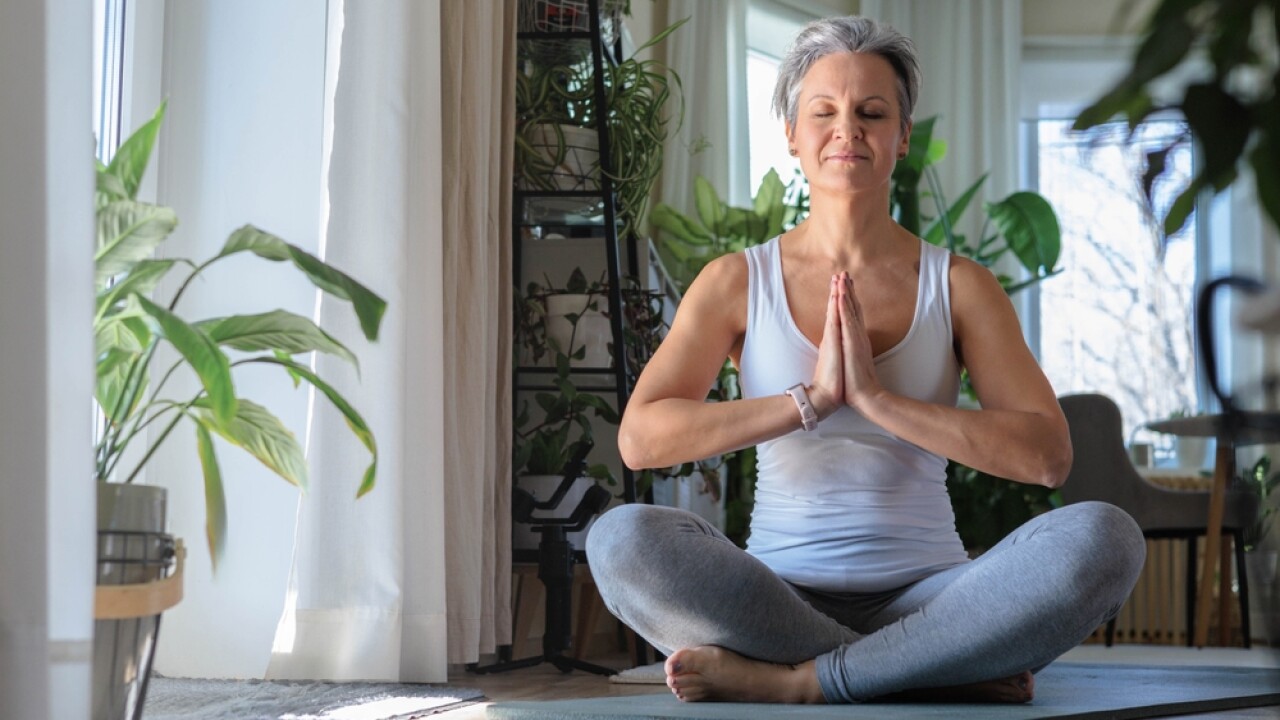

In a large gathering space at the C.A. Scott Recreation Center on the northwest side of Atlanta, an instructor in a light brown track suit and mala beads urged a couple dozen women to bring their chairs closer. As gentle electronica played over a crackly speaker, the women laughed and chatted, eventually doing as asked.
The women — in their 60s, 70s and 80s, part of the city’s free Primetime Seniors program — weren’t there to passively listen to a lecture; rather, they laced up their sneakers to stretch, breathe deeply and perfect their yoga poses. The women say the yoga and other classes – the day before, it was line dancing; the day before that, computer class; soon, it would be warm enough for swim lessons – keep them mentally and physically agile.
Many also echoed what a new study found: What makes for “good aging” is having the right attitude.
“I was a caretaker for a lot of people in my house who just sat, and I saw what that did to people, so I’m going to do what I can,” 66-year-old Vivian Cook said. “I don’t sit still. I don’t stay home, and I’m always thinking positive. Just ask my kids – I’m encouraging them to think positive, too.”
Lilla Doe, 74, and Sirlene Watts, 67 – friends Cook made through the program – nodded in agreement.
“I’m going to be happy because I woke up in the morning,” Doe added.
“It’s better than the alternative,” Watts added.
RELATED STORY | Social Security checks rise 2.8%, but many retirees say it’s not enough
Despite the stereotype that the body and brain automatically decline as people get older, research shows that many people really are more like fine wine: improving with age.
The secret isn’t a special supplement or a complicated diet. What seems to really matter is a positive attitude toward aging.
Attitude is everything
Researchers saw this trend in the new study published this month in the journal Geriatrics that followed more than 11,000 seniors for about a decade. They gauged mental and physical health with a common cognitive exam that tests short-term memory and math skills, as well as a simple walking test. Walking engages cardiovascular, sensory, nervous and musculoskeletal systems. A slower gait – typically less than about 4 feet a second – can indicate underlying health issues.
In the end, more than 45% of the participants showed improvement in their thinking skills and/or walking speed over time. Improvement was more likely among those with positive attitudes about their aging.
A 2023 study also found that people with more positive feelings about aging reported less frequent concentration or focus problems. A 2022 study that followed 14,000 adults over age 50 for four years found that those with the highest satisfaction with aging had a 43% lower risk of dying from any cause then those with more negative attitude. They also had lower risk of chronic conditions.
“Sometimes as we get older, things do start falling apart a little,” said Marye Hall, 76, one of the Primetime Seniors.
Hall has high blood pressure and arthritis, and she’s had her knees replaced, but she doesn’t use a cane and lives on her own.
After retiring from Delta Air Lines in 2008, she said, she realized that staying home wasn’t her. In addition to walking every morning, she attends the Primetime Seniors program nearly every day.
“You know, 76 is different than it was 20 or 30 years ago. I stay active. Not sitting around the house is so important,” Hall said.
Why a positive attitude affects aging isn’t explained in the latest study. Earlier research shows that people who are more positive about aging have increased self-confidence about their thinking, and that alone can improve memory and general cognitive skills.
Positive thinking also tends to make people more resilient. Positive people also tend to be more social, and studies show that healthy connections keep people healthier overall.
Another practical reason why positivity may help with aging well: People who remain positive are more likely to use preventive health services, a 2014 study found.
Hall agrees that positivity works, and so does being proactive about the doctor.
“You keep those appointments, you stay tuned into your health and address it, and it gets better,” Hall said.
RELATED STORY | More older Americans are returning to work over finances, survey finds
A swimming inspiration
Dr. Becca R. Levy, co-author of the new study and a professor of social and behavioral sciences at the Yale School of Public Health, says what can be tricky is that people internalize all the cultural suggestions that we decline with age.
“Negativity about aging is reflected in a number of different surveys or even in the messages one gets if you walk in to get a birthday card,” Levy said.
Levy said the new research was inspired in part by long-distance swimmer Diana Nyad, who finally succeeded in making a 53-hour, 110-mile world-record swim from Cuba to Florida at the age of 64. Levy also saw a retrospective of the 17th-century British painter J.M.W. Turner, whose art seemed to get more creative with time.
“I started to wonder if these examples of increased creativity and increased physical endurance, whether those are exceptions or whether there’s a large cognitive reserve and physical reserve that’s available to more people as they get older,” she said.
Levy says she anticipated that the study would show that people who thought positively about their age would get better with age, but she says she was surprised by just how many people improved.
Nyad said she was in fabulous physical shape when she made her first attempt to swim from Cuba to Florida at 28. But she didn’t make it – in part because she lacked an advantage that came with age.
“I think a big part of it, honestly, was this widening of perspective I had, and an enrichment of my deeper self,” Nyad said of her successful attempt decades later. “As I got older and I was training hard for these swims, it wasn’t all torture. It wasn’t ‘I’ve got to suffer through this day.’ I was out there in that state of beatific gratitude.”
Now, at 76, Nyad says she “doesn’t have any perception of age whatsoever” other than when she looks in the mirror and sees what “aging does to skin cells.” She says her vitality, energy and positivity have not diminished.
She’s also fueled by that same sense of urgency she had when, at age 11, she gave a speech to her classmates about how everyone needed to get busy, “because we only had about 70 years left.”
Being useful
Dr. John Adler, a neurosurgeon and an emeritus professor at Stanford, said studies of aging brains have shown how “you prune unproductive neural synapses, so your brain is intrinsically hard wired to be more efficient in some ways.”
“You’re maybe giving up something, but generally, I think as you age, you have a more efficient brain, and I feel that,” said Adler, 72. He says he’s gotten more philosophical with age but otherwise feels the same. “And I’m glad I’m not as stupid as I was when I was young. I had some misdirected views of the world then that age has corrected.”
Adler’s peers just gave him what may sound like an end-of-career award – they named him to the National Inventors Hall of Fame for the CyberKnife, his invention that surgeons around the world use to remove tumors with a robotic arm that delivers a targeted high dose of radiation from various angles – but he said he doesn’t feel like he needs to slow down. Rather, he lives with the same sense of urgency Nyad has about being as “useful as I possibly could” every day.
Adler says he is “not unmindful” that when he walks into the company he started, “I’m the oldest in the room,” but unless the others are talking about popular music, he “can go toe to toe with any of them over virtually any issue.”
“I feel, cognitively, not that much different than I did 30 years ago,” Adler said. “If you’re passionate about something, you change the epigenetics, and you foster your abilities even further.”
Even if you don’t have Nyad’s and Adler’s positive feelings about age, Levy demonstrates that you can learn to adopt that way of thinking. The author of the book “Breaking the Age Code: How Your Beliefs About Aging Determine How Long & How Well You Live” hopes her research will inspire doctors and others to encourage older patients to think positively.
Experts have some suggestions to help develop positivity:
- Focus on goals. Even achieving small realistic daily goals can create confidence and reinforce positivity.
- Positive self-talk and thinking about what deserves gratitude can make a difference, as can reframing negative thoughts by doing something as simple as looking at positive images of aging.
- Focus on what can be controlled. Although some physical aspects of aging are inevitable, eating healthy and exercising helps the brain and body.
- Keep positive people in your life, as positivity can be contagious.
A program like Primetime Seniors has definitely done that for 74-year-old Doe.
“If I didn’t come here, I’d be sitting. You form real friendships here, and I’m telling you, they’re lasting,” she said. “We don’t do what our parents do. … We walk the park. We’re going to exercise. My mama didn’t exercise. She just sat there and watched TV. But this keeps us positive, and we want to get out there and exercise. We want to walk. And what surprised me is, we seniors love line dancing, too.”
As instructor Kofi Ksa instructed the seniors in their yoga poses, there were smiles all around.
“Bring your hands to heart, close your eyes and connect to the stillness of your body,” Ksa instructed as the women settled into the morning’s lesson. “Think about the prayer that you said when you woke up this morning, or an intention for today.”
Nyad says her intention every day is to remember that life “is very, very finite and sort of grippingly short.”
“It’s up to me and it’s up to you to decide what is a worthwhile way to spend, as the poet Mary Oliver says, ‘your one wild and precious life.’”
The-CNN-Wire
™ & © 2026 Cable News Network, Inc., a Warner Bros. Discovery Company. All rights reserved.
