
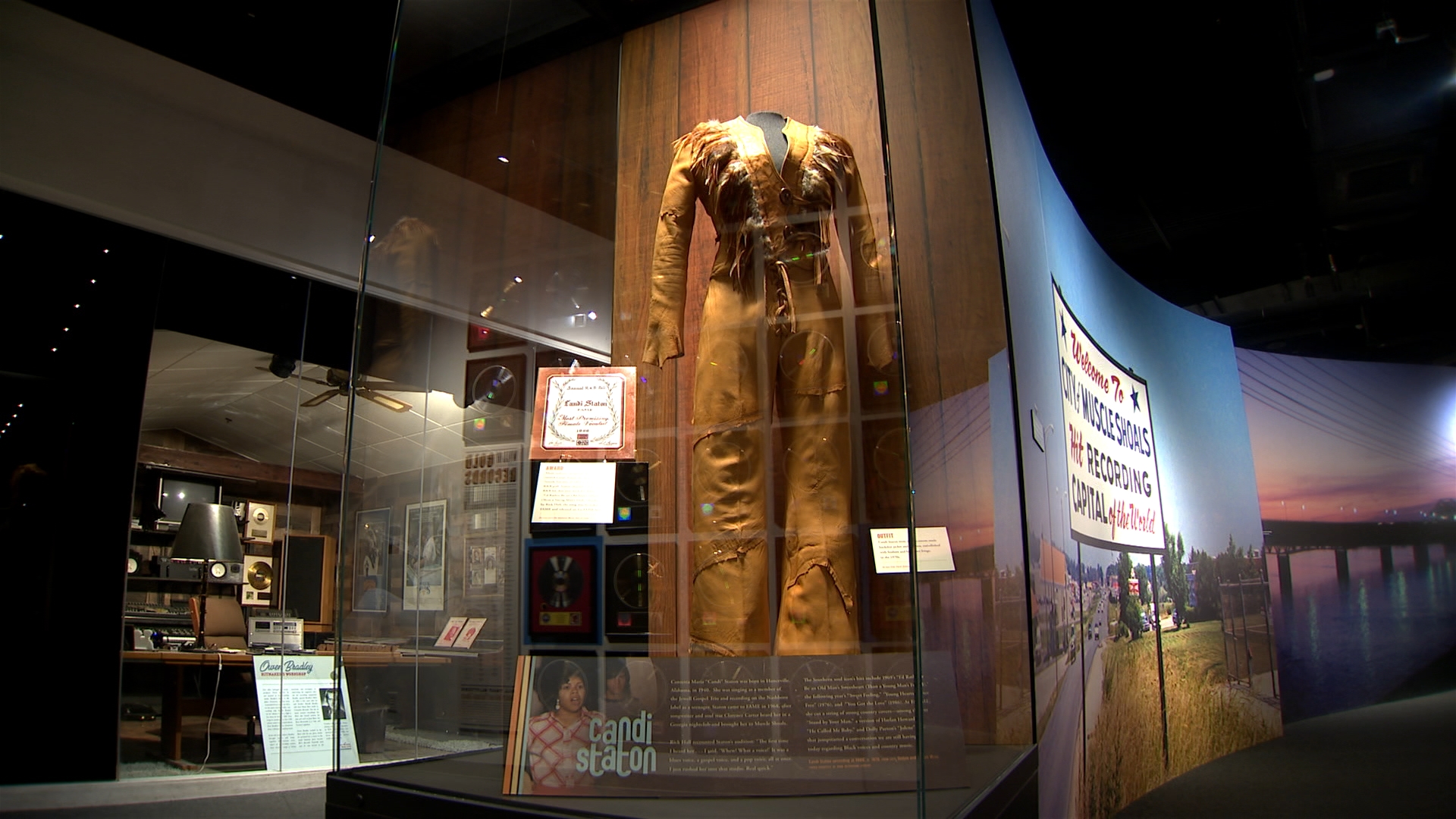


MUSCLE SHOALS, Al. (WTVF) — There are so many stories tell in Nashville about music history. Right now, at the Country Music Hall of Fame and Museum, there's a different story being told by exhibit curators Michael Gray and RJ Smith.
"It's a love letter to music that we love," Smith said.
It's a love letter to another city.
It was in the 1960s when FAME Recording Studios in Muscle Shoals, Alabama first saw musician, producer, and songwriter Mickey Buckins.
"The first song I got recorded was Etta James!" Buckins said, speaking from FAME. "I'm goin, 'man!'"
Not long after James, someone else arrived at FAME; five-time Grammy nominated singer Candi Staton.
"Long before Beyonce was doing country, I was doing country years before then!" Staton said.
That was the thing about those early days at FAME. Musicians there could perform anything.
"We had jazz people, we had R&B people, we had country people," Buckins explained.
"Oh my God, it was like going to church!" Staton said.
"We could cut any kind of artist," Buckins continued. "Take Liza Minnelli. We knew we had to cut a great record, because this is Liza Minnelli!"
When FAME began creating hits, there was segregation. Black travelers were still using green books to find safe addresses to stay. Staton was already touring and lived this.
"Chitlin circuit? Yeah," she nodded. "It was basically Black crowds. Couldn't go to hotels, and we had to sleep under trees."
Then Staton met Rick Hall, producer and songwriter and owner of FAME. Hall was integrating Black and white musicians for sessions, and that was still rare.
"Rick was so bold," Staton remembered. "He was so bold. He was so kind, and he didn't have a prejudiced bone in him. We were musicians. We didn't look at color."
"I knew we were making a little history there, but it's nothing we dwelled on," Buckins added. "We just went to work and cut great records."
FAME's breakthrough was in the 60s, big hits by big names. The hit songs included Wilson Pickett's Mustang Sally and Percy Sledge's When A Man Loves A Woman. Many of the songs featured the Muscle Shoals Rhythm Section, the Swampers.
"We kept trying to get Pickett to record Hey Jude," Buckins remembered. "He said, 'I can't do no Beatles song!' Oh man. I was just knocked out. Pickett sung it. Man, he sung it so good."
The Swampers opened their own Muscle Shoals Sound Studio in 1969 where they recorded even more hits. Brown Sugar by the Rolling Stones and I'll Take You There by The Staple Singers were among the early recordings at that location. What was happening in Muscle Shoals was part of a changing country.
"We walked into one of the restaurants in Muscle Shoals," Staton remembered. "It was Black, white. There was just a mixture of all of us. Everybody was eating, [and they froze] cause they'd never seen Black people in that restaurant before. Rick had us all seated. He was looking around the restaurant. He said, "WHATCHA LOOKIN' AT?! They started back eating again. I wanted to go under the table with laughter!"
Those are the kind of stories that make Hall's son, Rodney Hall, proud.
"This was my dad, Rick Hall's office, from 1967 until he passed away in 2018," Rodney Hall said, sitting in an old leather chair. "He came from nothing. He's the American dream."
"It was Black singers working with white musicians and songwriters and producers," Michael Gray said, speaking from back at the Country Music Hall of Fame and Museum.
"It is a part of the American story today," Smith added.
What's on display at the Country Music Hall of Fame and Museum today is 5,000 square feet of the Muscle Shoals story.
"This is the grand piano that was at FAME Studios," Gray said, gesturing to an item in the exhibit. "This is the piano Aretha Franklin used to record I Never Loved A Man The Way I Love You."
Also included in the exhibit is a tambourine used by Buckins.
"I had the artists that I worked with sign it!" he said.
There's also one of Staton's outfits.
"Oh, I love it," she said about the 60s outfit on display. "I just can't wear it no more!"
For the people who lived it, this exhibit is so special, a love letter from one music city to another.
"We kept this music alive, even through the hardships and the segregation," Staton said.
"It's just like, man, we're all in the same room together again," Buckins continued.
"I'm so glad God allowed me to be a part of this history," Staton said.
Do you have a positive, good news story? You can email me at forrest.sanders@newschannel5.com.

September 11, 2001 is a day most associate with terror and tragedy. Austin Pollack shares a story from that day about hope and persistence: the effort to save a little girl’s life – with an organ donation. The problem? The young patient was in Houston, and her life-saving liver here in Nashville. With the grounding of all civilian aircraft, how could it be done? “Nobody ever said this isn’t possible.”
- Rhori Johnston