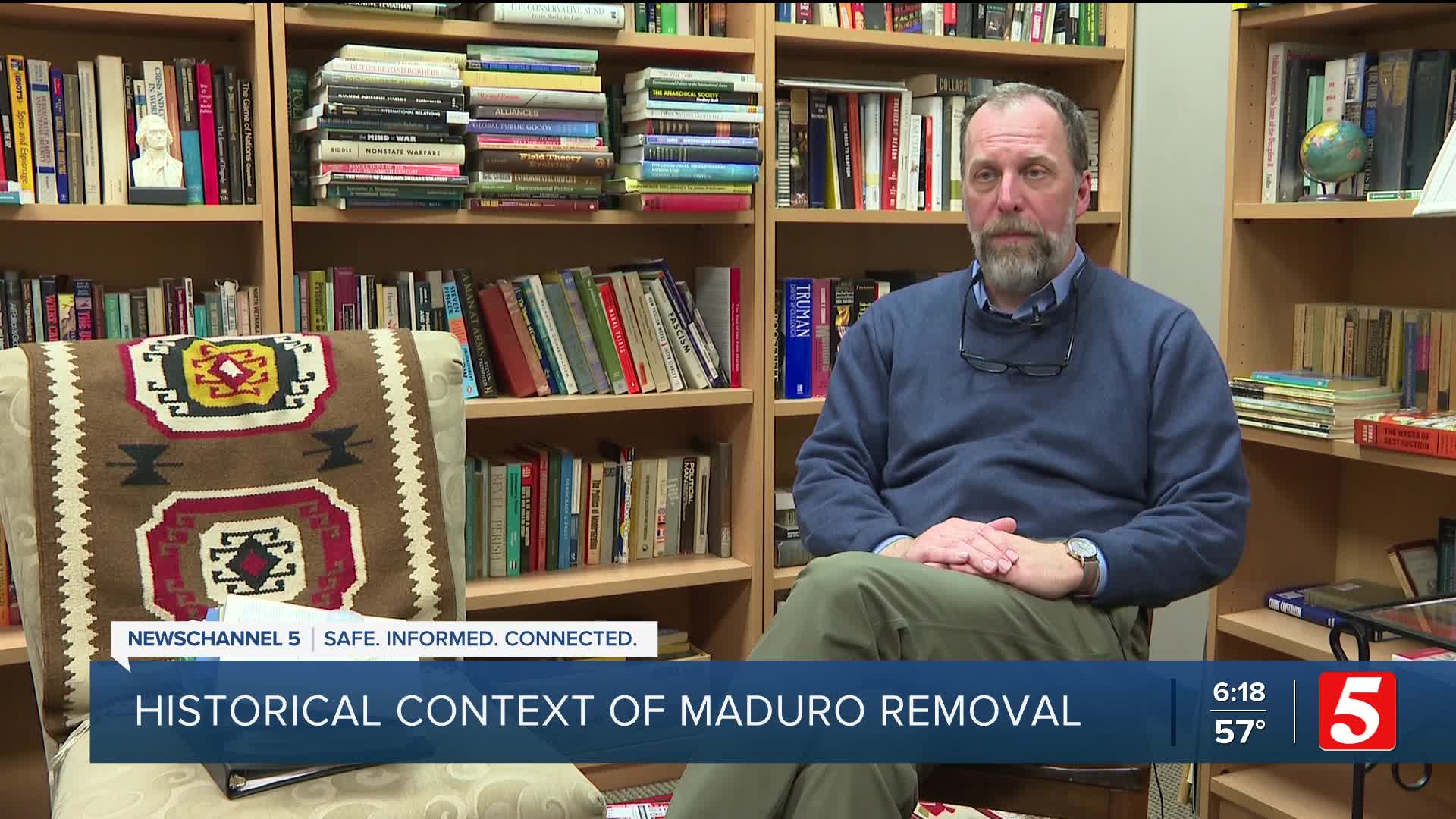


NASHVILLE, Tenn. (WTVF) — The recent U.S. government operation in Venezuela that removed President Nicolás Maduro represents another chapter in America's long history of military interventions in Central and South America, according to a political science expert.
Even with that history in mind, Dr. Marc Schwerdt, a political science professor at Lipscomb University, said he was surprised by the weekend operation.
"I was very surprised by it. This is not an operation that I would have predicted," said Schwerdt.
According to Schwerdt, the Venezuelan situation had been developing for more than 20 years, and the United States had previously attempted intervention during the George W. Bush administration when they tried to support an unsuccessful coup.
The United States has a documented history of intervening in Central and South American countries, most notably in Grenada during the 1980s and the removal of Manuel Noriega from Panama in 1990.
"Going in and removing a leader of another country is not unprecedented, but it's not something we do all the time," Schwerdt said.
While multiple factors contributed to the United States' decision to remove Maduro, Schwerdt said Venezuela's vast oil reserves likely played a significant role in the operation, though not in the way many might expect.
"Oil certainly does play a role in this," Schwerdt said.
However, he believes the intervention was less about the United States gaining direct access to Venezuelan oil and more about controlling who else can access those natural resources.
"We are the largest exporter of oil in the world," Schwerdt said. "From a geopolitical sense, it denies the ability of a rival such as China to actually have access to that oil at discounted prices and things like that, such that it's not so much power-grabbing that gives us something. It's that it denies something to other countries."
Despite Maduro's removal, Schwerdt expects limited immediate change for Venezuelan citizens since much of the current regime's infrastructure remains intact.
"That corrupt system is still in place," Schwerdt said.
The real transformation may come from how remaining Venezuelan officials choose to cooperate with the United States moving forward.
"All of the people who are part of that are now sort of saying, okay, now what do we do if we want to keep our position? We have to deal with the United States," Schwerdt said.
The operation has generated mixed reactions from Venezuelans both domestically and internationally as the South American country navigates this significant political transition.
Click here for our coverage detailing the latest updates on the situation in Venezuela.
This story was reported on-air by Robb Coles and has been converted to this platform with the assistance of AI. Coles verifies all reporting on all platforms for fairness and accuracy.
Do you have more information about this story? You can email me at robb.coles@newschannel5.com.

In a town built by a chorus of voices, Bill Cody is among the legends. Cole Johnson beautifully captures his life and legacy and brings us to the service to honor Cody. What a touching tribute to one of Nashville's best.
- Carrie Sharp