
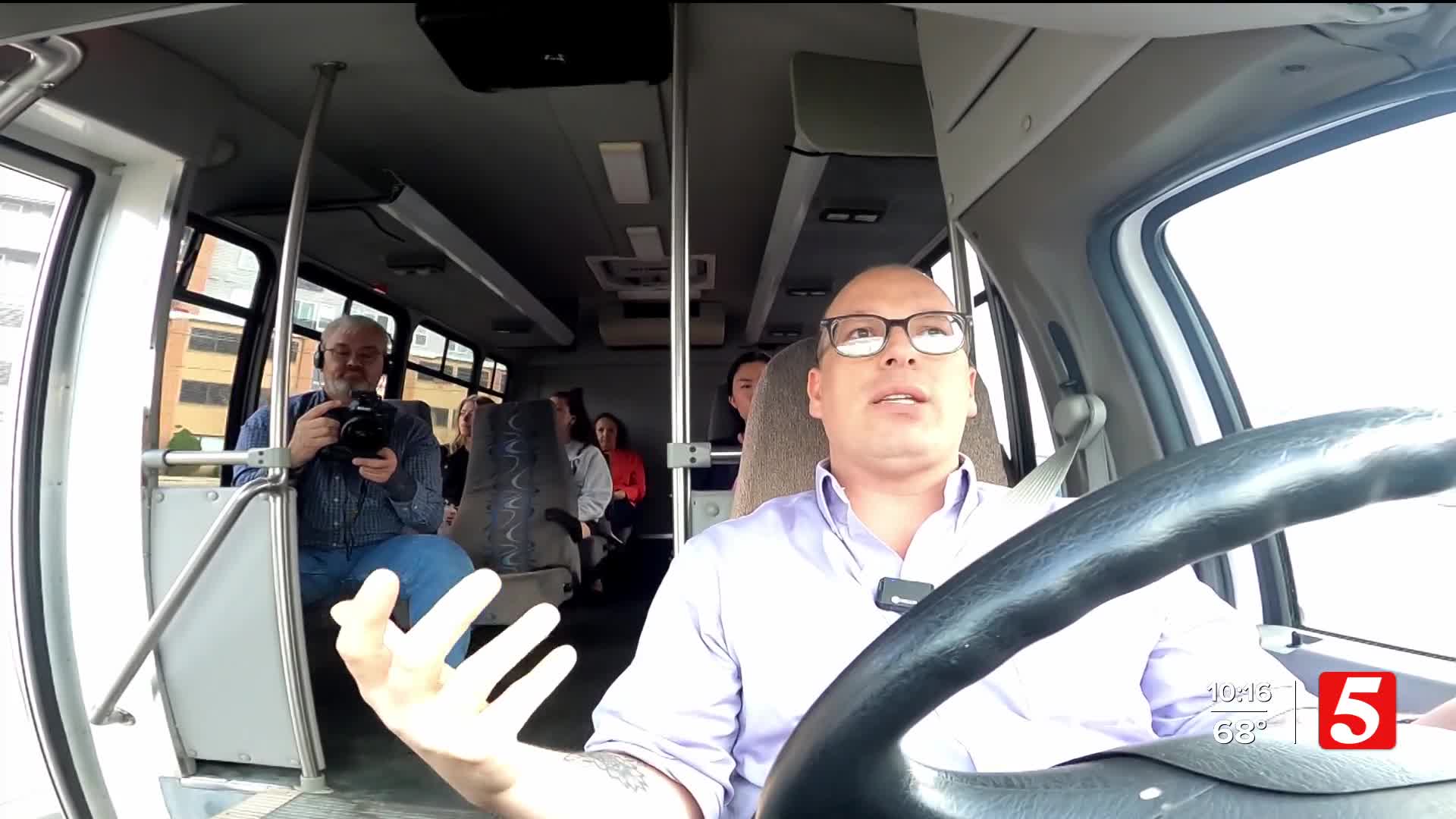


NASHVILLE, Tenn. (WTVF) — Each February, Trevecca Nazarene University transforms Black History Month into a moving classroom, taking students on a powerful journey through Nashville's Civil Rights landmarks.
The lesson doesn't begin in a classroom. It begins on a bus.
Behind the wheel is Zack Church, Associate Dean of Residence Life at Trevecca Nazarene University, who has been driving students through Nashville's Civil Rights story since 2019.
"I think it's really interesting to start at Trevecca," Church said.
Rather than learning from textbooks, students experience history from the very streets where it unfolded. The tour passes cemeteries, churches, and street signs that tell stories of resilience and courage.
"We're going to point out a lot of different historical markers that explain a lot of the history that we're going to talk about today," Church said.
What started as Black History Month programming has evolved into something much more significant: a moving classroom where every stop carries profound weight.
The bus travels past sites of historic sit-ins, the bombing of Z. Alexander Looby's home, and the steps of City Hall, where courage confronted power. Students learn about pivotal figures like John Lewis and Diane Nash, who played crucial roles in Nashville's desegregation movement.
"One of the people that we talk about a lot on this tour is John Lewis," Church said.
Church, who was raised in Clarksville, admits he never learned this history in school. With guidance from Dr. Brodrick Thomas, he ensures these students have a different experience.
The tour highlights a pivotal moment when Diane Nash confronted Mayor Ben West during a march of 3,000 people from Fisk University to City Hall.
"Diane walks right up to the mayor and says, Mayor West, do you believe that it is ethical to judge someone based on the color of their skin? And he says, No ma'am, I do not," Church said.
Within weeks of that confrontation, Nashville's lunch counters were desegregated.
The journey takes students from JC Napier's legacy to James Lawson's teachings, from Fisk University to First Baptist Church and Capitol Hill. Each location represents a chapter in Nashville's Civil Rights story.
"I think it's very important, you know, as a white man. I think it's important for me to know about this and know about the history to share with others," Church said.
For Church, the tour represents more than education—it's about understanding how history influences the present.
"We need to be aware of our history and how it influences where we're at now," Church said.
The past in Nashville doesn't sit still. It moves, just like the bus that carries these students through living history.
Church remains committed to continuing this important work.
"If I'm still here and the bus is still running, we'll keep doing these tours," Church said.
As long as the wheels keep turning, so will the lesson.
This story was reported on-air by a journalist and has been converted to this platform with the assistance of AI. Our editorial team verifies all reporting on all platforms for fairness and accuracy.

Kelsey Gibbs brings us a powerful story of humanity, compassion, and love in action while showing us the hard and lifesaving work our officers do daily. Nashville is lucky to have people like Lt. Hotz wearing the badge.
- Carrie Sharp