
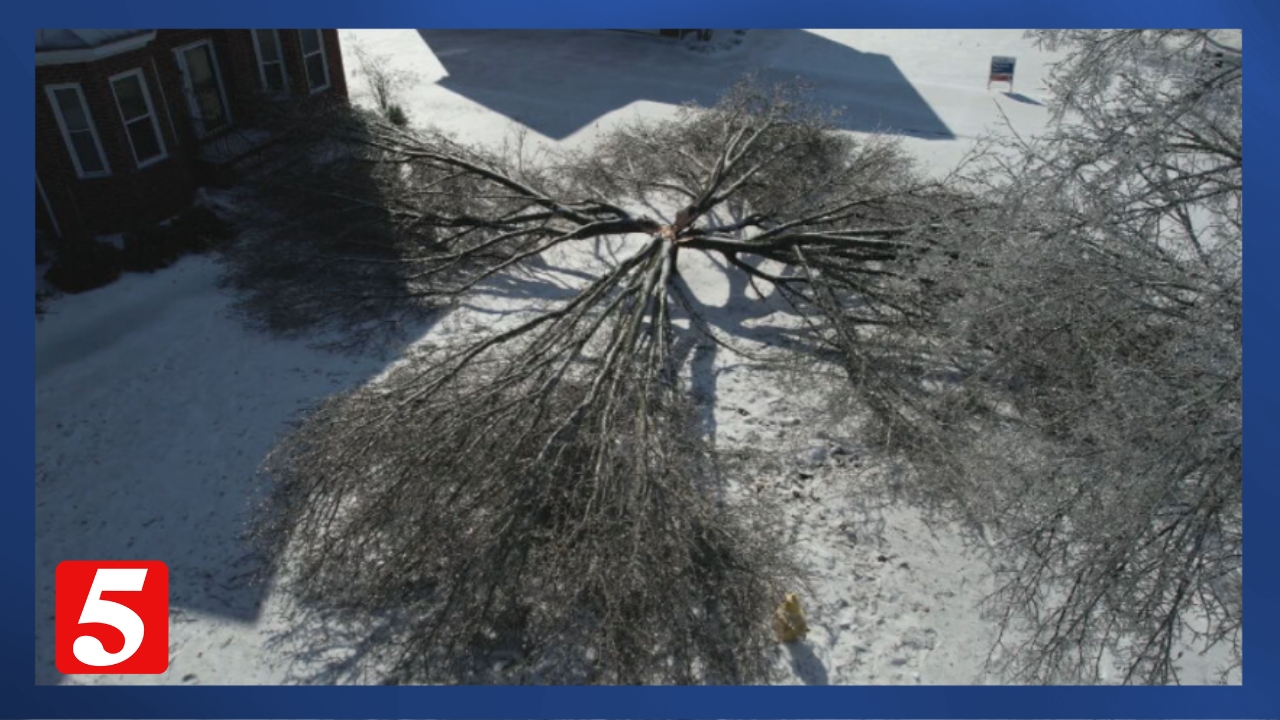


HENDERSONVILLE, Tenn. (WTVF) — In Hendersonville, Crystal Brown discovered the tall tree in her front yard split into thirds and collapsed after the snow and ice storm this weekend.
"When I opened the door I couldn't believe how close it was," said Crystal Brown, a homeowner in Hendersonville.
The massive tree narrowly missed hitting her house, but trees in the backyard damaged her fence.
Like so many people, Brown has started the process of getting things cleaned up.
She’s made a call to her insurance company and began seeking quotes from tree removal services, a process that can be more complicated than many homeowners expect.
That’s why I reached out to Chris Stafford with ChopTop Tree Service.
For the past few years, he’s been working for folks to clear trees out of their yards.
When it comes to dealing with insurance, his first recommendation is to take pictures of the damage while maintaining a safe distance from weighted-down trees.
"It can crack and fall at any moment," Stafford said.
When selecting a tree removal company, Stafford emphasizes the importance of verifying two critical documents.
"A certificate of insurance and workers' compensation, because if the workers get hurt on your property and they're not insured, the homeowners will be liable for it," Stafford said.
Stafford, who frequently deals with insurance companies as part of the job, explained what typically qualifies for coverage under most homeowner policies.
"So in insurance claims, they'll cover anything that is considered property damage. So if a tree just falls in your yard, it's not property damage, sadly, but if a tree falls in your house, a shed, a car, or a fence or something of that nature, then it'll be covered under insurance in most cases," Stafford said.
Leaders with the Better Business Bureau recommend checking out any company that could do work on your home on their website for past complaints.
For people who cannot afford professional tree removal services or are unable to handle the work themselves, the state has activated its CRISIS Cleanup Hotline.
Residents can call 844-965-1386 to learn more about the volunteer tree removal program.
I also reached out to the Tennessee Department of Commerce and Insurance for more guidance on what may be covered by your insurance company. They provided me with the following statement:
If You Have Damage To Your Home/Auto:
- Contact your insurance agent or company as soon as possible. Determine what forms, documents, and data you will need to provide in order to process your claim.
- Keep all receipts and damaged property for the adjuster to inspect. If possible, take photos or videos of the damage before making temporary repairs to protect your property from further damage. Do not make permanent repairs. An insurance company may deny a claim if you make permanent repairs before an adjuster inspects the damage.
- Remember, most insurance companies will not pay for damage to an unoccupied house unless you prepared your house for the freeze. If you’re going to be away from your house and it might freeze, you must use reasonable care to heat the house or shut off the water supply and drain the water from plumbing, heating and air conditioning systems.
What to Do if Damage Occurs to Your Home
- Call your insurance company or agent with your policy number and other relevant information as soon as possible. Cooperate fully with the insurance company and ask what documents, forms and data you will need.
- Take photographs/video of the damage.
- Make the repairs necessary to prevent further damage to your property (i.e., cover broken windows, leaking roofs and damaged walls). Do not have permanent repairs made until your insurance company has inspected the property and you have reached an agreement on the cost of repairs.
- Save all receipts, including those from the temporary repairs covered by your insurance policy.
- If your home is damaged to the extent that you cannot live there, ask your insurance company if you have coverage for additional living expenses incurred while repairs are being made. Save all receipts to document these costs.
What Damage to Your Home is Covered?
- Damage caused by wind, wind-driven rain, trees or other falling objects and the collapse of a structure due to weight of ice or snow are all covered under most standard homeowners policies. Frozen pipes as the result of extreme cold might not be covered if the damage is due to negligence such as failing to maintain an adequate temperature in the house when the ability to do so is there. Check your policy and call your insurance agent or company if you need clarification or have specific questions.
What Damage to Your Home is Not Covered?
- The following events are typically not covered by the standard homeowners insurance policy: Interior water damage from a storm, when there is no damage to the roof or walls of your home; damage as the result of a flood; removal of fallen trees (if the trees do not land on and damage your home); food spoilage due to a power outage; and water damage from backed-up drains or sewers. Some insurers offer endorsements (i.e., additional protection that may be purchased) for certain coverages not covered under the standard homeowner policy. Check with your agent or company to determine your needs.
This story was reported on-air by Robb Coles and has been converted to this platform with the assistance of AI. Coles verifies all reporting on all platforms for fairness and accuracy.
Do you have more information about this story? You can email me at robb.coles@newschannel5.com.

September 11, 2001 is a day most associate with terror and tragedy. Austin Pollack shares a story from that day about hope and persistence: the effort to save a little girl’s life – with an organ donation. The problem? The young patient was in Houston, and her life-saving liver here in Nashville. With the grounding of all civilian aircraft, how could it be done? “Nobody ever said this isn’t possible.”
- Rhori Johnston