
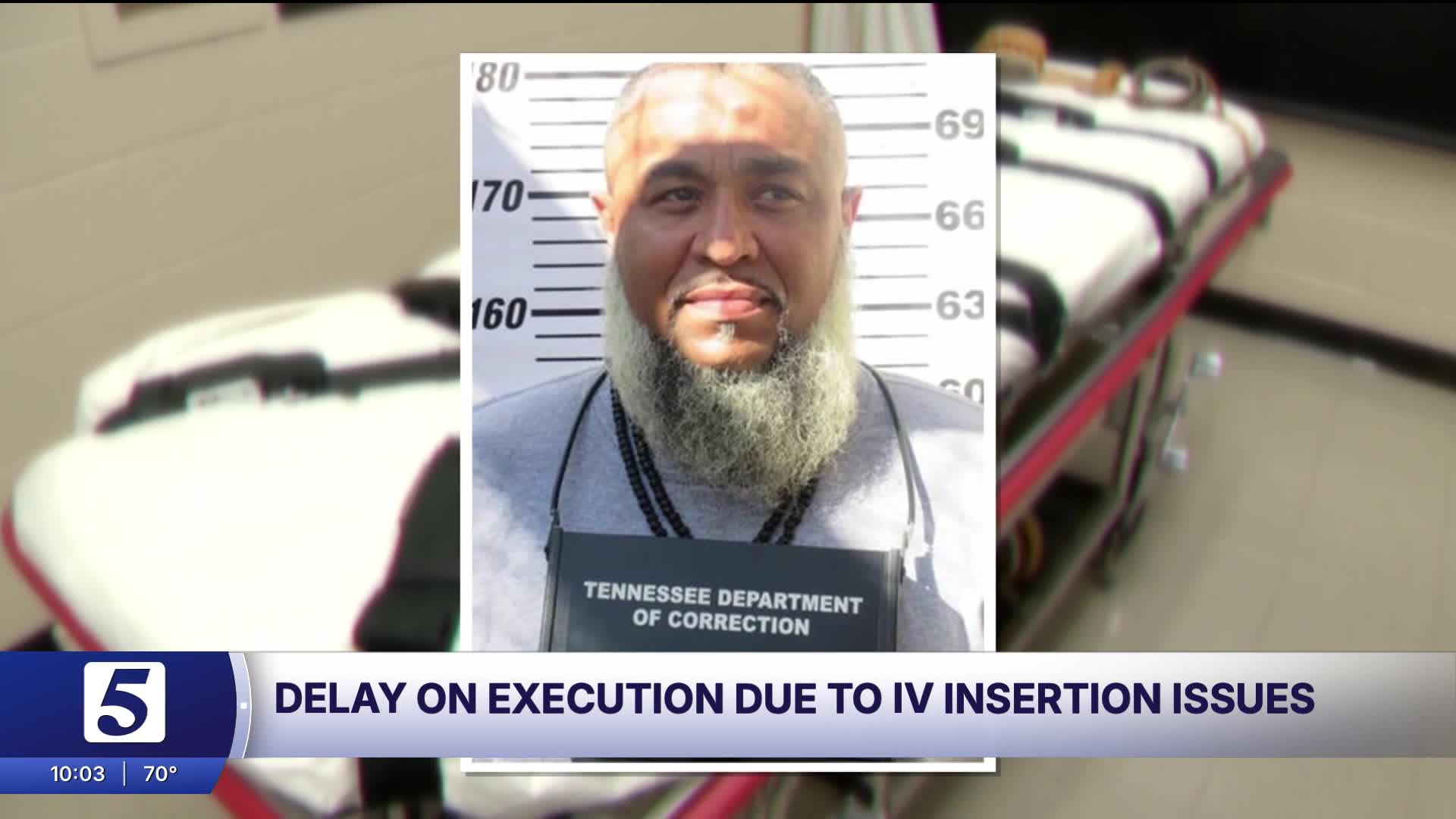


NASHVILLE, Tenn. (WTVF) — Gov. Bill Lee granted a one-year reprieve Thursday after Tennessee halted the planned execution of death row inmate Tony Carruthers amid reported problems establishing IV access for the lethal injection.
Carruthers, 57, was scheduled to be executed at 10 a.m. for the 1994 kidnappings and killings of Marcellos Anderson, Delois Anderson and Frederick Tucker in Memphis.
The Tennessee Department of Correction said execution staff were unable to establish the backup IV line required under the state’s lethal injection protocol.
“Medical personnel quickly established a primary IV line; however, the team was unable to immediately establish a backup line pursuant to the lethal injection execution protocol,” TDOC said in a statement.
“The team continued to follow the protocol, but could not find another suitable vein. The team attempted to insert a central line pursuant to the protocol, but the procedure was unsuccessful. The execution was then called off.”
The statement did not say who specifically called off the execution initially: whether that was Gov. Lee, the TDOC commissioner or another TDOC employee.
Steven Hale, a Nashville Banner reporter and media witness on Thursday, said the curtain was closed the entire time, so members of the media were unable to see what was going on.
"We heard [someone] questioning the qualifications of the doctor who was trying to get the central IV line in. Something along the lines of, 'Are you qualified to do this?' And him sort of snapping and responding pretty bluntly back to her, 'I'm qualified'."
"If we're gonna have a death penalty in this state, we should all have to confront what that looks like," added Hale. "And if people are okay with that, that's up to them, but we should see as much of it as there is to see and then decide based on that."
Maria DeLiberato, senior counsel at the American Civil Liberties Union (ACLU)’s Capital Punishment Project, who was present for the planned execution, told The Associated Press she watched officials spend roughly an hour attempting to establish IV access before the execution was halted.
DeLiberato said Carruthers was “wincing and groaning” during the process and described it as “horrible” to witness.
Earlier in the day, Amy Harwell, First Assistant Federal Public Defender for the Middle District of Tennessee, told NewsChannel 5 the execution process had been paused.
“Everything is stopped ‘for now,’” Harwell said in a text message. “They will not tell us how long that means.”
THE EXECUTION PROTOCOL
Current Tennessee Department of Correction execution procedures, adopted in 2025, call for execution staff to insert both a primary IV catheter and a backup IV catheter. The protocol states the primary IV is used to administer the lethal injection chemicals, while the backup catheter is reserved in case the first IV fails. The protocol also states that any IV line failure must immediately be reported to the commissioner.
The 2025 protocol further states: “If necessary, the Physician will insert a central line.” A central line, or central venous catheter, is a long tube inserted into a large vein in the chest, neck or groin that leads directly to a large vein near the heart.
While the current protocol is less detailed about how execution staff should respond to IV access problems, previous TDOC protocols show the department has prepared for these situations in the past.
REACTION TO THE EXECUTION
Reaction to the halted execution attempt quickly followed on Thursday.
Federal Public Defender for the Middle District of Tennessee Amy Harwell shared various concerns in a statement.
She alleged that unqualified execution staff punctured Carruthers more than a dozen times during repeated attempts to insert IV lines, before they decided to stop. Not long after, word came that Governor Bill Lee granted Carruthers a one-year reprieve. Harwell claims the Tennessee Department of Correction knowingly used an unqualified physician who admitted under oath that he isn't certified to establish a central IV line at any hospital.
The Federal Public Defender’s office previously sued TDOC, alleging the state’s lethal injection protocol would almost certainly cause a torturous death because those involved in setting the IV line, they claimed, are not sufficiently trained. It's an allegation, Harwell said, that was proved Thursday.
In a statement, the ACLU called it “botched and torturous,” renewing demands for DNA testing in Carruthers’ case.
“Permitting Tony Carruthers’s execution to move forward without ordering DNA testing was already a profound injustice,” DeLiberato said in the statement. “Today, that injustice became outright barbaric after Mr. Carruthers was subject to a botched execution attempt.”
DeLiberato said the organization would continue pushing for forensic testing in the case, arguing Tennessee “cannot continue torturing a man while refusing to answer serious questions about his innocence.” The ACLU also said more than 130,000 people signed petitions supporting Carruthers and calling for additional testing.
“Today's botched execution attempt of Tony Carruthers is horrifying but not surprising,” Stacy Rector, executive director of Tennesseans for Alternatives to the Death Penalty, said in a statement. “TADP has sounded the alarm for years about the serious problems with lethal injection and urged our state toward greater transparency so these problems can be addressed.”
Laura Porter, executive director of the U.S. Campaign to End the Death Penalty, also criticized the state’s handling of the case.
“Tennessee has effectively made the case against the death penalty,” Porter said in a statement. “They forced Tony Carruthers to represent himself at his own capital trial, failed to test DNA and fingerprint evidence, and now they have failed to execute him. It is time to end the death penalty.”
LETHAL INJECTION SCRUTINY
The pause comes amid ongoing scrutiny surrounding Tennessee’s lethal injection procedures. In recent days, Carruthers’ attorneys questioned whether the Tennessee Department of Correction (TDOC) could use expired execution drugs, citing concerns about the state’s lethal injection protocol and TDOC’s refusal to explicitly confirm the drugs were not expired.
Tennessee executions were halted for nearly three years beginning in 2022 after Gov. Bill Lee stopped the execution of Oscar Smith roughly an hour before it was scheduled to begin because required testing had not been completed on lethal injection drugs.
An independent review later found Tennessee had not fully tested drugs prepared for several executions dating back to 2018.
Carruthers’ attorneys had also unsuccessfully sought DNA and fingerprint testing in the case and argued he was mentally incompetent to be executed. Courts denied those requests ahead of Thursday’s scheduled execution.
Carruthers was convicted in the 1994 killings largely on testimony from witnesses who claimed he confessed to the crimes. Court records show there was no physical evidence directly tying him to the murders.
ONE-YEAR REPRIEVE
The reprieve, or pause, Gov. Lee issued for Carruthers will be in place for one year. That is substantially longer than the reprieves immediately issued following other concerns with the execution process in Tennessee.
In 2022, Gov. Lee issued a 41-day reprieve to Oscar Smith following concerns over the proper testing of the lethal injection chemicals. That was later expanded to a years-long delay while an independent investigation into TDOC's procedures took place.
In 2018, after death row inmate Edmund Zagorski elected to be put to death in the state's electric chair, Gov. Bill Haslam (R-Tenn.) issued a 10-day reprieve to ensure proper function of the device, which hadn't been used in more than a decade.
EXECUTION TRANSPARENCY LAWSUIT
NewsChannel 5 and its parent company, Scripps Media, is part of a group of news organizations suing the Tennessee Department of Correction to give media witnesses more access to different aspects of the execution process, including allowing media witnesses to observe the inmate being secured with restraints and to witness the IV insertion process itself — the portion of the execution process that TDOC said Friday led to the execution being called off.
While a lower court had issued an injunction to allow increased media access for the Carruthers execution, the Tennessee Supreme Court paused that order, keeping the current procedures in place. The state's highest court still must hear oral arguments in the case before a final ruling.
QUESTIONS WE ARE ASKING:
We have left emails for spokespeople at both TDOC and the Governor's office, asking:
- Whether it was the governor or another TDOC official who initially called off the execution.
- Why Gov. Lee's reprieve lasts for an entire year.
Editor's Note: Executive Reporter Jason Lamb, who contributed to this article, submitted a personal affidavit in support of the lawsuit described above. This article was reviewed and approved by a senior NewsChannel 5 editor who did not personally participate in the litigation.

September 11, 2001 is a day most associate with terror and tragedy. Austin Pollack shares a story from that day about hope and persistence: the effort to save a little girl’s life – with an organ donation. The problem? The young patient was in Houston, and her life-saving liver here in Nashville. With the grounding of all civilian aircraft, how could it be done? “Nobody ever said this isn’t possible.”
- Rhori Johnston