
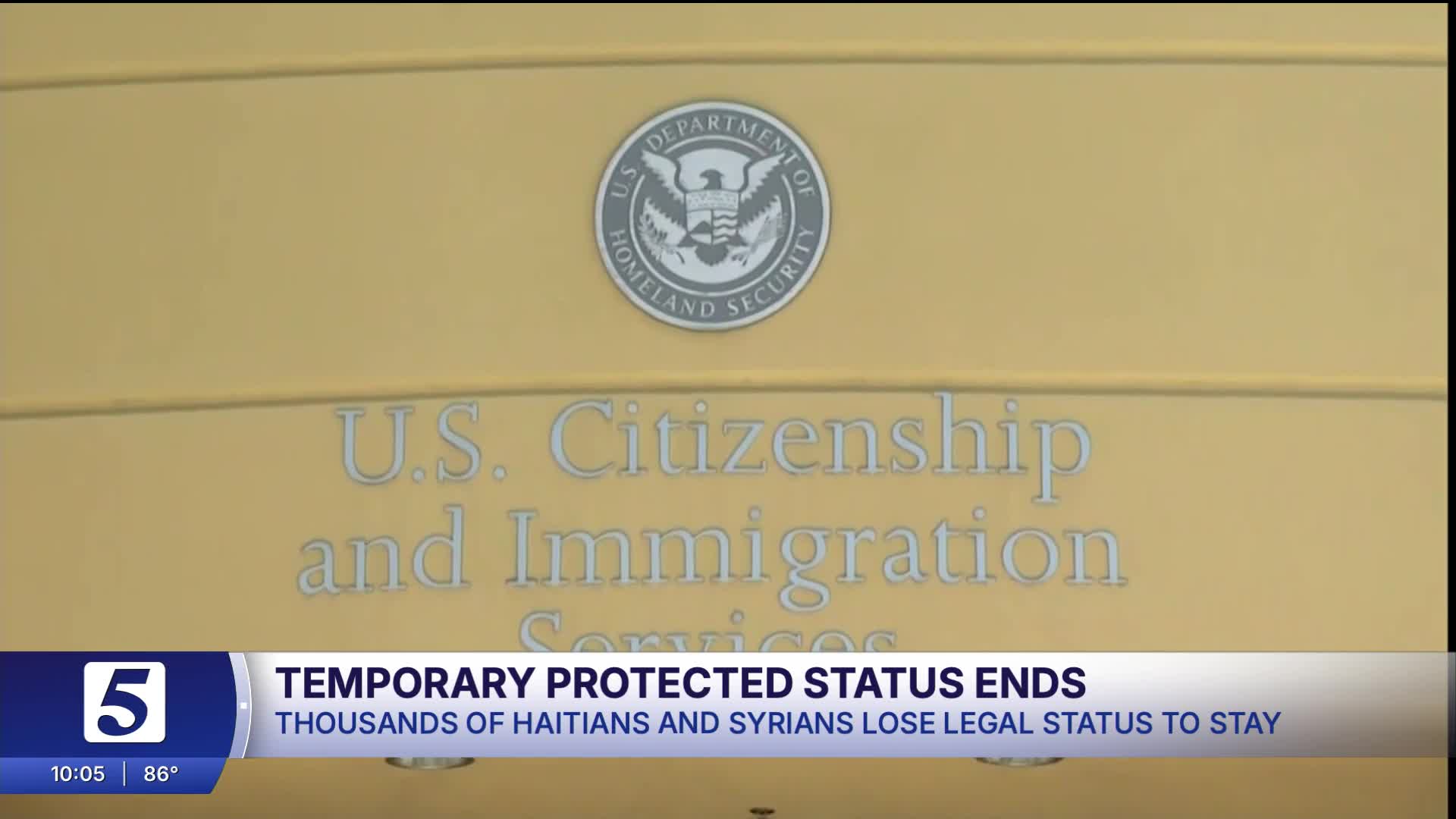


NASHVILLE, Tenn. (Nashville Banner) — This story was originally published by the Nashville Banner. Sign up for their newsletter.
More than 300,000 Haitian and 6,000 Syrian immigrants under Temporary Protected Status (TPS) and work permits across the U.S. have to seek other options to stay in the country as their status officially ended on Monday. That affects thousands in Tennessee.
Aineth Murguia, assistant legal director at Tennessee Justice for Our Neighbors (TNJFON), told the Banner that this decision is “just another tool for the [Trump] administration to carry out its deportation campaign.”
In late June, the U.S. Supreme Court ruled that the Department of Homeland Service’s attempts to end TPS protections for Haitian and Syrian immigrants weren’t “judicially reviewable,” as reported by the National Immigration Forum, which will make it more difficult to challenge the administration’s future TPS terminations.
Murguia said while it varies case by case, options for the Haitian and Syrian families affected as of Monday are limited due to the current immigration system. Only three options are available: families could return to their home country, seek alternative routes for relief through family or other means, or remain in the U.S. without authorization. Many of these options come with risks of their own.
For many of Murguia’s clients returning to the homes they fled means facing “conditions … worse than when they left,” she said.
Jazmin Ramirez, Tennessee Immigrant and Refugee Rights Coalition’s (TIRRC) senior strategy advisor, told the Banner that the TPS termination will uproot families as they consider how to move forward.
“[These] are really hard conversations to have as a family,” Ramirez said. “They’ve already made a life here in the United States and [this is] uprooting the whole ecosystem of what they’ve known for the last couple of years.”
While advocates have been expecting a ruling from the U.S. Supreme Court for the past few months, Ramirez said it was still difficult to have conversations with clients about the lack of options they have.
“It’s very limiting on what we are able to advocate for,” she said. “This administration has time and time again said that it is shutting down programs with very little ways to do some proactive advocacy to provide safeguards to these families.”
Ramirez and Murguia said this termination is a part of a bigger agenda of the Trump administration to leave people without documentation. In addition to TPS terminations, there have been delays on green card renewals and DACA recipients are losing their protections, too.
As a result, families and individuals are left more vulnerable and “subject to the mass deportation machine” the administration is building, Ramirez said.
She encourages Tennessee residents to check on their neighbors who may be facing these challenges and all that may come with it, including job loss and food insecurity. She added that those who want to help can also consider donating to organizations that provide legal support, like TIRRC and TNJFON.
“That will also be really impactful because we live in a legal desert in Tennessee,” she said, “and making sure that those families even have an option to continue to get consultations on whether there’s a path forward in their case.”
According to the American Immigration Council, around 1.3 million immigrants were living in the U.S. under TPS as of March 31, 2025, “the last date for which publicly available data exists.” Since 1990, as a result of former president George H. W. Bush’s Immigration Act, millions have entered the U.S. through TPS services as they fled political conflict and environmental disasters, including people from Afghanistan, Honduras and Burma.
Other countries’ statuses have been targeted by the Trump administration, including Venezuela, Burma, Ethiopia, Somalia, South Sudan and Yemen. While Venezuelans’ TPS ended in November 2025, the remaining countries’ terminations are still pending. Immigrants from El Salvador, Lebanon, Sudan and Ukraine could face TPS termination by the end of this year.
This article first appeared on Nashville Banner and is republished here under a Creative Commons Attribution-NoDerivatives 4.0 International License.

September 11, 2001 is a day most associate with terror and tragedy. Austin Pollack shares a story from that day about hope and persistence: the effort to save a little girl’s life – with an organ donation. The problem? The young patient was in Houston, and her life-saving liver here in Nashville. With the grounding of all civilian aircraft, how could it be done? “Nobody ever said this isn’t possible.”
- Rhori Johnston