



NASHVILLE, Tenn. (WTVF) — For more than 40 years, Jackie Todd has known life with tremors longer than life without them.
"I've just become a homebody," Todd said. "Never done anything. And they're giving me a chance of a regular life now because of this."
That chance comes without a single scalpel.
At Vanderbilt University Medical Center, Dr. Dario Englot is part of a team using focused ultrasound to help patients like Todd regain some of what tremors have taken away. The procedure uses an MRI to guide sound waves to a specific part of the brain responsible for tremors — no incision required.
Todd's dominant right side was treated about nine months ago. He returned recently for treatment on his left side, and the results were visible almost immediately.
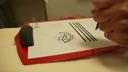
Before the procedure, Todd completed a simple test: tracing a spiral, trying to keep a marker between the lines. The comparison before and after the treatment showed a clear improvement.
"Feel real good," Todd said after the procedure.
The most difficult part of the process, Todd said, is not the treatment itself — it's the preparation. A numbing agent is applied, and a headframe is fitted to keep the head still during the MRI. Once inside the scanner, the medical team performs what Dr. Englot calls a "sonication" — the moment the treatment is actually delivered.
Because patients are awake during the procedure, they can communicate with the medical team throughout.
"Do a sonication, which is when we do the treatment, bring you out, test your tremor, make sure we're getting good benefits, make sure we're not getting any side effects," Englot said to Todd before the procedure.
Todd said the improvement on his left side was noticeable.
"I noticed a lot of difference but not as much as it was on my right side," Todd said.
Dr. Englot was clear about the outcomes of the procedure.
"We always tell patients the treatment is not a cure," Englot said. The goal is to substantially reduce their tremor and improve their quality of life."
For Todd, the results go far beyond a cleaner spiral on a piece of paper.
"I can go into restaurants and eat without people staring at me and pointing," Todd said. "It has changed my life."
To learn more, you can click here.
This story was reported on-air by a journalist and has been converted to this platform with the assistance of AI. Our editorial team verifies all reporting on all platforms for fairness and accuracy.
