
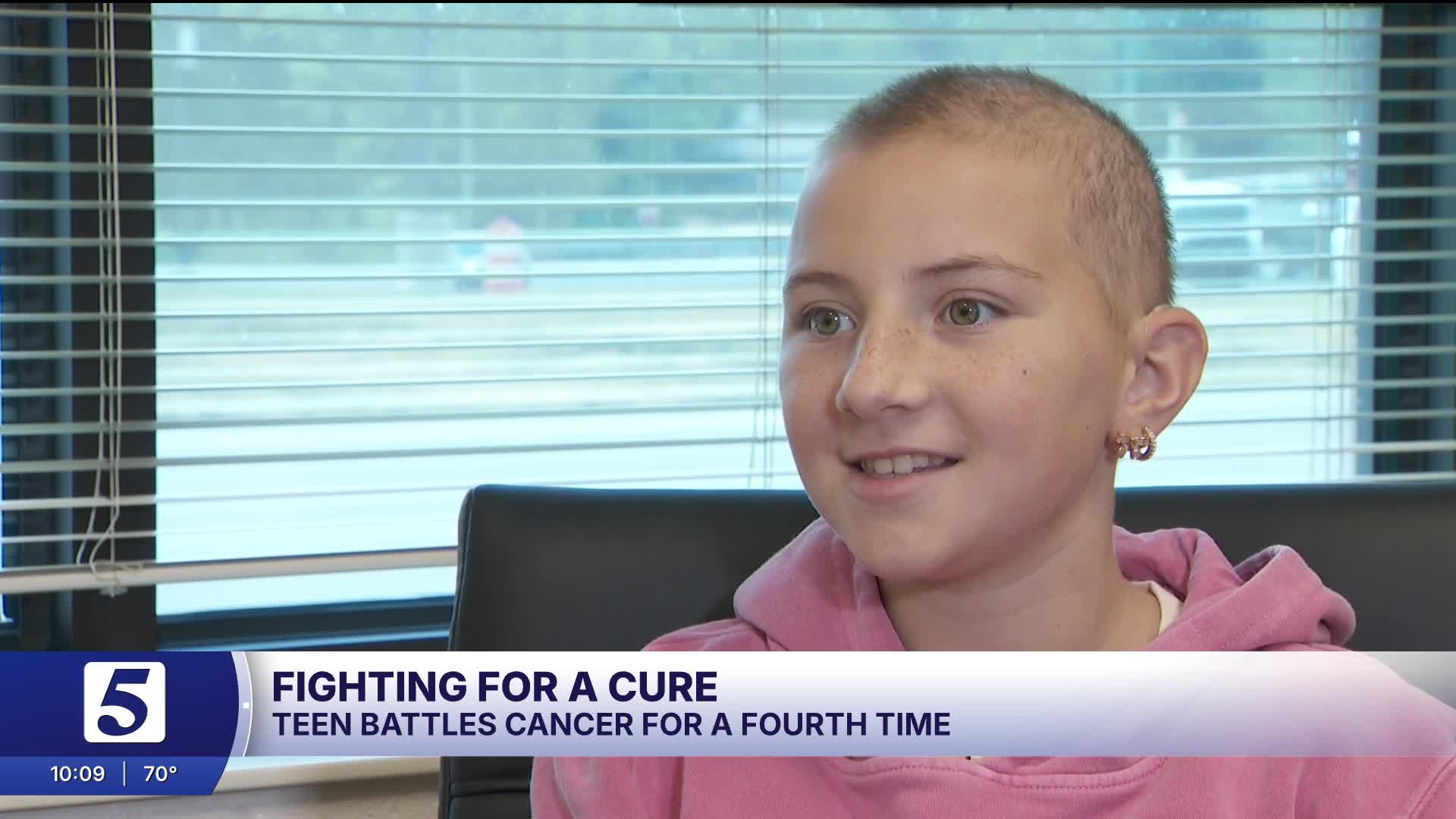


NASHVILLE, Tenn. (WTVF) — At 13 years old, Caroline Lantz should be worrying about homework, friends, and her next flag football game.
Instead, much of her childhood has been spent inside hospital rooms — enduring chemotherapy, radiation, surgeries and a fight most people will never have to face.
“I love school. I love seeing all my friends,” Caroline said. “But I’m really excited because we have Panther Party tonight.”
If you watched our story last year, you may remember Caroline as the Iroquois Steeplechase Child Ambassador for Monroe Carell Jr. Children’s Hospital at Vanderbilt.
Back then, we met her in her bedroom, surrounded by family photos, childhood memories and strands of colorful Beads of Courage — each one representing a procedure, treatment or milestone in her cancer journey.
“When I was four years old, I got diagnosed with stage four solid tumor neuroblastoma, and it was all throughout my body,” Caroline said. “But yeah, so that was when I was four. So it’s been a while now, but I’ve gotten it four times since then.”
Four diagnoses. Nearly a decade of fighting.
Since she was a little girl, Caroline has undergone years of aggressive treatment: chemotherapy, radiation, a stem cell transplant and a nine-hour surgery.
Her father says cancer has stolen many of the moments that define childhood.
“She’s had radiation, chemotherapies, stem cell transplants, nine-hour surgery,” Mark Lantz said. “Missed a ton of school and activities. She’s actually had to be held back a grade just because she missed so much school when she was in kindergarten.”
And despite everything she’s endured, there is still no cure for neuroblastoma.
Her father says that’s why research matters so deeply.
“There will be a cure,” he said. “And we just need to get her to that point — and the other kids that are still fighting today.”
One of Caroline’s longtime doctors, pediatric oncologist Dr. Brianna Smith, has watched her grow from a little girl into a teenager still determined to keep going.
“She is such an inspirational person,” Smith said. “She’s such a good sister, good daughter, great friend, and such an advocate for pediatric cancer.”
But doctors say inspiration alone cannot save children’s lives.
Pediatric cancer receives just four percent of federal funding for cancer research — a reality doctors say slows the development of lifesaving treatments for children facing aggressive diseases like Caroline’s.
“We really need better drugs,” Smith said. “We need better treatments. We need more immunotherapy. Better options for those patients so that they can have a long, healthy life.”
Caroline continues to share her story because she knows another child may be listening.
“I feel like there’s always going to be a little kid who’s going to look up to you and be like, ‘If she can do it, I can do it,’” she said.
Right now, Caroline’s cancer is responding to a new treatment. Her family says she has also participated in several clinical trials over the years — opportunities they hope will not only help her, but future children diagnosed with cancer.
And after nearly ten years of hospital stays, painful treatments and unimaginable uncertainty, Caroline says she still holds on to hope.
“Probably to keep going,” she said, “and there’s always light at the end of the tunnel.”
During Childhood Cancer Awareness Month, Caroline’s story is a reminder that behind every diagnosis is a child still trying to live a childhood — and still fighting for a future.
If you’d like to support pediatric cancer research, you can donate to Monroe Carell Jr. Children’s Hospital at Vanderbilt.
This story was reported on-air by journalist Kelsey Gibbs and has been converted to this platform with the assistance of AI. Our editorial team verifies all reporting on all platforms for fairness and accuracy.

September 11, 2001 is a day most associate with terror and tragedy. Austin Pollack shares a story from that day about hope and persistence: the effort to save a little girl’s life – with an organ donation. The problem? The young patient was in Houston, and her life-saving liver here in Nashville. With the grounding of all civilian aircraft, how could it be done? “Nobody ever said this isn’t possible.”
- Rhori Johnston