

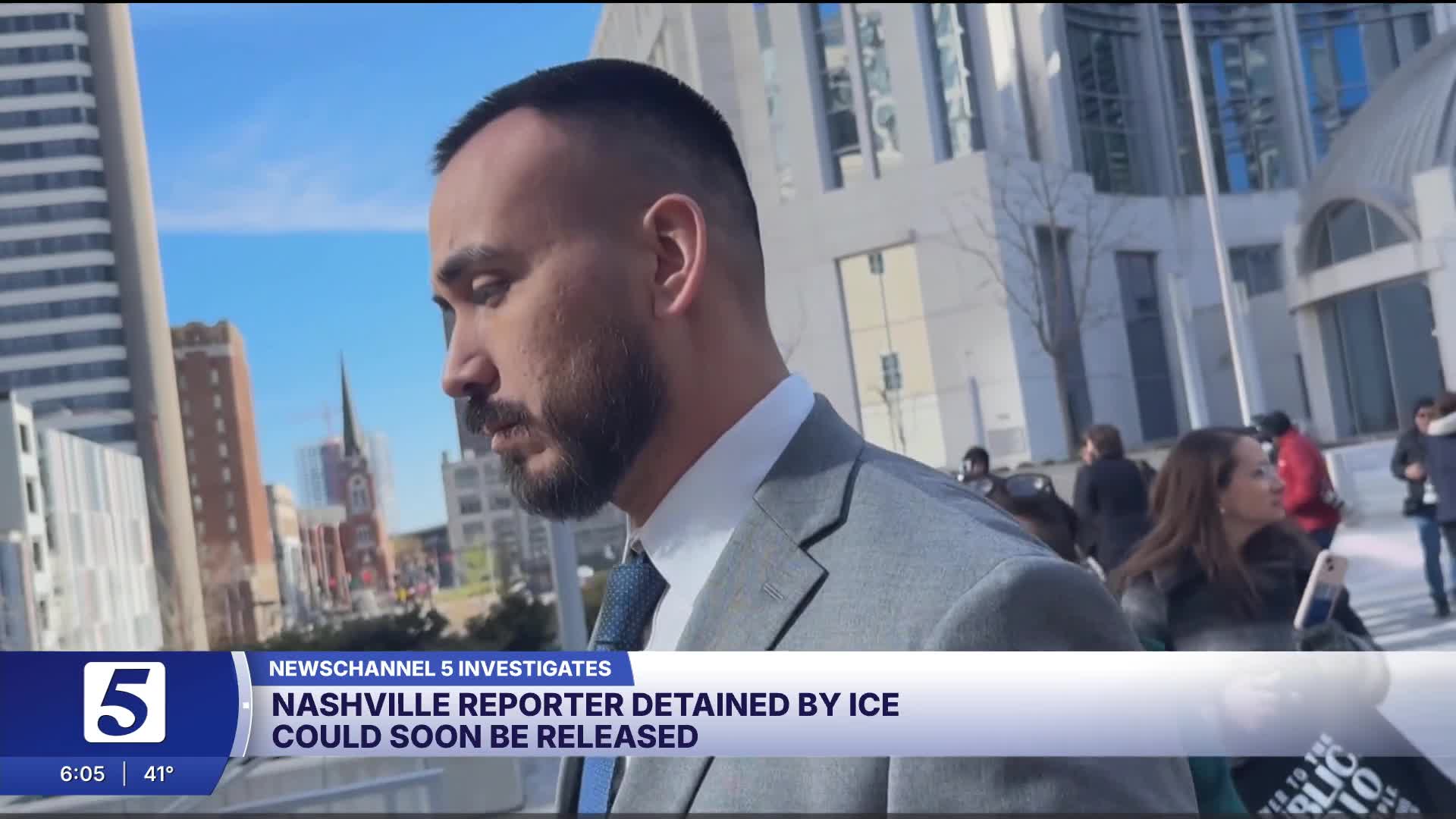


NASHVILLE, Tenn. (WTVF) —
Update: March 18, 2026 at 5 p.m.
Attorneys for Estefany Rodriguez told the court during a conference call on Wednesday that her family had trouble with the electronic system for paying her bond, so she will have to wait one more day before she's released.
Rodriguez's attorney, Michael Holley, said this has been the case for anyone signing up through this system for the first time, so family now plans on driving the money to a Memphis ICE facility for faster processing, before picking up Rodriguez from the Louisiana ICE facility where she's currently being held.
Rodriguez is expected to return to Nashville by Thursday afternoon, while her attorneys continue pursuing their case against ICE for allegedly violating their clients constitutional rights when she was detained.
Holley and Rodriguez's legal team will work on a brief detailing what if any bond conditions were imposed on their client, so the courts in Nashville are aware of any limitations for Rodriguez. They will also have to respond to the government's motion to dismiss the pending lawsuit.
Attorneys for the government will have a chance to file their own response, before U.S. District Judge Eli Richardson issues any new rulings. No new deadline has been set for these briefs.
____________________________________________________
U.S. District Judge Eli Richardson is calling for more time after Tuesday's show-cause hearing for Nashville Noticias reporter Estefany Rodriguez left the court with more questions than anticipated.
Richardson scheduled a conference call for the following day, Wednesday, at 4 p.m..
His decision was made after hearing several conflicting arguments, including whether Rodriguez could have been released from Immigration and Customs Enforcement (ICE) custody as early as Tuesday morning.
An immigration court out of Louisiana where she's been detained, granted her a $10,000 bond Monday morning, but ICE attorneys checked the box reserving their right to appeal the order.
Rodriguez's attorney Michael Holley said this triggered a one-day hold while the government decides whether to appeal.
"There are regulations that govern this and the regulations say that there's a stay for one business day and it started this morning. There was a stay for today. Everyone who does immigration law knows this is how it works," Holley said.
Assistant U.S. Attorney Mercedes Maynor told the court the only thing standing in the way of Rodriguez's release is whether she can post bond.
"There has been no phone call or request. They could have bailed her out, which would have made a lot of what we're talking about moot," Maynor said.
Maynor said no appeal had been filed at the time and that there are no conditions on Rodriguez's release. She did not say whether an appeal would be filed by midnight on Tuesday, which would keep Rodriguez behind bars until a review by the Board of Immigration Appeals.
Sensing that most questions over what to do next could be answered overnight, Richardson chose not to make any decisions based on what could end up being a moot point.
Holley and other attorneys for Rodriguez have argued that their client's constitutional rights were violated and that she was targeted by ICE only after she began reporting on their activity in Nashville.
At least for now, they're optimistic Rodriguez will be on her way home Wednesday morning.
"Basically we're very pleased the government has said that Miss Rodriguez will be able to pay her bond and get out. So, she should be able to get out tomorrow and we're also pleased to see the judge set a status conference for us to talk tomorrow about next steps forward in this case," Rodriguez said.
Rodriguez's husband, Alejandro Medina III, spoke only briefly after the hearing to say "I got to get out of here." A smile from attorneys indicated Medina had no interest in waiting any longer to drive to Louisiana and be there if his wife is released.
Constitutional arguments
While arguments over what happens next with Rodriguez in Louisiana dominated much of the discussion, attorneys still managed to argue some of the claims that her First, Fourth and Fifth Amendment rights were violated.
Holley said his client was not presented with a warrant when she was detained.
Maynor said a warrant dated March 2 was in the hands of an ICE agent when they detained Rodriguez on March 4. She later said a more detailed, typed version of the warrant dated March 4 was presented to Rodriguez, but Holley argued that if it was not presented during her arrest, it constitutes a warrant-less arrest.
There were also questions about whether the warrant was issued before a Notice to Appear (NTA). Holley said the warrant should have been filed only after the NTA.
Richardson read from a document stating that "an administrative arrest warrant cannot be issued until an NTA has been issued."
He asked Maynor whether that would make the March 2 warrant invalid because the NTA was issued after, and she said no.
Maynor offered her own explanation, saying that sometimes a warrant used in the field does not make it back to their files. She said the individual can still be detained and processed while a new, more detailed warrant is entered into the system.
"This is certainly not the only case where warrants that are crumbled never make it to the A file. That's why you see a crisper, cleaner document," Maynor said.
Other questions centered on how much urgency is necessary in a case that could require everything from witness testimony to discovery, while Rodriguez remains in a Louisiana ICE facility.
Richardson acknowledged the circumstances of dragging out the proceedings, and Holley responded by saying this is why they are asking for injunctive relief, which could offer even temporary relief.
Rodriguez's arrest
Medina was present when ICE agents surrounded the Nashville Noticias news vehicle and detained Rodriguez. He said one agent told him he had nothing to worry about because agents knew he was a US citizen, that the couple was married, and that Rodriguez had a pending green card application.
Medina said he told the agent there was also a pending asylum case for his wife, who fled Colombia after multiple death threats over her reporting on political corruption. The ICE agent responded by saying they knew Rodriguez had missed two scheduled meetings.
Medina said a massive winter storm shut down practically all of Nashville on the same day as the first scheduled meeting. A second meeting in February was also rescheduled when he said ICE officials could not find anything related to a scheduled meeting in their system.
Maynor disputed this claim on Tuesday by saying attorneys did not hand over the G-56 immigration call-in letter which would have detailed her scheduled meeting. Holley responded by saying they did go back and physically hand the letter to the ICE field agent.
ICE agents rescheduled that meeting with Rodriguez to mid-March but detained her days in advance, later claiming they did so because they believed she was a flight risk.
ICE attorneys denied claims that Rodriguez was targeted for her reporting, saying that even though she had a valid work permit and applied for political asylum, she still overstayed her original visa.
Rodriguez attorney, Joel Coxander, has said he and the legal team worry she was retaliated against for her reporting on ICE activity throughout Nashville for the Spanish-language outlet. They noted that ICE had never been in contact with Rodriguez until January — roughly five years after she first entered the country legally on a tourist visa in 2021.
This is a developing story. We will have updates as soon as they're made available.
