


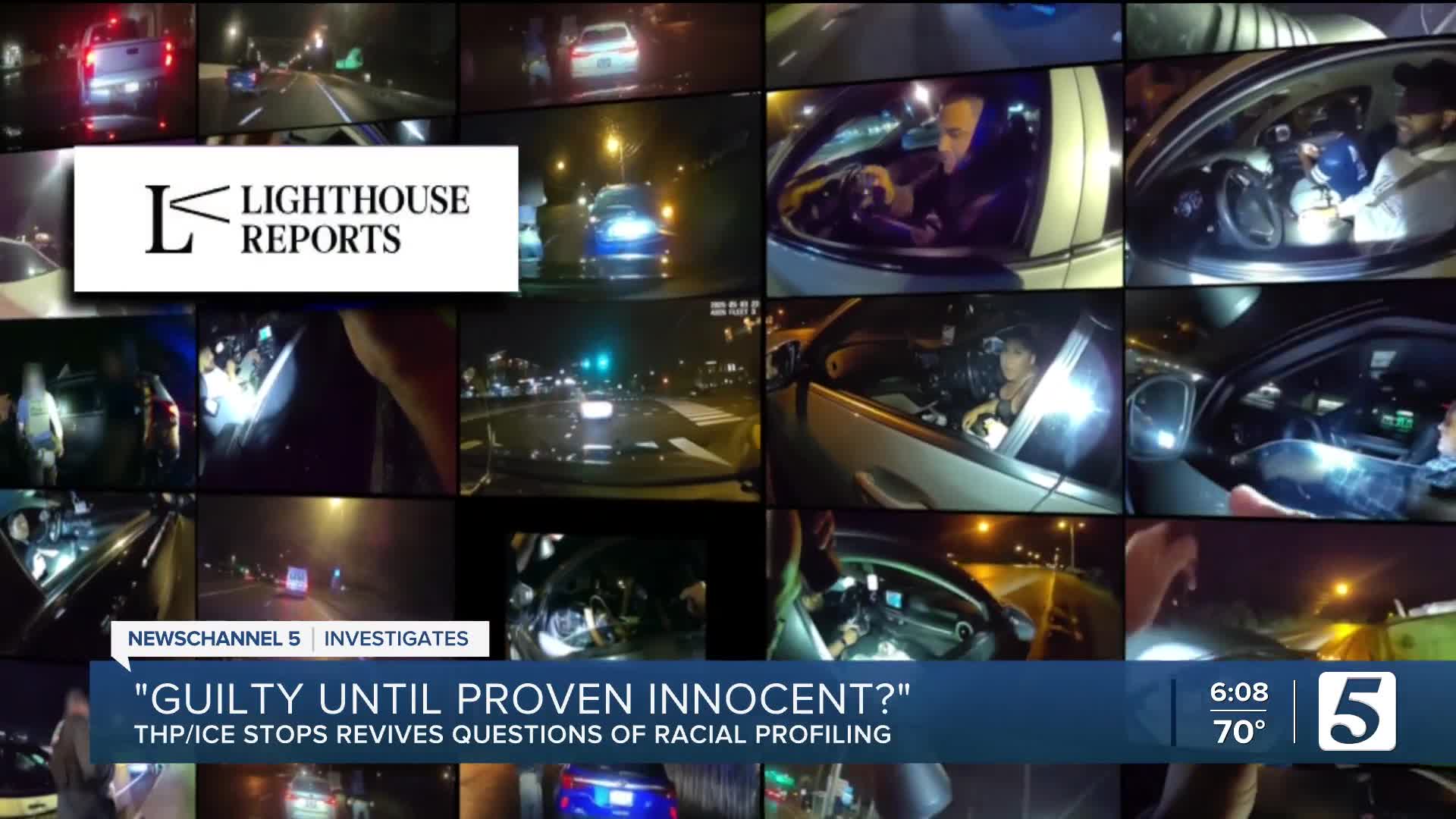


NASHVILLE, Tenn. (WTVF) — More than 50 hours of newly obtained footage from a joint operation by the Tennessee Highway Patrol and Immigration and Customs Enforcement has revived questions about whether drivers were racially profiled as officers made more than 100 immigration arrests.
Watch the full investigation in video player above.
Summary of key findings of immigration investigation
The video was obtained in partnership with the Tennessee Immigrant and Refugee Rights Coalition (TIRRC) after the advocacy group sued to learn more about the stops that took place the weekend of May 3, 2025.
THP says they had 10 troopers that night working alongside ICE agents to make stops related to "hazardous traffic violations," but the footage routinely shows troopers questioning drivers about where they were born.
In some of the more than 200 videos, troopers pressed drivers for a more believable answer if there was any hint of an accent.
“We’re no longer saying ‘innocent until proven guilty.’ We’re saying ‘guilty until proven innocent’ – and it seems to me that the people that they’re assuming to be guilty all look a certain way,” said immigration attorney Allen King.
“The people who are getting the benefit of the doubt, don’t share those characteristics.”

This story was produced as part of a collaboration coordinated by Lighthouse Reports, in partnership with Mother Jones/Center for Investigative Reporting, the Nashville Banner, Nashville Noticias and the Institute for Public Service Reporting.
Analysis of the footage revealed moments where troopers reacted differently to white drivers compared to anyone they assumed was born outside the U.S.
Connect with our partners on this project on Facebook: Nashville Banner, Lighthouse Reports, Mother Jones
Different drivers, different standards
In one video clip, a white driver was stopped and, even though we could see someone in the passenger seat, the trooper never asked the passenger for an ID.
On that same night, troopers questioned certain minorities about where they were from before turning to passengers.
Those who refused, remained silent, did not have identification or had identification from another country were almost always taken away in handcuffs.

"Reasonable suspicion – he’s not answering my questions and won't give us ID," one trooper said as he escorted a passenger away in handcuffs.
To be clear, attorneys say, only the driver is obligated to present an ID during a traffic stop, unless there’s reason to believe the passenger may have committed a crime.
We saw ICE and THP repeatedly use these stops as an opportunity to challenge everyone in the car over their immigration status, even though some troopers could be heard saying that passengers are not required to turn over anything.
"I mean I could just ask and he could give it to me, but if he says no… no passenger is required to," one trooper says.
Attorney King said, “A lot of community members have seen footage of individuals in cars being dragged out of them. They don’t want that to happen to them and so, in the moment, it might be easier to just comply, rather than face possible injury.”
One trooper was seen stopping a driver for having a headlight out, running a quick background check and finding nothing.The trooper then told the driver he was good to go, when an ICE agent suddenly appeared to detain the driver without any explanation.
Troopers turn off mics during stops

The same trooper then appeared to turn off the audio on his body camera, leaving no record of what was said between him and agents over the last three minutes.
The same thing happened on several other videos. In one case, a trooper silenced 12 minutes of conversation during a search, only to admit he was not clear on the policy behind doing so.
"I need to read the policy more," the trooper said.
At the time, ICE agents were not required to wear body cameras, so the only way to know what was said during these stops comes from the body cameras worn by troopers.
It is not clear what troopers were trying to keep us from hearing, because what we did hear was concerning enough.
“She might be wet. It just means illegal. I think it comes from like crossing the river or whatever,” said one ICE agent.
'We're not letting them know'
A trooper later asked an ICE agent if they could call a family member to pick up the car of one of the drivers they detained, to which the agent replied, “No, we’re not letting them know that they’re in immigration custody at all.”
Nashville woke up the next morning to find that several people were taken away to a nearby ICE facility. Yali Molero showed up with papers in hand searching for her husband, Leugim Romero, who was on his way home after working a late shift the night before.
We found Romero’s stop in the body-camera footage where ICE agents questioned his legal status and even his tattoos, before concluding that they believed he was a member of the violent Venezuelan gang Tren de Aragua.
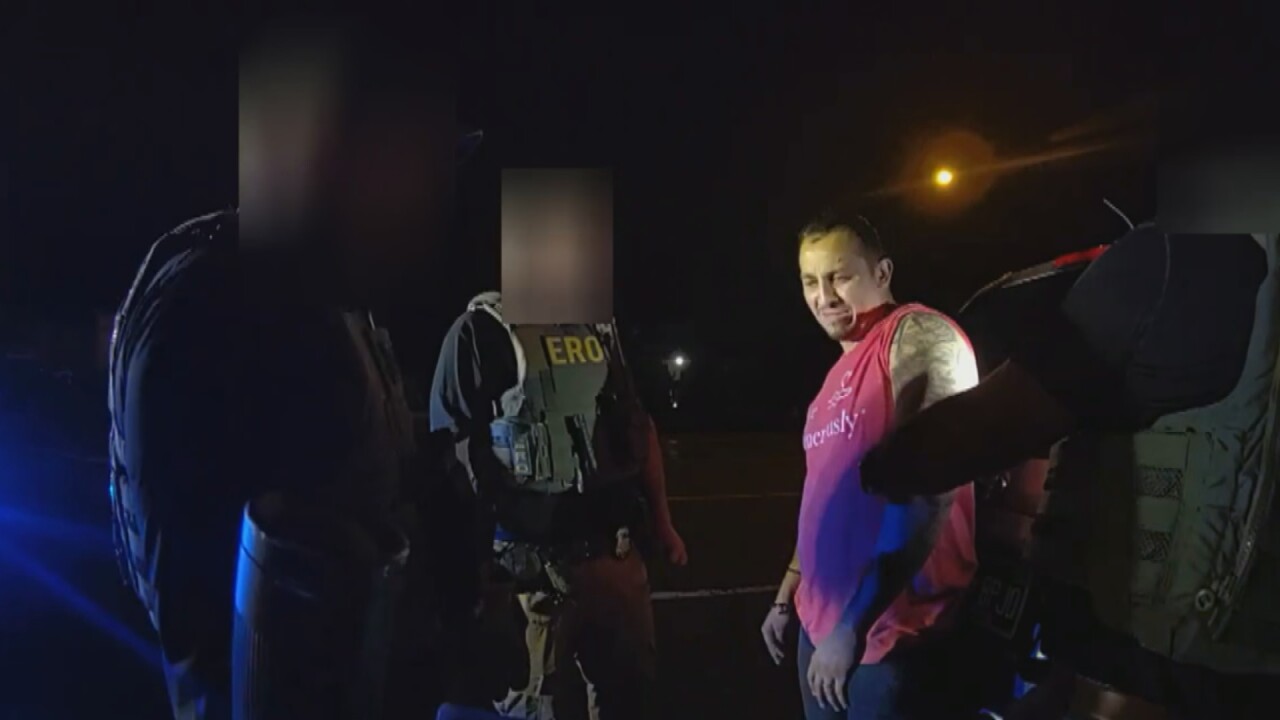
When ICE began explaining why they detained Romero, the trooper muted his body camera audio and left it that way for the remaining 36 minutes of the video.
Molero showed up the following day to share her husband's asylum documents and explained that her husband is far from a problem and has been trying to gain asylum the right way.
"He's not a criminal, and it hurts that immigrants are being stereotyped," Molero told NewsChannel 5.
Romero was later deported to Venezuela, and Molero soon joined him in the country they had once fled after fearing for their lives.
Majority have no criminal record
The Department of Homeland Security said they detained 196 people as part of this joint operation. Of those, they said, 95 had prior convictions.
New data uncovered by Lighthouse Reports found that of the record number of people recently detained by ICE, those arrested in Tennessee without a criminal record grew from 42 percent before President Donald Trump’s second term to 66 percent since Jan. 20, 2025.
This means the majority of those detained in Tennessee had never been convicted of a crime.
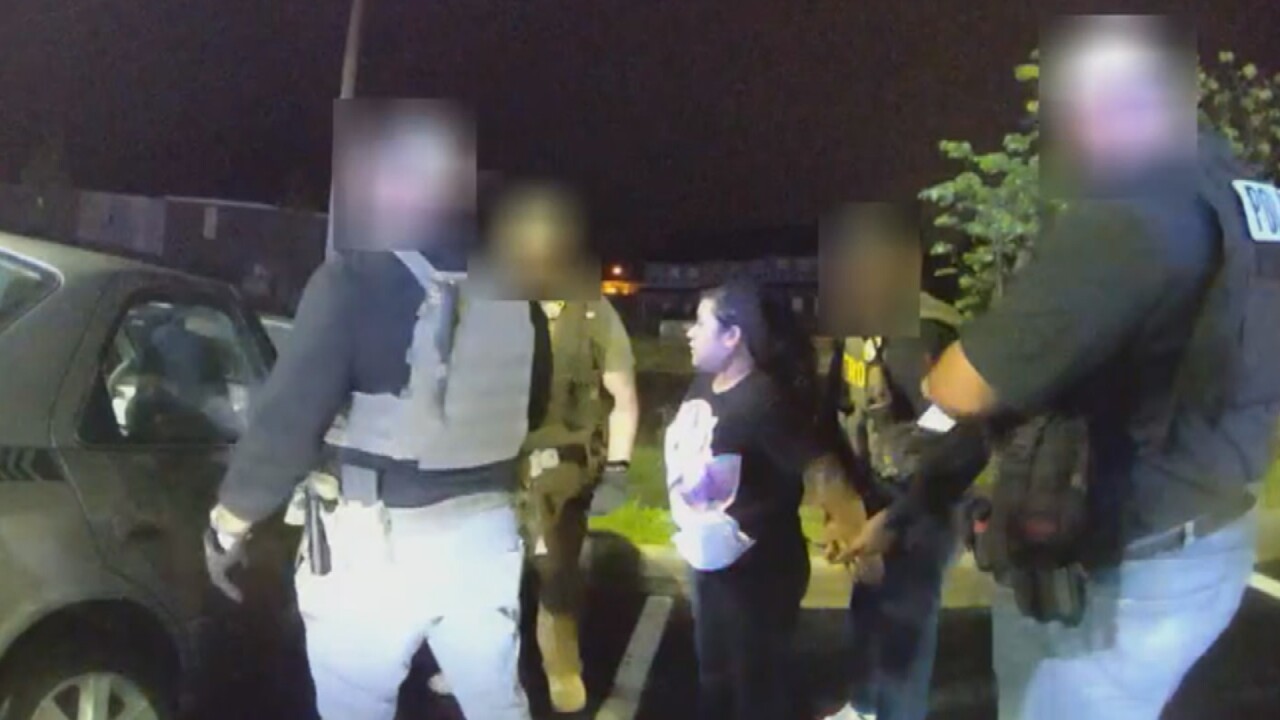
DHS Secretary Kristi Noem traveled to Nashville where she said this operation was about detaining criminals.
"All of these criminals are evil. They're horrible human beings. They're the worst of the worst," Noem said.
However, more than half of those detained had no criminal record and, in some cases, were seen carrying asylum documents.
Justification for traffic stops
As for the "hazardous traffic violations" THP used to justify these stops, troopers questioned and surrounded drivers they suspected of being foreigners over minor violations like driving with high beams on, a broken headlight or even a bent license plate.
Yet, if drivers spoke English clearly, troopers appeared less concerned about public safety, giving out warnings to drivers who were going as much as 18 mph over the speed limit.
"I believe that race is playing a factor, and I think the issue right now is that it's unclear whether our legal system allows it," King said.
The US Supreme Court recently ruled that immigration officers can briefly detain someone and compel them to prove legal status if they suspect they are in the country illegally. The so-called Kavanaugh Stops are named after Justice Brett Kavanaugh who was the only justice to write a concurring opinion.
Kavanaugh later clarified that, while apparent ethnicity alone cannot justify a stop, it may add to other factors like the ability to speak English, which should be enough reasonable suspicion to warrant a stop.
Calls for transparency
"I think one of the difficulties with giving legal advice for people in cars is that it's a situation where people's constitutional rights are the most vague," King said.
King and TIRRC are calling for more transparency, not just for the names of all those arrested, but over the tactics used while making these arrests.
"Here we are, you know, in 2026, there are still people who were detained in this operation that no information was released about them," King said.
King tells clients to memorize contact information of someone they trust and carry documentation as often as possible.
"I think that these are really dark times and that a lot of people justifiably are afraid," King said.
Responses from THP/ICE
The Tennessee Highway Patrol did not respond to a series of questions submitted to the agencies by the journalists working on this collaboration.
Instead, they provided the following statement:
"The Tennessee Highway Patrol conducts lawful traffic stops based on observed violations of Tennessee law and does not engage in enforcement actions based on race, ethnicity, language, or national origin. Troopers are trained to enforce state traffic statutes in a professional manner and, during joint operations with federal partners, their role remains grounded in upholding Tennessee law and ensuring roadway safety. Each trooper is afforded appropriate discretion in determining how to conclude a traffic stop, consistent with state law and department policy. We expect all personnel to conduct themselves in accordance with professional standards and remain committed to fair, constitutional policing across the state."
After the stories were published Thursday, ICE finally responded with the following statement:
"In conjunction with Tennessee Highway Patrol (THP), ICE Enforcement and Removal Operations participated in Nashville Secure Streets in May 2025.
"As part of ICE’s ongoing mission to uphold U.S. immigration laws, the targeted enforcement operation specifically focused on individuals who threatened public safety or national security. Of the 196 individuals arrested, 95 had prior criminal convictions and pending criminal charges and 31 were previously removed individuals who reentered the U.S. illegally, a felony offense under federal law. For information on specific arrests by the state authorities, please reach out to THP. In addition, ICE worked with the Tennessee Department of Corrections Apprehension and Enforcement Unit to identify convicted illegal aliens who were on probation or parole.
"All officers, agents, and any other law enforcement personnel participating in the operation attended operation briefings held on May 2 and 3, 2025.
"ICE does not operate under arrest quotas.Under Secretary Kristi Noem, ICE is fulfilling President Trump’s mandate to arrest and deport criminal illegal aliens to enhance public safety. The agency’s focus remains on those who pose threats to the security of our communities, including individuals with criminal convictions, outstanding warrants, illegal re-entries, or final orders of removal."
OTHER REPORTING FROM THE COLLABORATION:

'Guilty until proven innocent?' Video from Nashville THP/ICE stops revives questions of racial profiling, NewsChannel 5
More than 50 hours of newly obtained footage from a joint operation by the Tennessee Highway Patrol and Immigration and Customs Enforcement has revived questions about whether drivers were racially profiled as officers made more than 100 immigration arrests.
Read more: Summary of key findings of immigration investigation
License to Profile, Lighthouse Reports
Lighthouse Reports in partnership with Mother Jones, the Nashville Banner, Nashville Noticias, NewsChannel 5 and the Institute for Public Service Reporting spent six months collecting and analyzing data, including thousands of pages of ICE documents, hundreds of criminal court records and Tennessee Highway Patrol incident reports.
Tennessee Said Yes to ICE—and Turned Into a Deportation State, Mother Jones
The May operation in Nashville could become a template for future incursions into Democrat-run cities in Republican-controlled states. For nearly a week in early May, state troopers roved the city’s Latino neighborhoods at night, with ICE officers riding shotgun and undercover vehicles following behind, leaving fear and panic in their wake.
‘Huntin’ Time’ — How ICE and Troopers Targeted Immigrants, Inflated Safety Claims, Nashville Banner
An analysis of immigration records and more than 50 hours of footage contradicts law enforcement arrest statistics and claims that the operation was about targeting criminals to improve public safety, showing fewer arrests than reported by ICE and a pattern of profiling suspected immigrants. (Leer este artículo en español.)
‘My Life Has Been a Mess’ — The Aftermath of May 2025 Highway Patrol, ICE Operation, Nashville Banner
The Banner contacted those deported to El Salvador, Venezuela, Saudi Arabia, Jamaica, Mexico and beyond; their family members remaining in Nashville; and U.S. citizens caught up in the operation to better understand the role of the highway patrol and the experiences of those detained. (Leer este artículo en español.)
Risky, High-Speed Chases Explode Under Memphis Safe Task Force, Institute for Public Service Reporting, Memphis
An investigation by the Institute for Public Service Reporting found the Safe Task Force surge has created public safety threats of its own with dozens of risky, at times accident-triggering vehicle pursuits, often initiated following infractions as minor as a missing headlight or a broken taillight or driving without a seatbelt.