

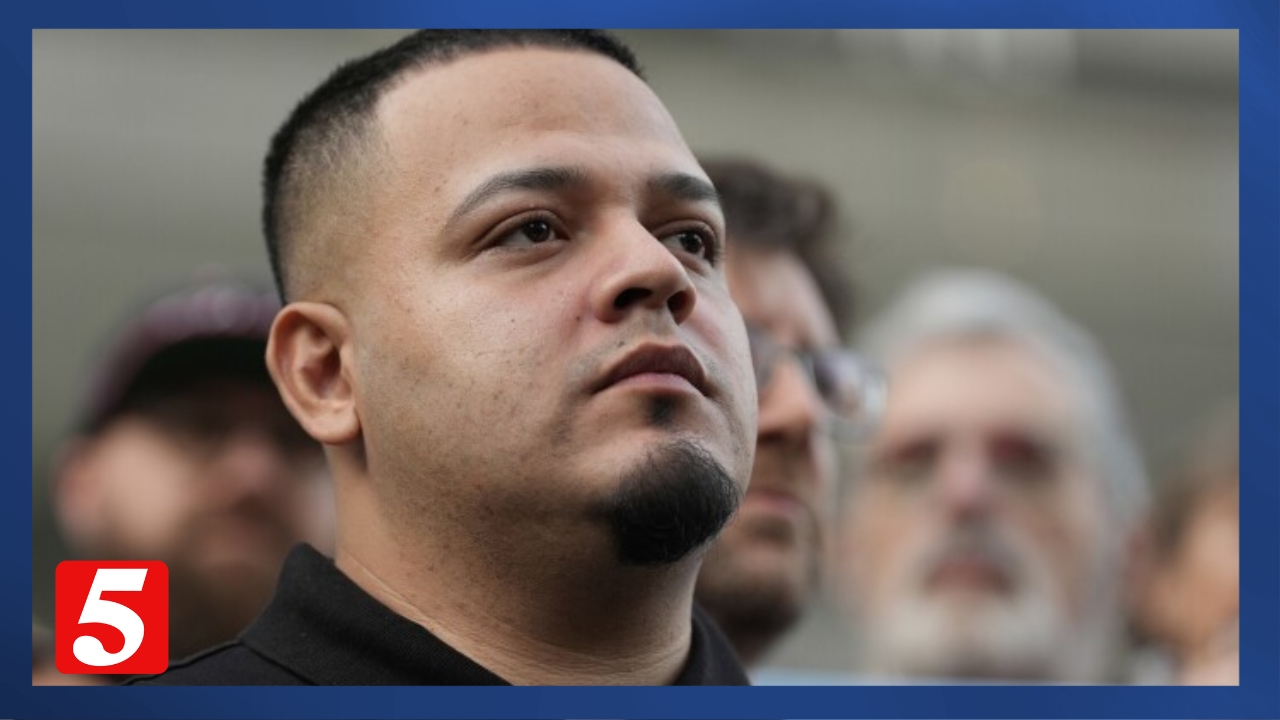


BALTIMORE (WTVF) — Kilmar Abrego Garcia's attorneys confirmed his release just hours after Maryland Federal Judge Paula Xinis granted his request for freedom.
The 30-year-old, married father, had been locked up in Immigration and Customs Enforcement custody since early this summer when he pleaded not guilty and was released from a Tennessee jail pending trial on two human smuggling charges from 2022.
After his release in Tennessee, Abrego Garcia was escorted to Maryland where he reported to the Department of Homeland Security as required. There he was immediately taken into custody and sent to an ICE facility.
Judge Xinis wrote in her order that the government has "never produced evidence of a removal order for Abrego Garcia." She added that "when Abrego Garcia was first wrongly expelled to El Salvador, the Court struggled to understand the legal authority for even seizing him in the first place."
Abrego Garcia had been wrongfully deported to a maximum-security prison in El Salvador against a judge's order from 2019. The ruling was a stay on deportation to El Salvador, meaning Abrego Garcia could be deported anywhere except that country.
After the U.S. Supreme Court forced the Trump Administration to admit they wrongfully deported Abrego Garcia and facilitate his return, the government resurrected the traffic stop as the centerpiece of their smuggling charges, according to Abrego Garcia's attorneys.
He was sent back to Nashville, where he was almost immediately placed in handcuffs and charged with the human smuggling charges.
For months, DHS officials sent representatives to Maryland courts arguing they had legal authority to deport Abrego Garcia. They offered to send him to several African countries, but those nations wrote back saying they never agreed to accept someone the U.S. government had labeled a dangerous gang member.
Abrego Garcia had agreed to being sent to Costa Rica, a Spanish-speaking country that said it would accept him. However, he later learned the Trump administration had not been in contact with Costa Rica despite their willingness to accept him.
Judge Xinis said at the time, "If the government has not done anything to effectuate the one place he says he'll go and the one place they say will take him, how can I find you're really pursuing this?"
All this time, Abrego Garcia remained locked up in an ICE facility.
"Respondents' conduct over the past months belie that his detention has been for the basic purpose of effectuating removal, lending further support that Abrego Garcia should be held no longer," Xinis wrote.
Judge Xinis had appeared frustrated in recent hearings with DHS's lack of concrete answers about deportation plans. She had earlier denied the government's motion to delay Abrego Garcia's case, rejecting claims that the government shutdown prevented some attorneys from working.
Abrego Garcia was notified that DHS intended to deport him to Ghana, but a DHS official later testified that the notice was premature and asked attorneys to disregard the document. Ghana's foreign minister, Sam Okudzeto Ablakwa, posted on X that the West African country was not accepting Abrego Garcia.
"This has been directly and unambiguously conveyed to US authorities," Ablakwa wrote.
DHS spokesperson Tricia McLaughlin posted on X calling the Maryland ruling "naked judicial activism by an Obama appointed judge." She said the "order lacks any valid legal basis and we will continue to fight this tooth and nail in the courts."
Tennessee Senator Marsha Blackburn also criticized the decision on X, writing that "an activist judge has ordered Kilmar Abrego Garcia to immediately be released from immigration custody. This decision cannot stand. It jeopardizes the safety of American citizens."
The release does not end Abrego Garcia's legal troubles. He must follow strict conditions of release for his Tennessee case, including staying in the custody of his brother in Maryland, wearing an electronic monitoring device and only traveling for work, court, church and medical appointments.
Meanwhile, Tennessee Federal Judge Waverly Crenshaw has yet to rule on whether the human smuggling charges against Abrego Garcia were "vindictive" and should be dismissed. Abrego Garcia's attorneys argue the charges were vindictive since they were only brought after the Trump administration was forced to bring him back to the United States.
Crenshaw wrote in a 16-page ruling that there was a "realistic likelihood" that the government may have acted vindictively with these charges. The ruling allowed attorneys to seek discovery and testimony from Trump officials about why they brought charges against Abrego Garcia.
Trial in the Tennessee case is expected to begin in January, pending any new rulings on whether to dismiss the human smuggling charges. Several sealed court documents were filed in that case Wednesday.
This is a developing story.
