



NASHVILLE, Tenn. (WTVF) — Artificial Intelligence is changing everything - including how we consume news.
As part of national News Literacy Week, NewsChannel 5 and our parent company Scripps are airing reports on how to identify misinformation.
We are partnering with the nonprofit and nonpolitical News Literacy Project, which helps educate students across the country about how to sort fact from fiction.
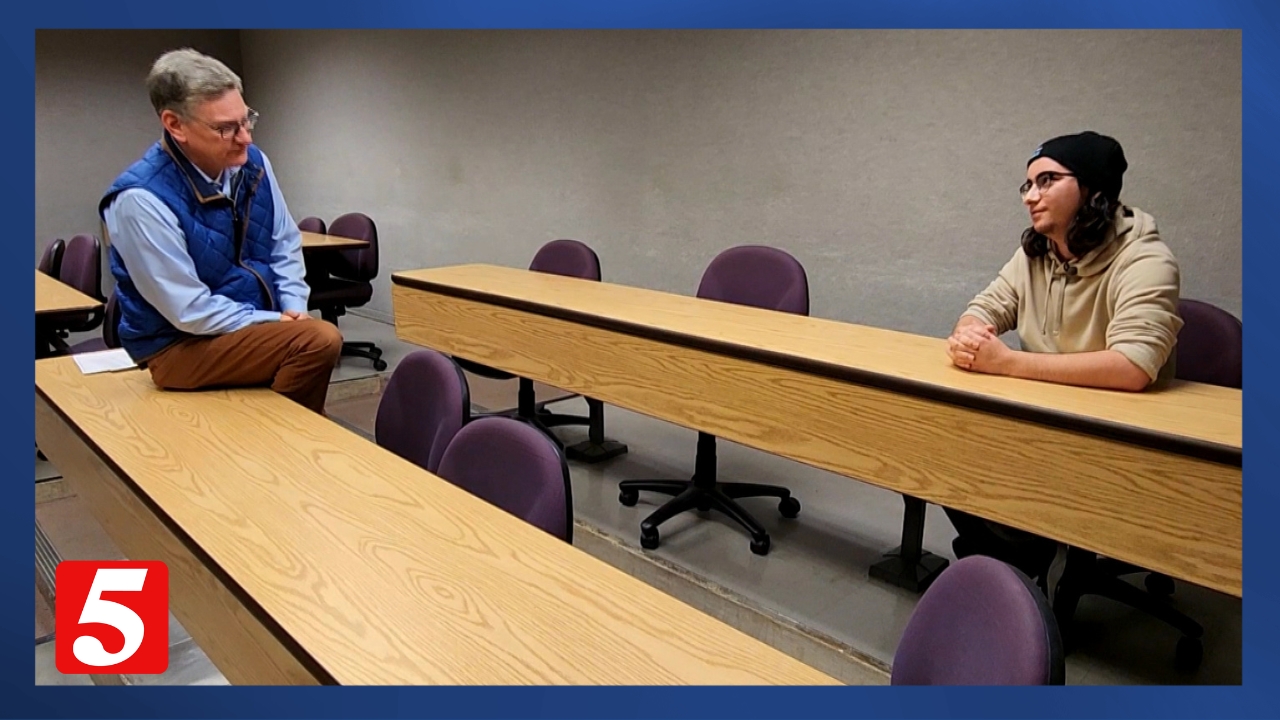
At MTSU, professor Todd O'Neill is aware of how a quick AI prompt can generate photos or videos that look factual.
He put descriptions into an AI engine to create a picture of an investigative reporter based in Nashville.
"It's going to give me a head-shot or a full body shot. I don't know what it's going to end up giving me," O'Neill said.
He asked for a male "television reporter" who "dresses business casual."
"It's going to create an imaged based on the information that it has scrapped from the internet at some point in the past," O'Neill said.
In less than a minute a picture pops up - representing a Nashville based investigative reporter - you see the Batman Building in the background.
NewsChannel 5 asked, "So you have created something that didn't exist before?"
O'Neill responded, "Yes. It never existed before."
O'Neill teaches interactive media, and said AI is changing everything.
It used to take hours to create a picture like this - now it takes seconds.
And with a few more commands, pictures can start talking, and in the case of a made-up reporter - start reporting.
"This is Dana Brooks reporting live from Ocean View Beach. (a UFO comes out of the water) Just kidding I'm not real."
You see fake pictures and fake videos being created all over the internet and on social media.
It can be confusing for even the most tech-savvy generation.
"It's harder to tell nowadays. I have to take a step back and be like, 'Okay is this actually AI?," said McKenna Smith who is an MTSU Senior, majoring in Music Business.
Smith said she has been fooled a few times by fake pictures or videos, and she has learned to question what she sees.
"I have to dive deeper into it, just to make sure that it's not AI, which I think is really important, because you don't want to be told something that is just completely not true," Smith said.
It's something we found over and over again with the students we talked to.
"I think it's definitely messing with people as far as, you know, knowing what to believe and what not to," said Tyler Morder, who is an MTSU senior with a double major in Audio Production and Interactive Media.
Students said AI may help with their careers, but it means more work when it comes to consuming news.
"I definitely am careful about what I believe and what I spread around to people based on what I see on an Instagram Post," Moder said.
All the students questioned where AI is headed - years from now.
"Where technology has come from 2002 to 2026 is insane," said Senior Zachary Thomas.
Thomas was born in 2002.
He remembers CDs, even cassette tapes. He also remembers the release of the I-phone.
"If technology is growing at that rate, it's tough to fathom where we'll be in 20 years," Thomas said.
It's why the nonprofit and nonpolitical News Literacy Project encourages education at schools nationwide.
It teaches students mostly in middle and high school to question what they see on-line.
"Think of the older generation on Facebook," McKenna Smith said. "They see a headline and they're like, 'Oh my Gosh it's true."
She is double checking everything and has a healthy skepticism about what she see on-line.
There are plenty of students who are questioning the right things - we all need to follow their example.
"It means that people have to not take things at face value and do their own research," McKenna Smith said.
