



NASHVILLE, Tenn. (WTVF) — Internal communications reveal Nashville Electric Service (NES) turned down multiple offers for outside line workers in the days following the January ice storm that left 230,000 people without power.
NewsChannel 5 Investigates obtained emails and text messages that show the utility was not prepared to bring on and manage contractors who offered help.
In response to our follow-up questions regarding what it learned, NES said it is now "formalizing a pre-arranged contractor framework" so it can bring on contractors more quickly.
The January emails show NES didn't have a streamlined process to bring on assistance from outside contractors, to the extent that the utility was literally turning away people open for work.
Brandon and Emily Boyce own Linewerx, which operates a fleet of utility vehicles that travel the country restoring power after storms.
They had crews near Nashville to help Duke and Dominion Energy during the storm.
"We're no strangers to these types of events," Brandon Boyce told NewsChannel 5.
"Logistically, this is what we do," Emily Boyce said.
On Monday, Jan. 26, the day after the ice storm hit, Emily emailed NES offering their services.
"We have a full fleet of bucket trucks, diggers, a 50-ton crane and manpower ready to mobilize immediately. We just got released from Duke and Dominion property," Emily wrote in the email.
The next day, she wrote NES again.
"Our crews are currently staged in Nashville and ready to provide support with no moblization cost," Emily wrote.
"We were thinking, well, you know, we're here, we're going to help and um... they never needed us," Emily said.
"Their emergency preparedness was kind of, like, it just didn't seem like there was much of a plan of action," Brandon said.
"And, I mean, it seemed like just by speaking to them on the phone, they didn't really have a good plan to bring anybody outside their mutual aid in," Emily added.
Emails show that Delta Services LLC, out of Louisville, which had worked on NES systems before, also offered manpower and equipment.
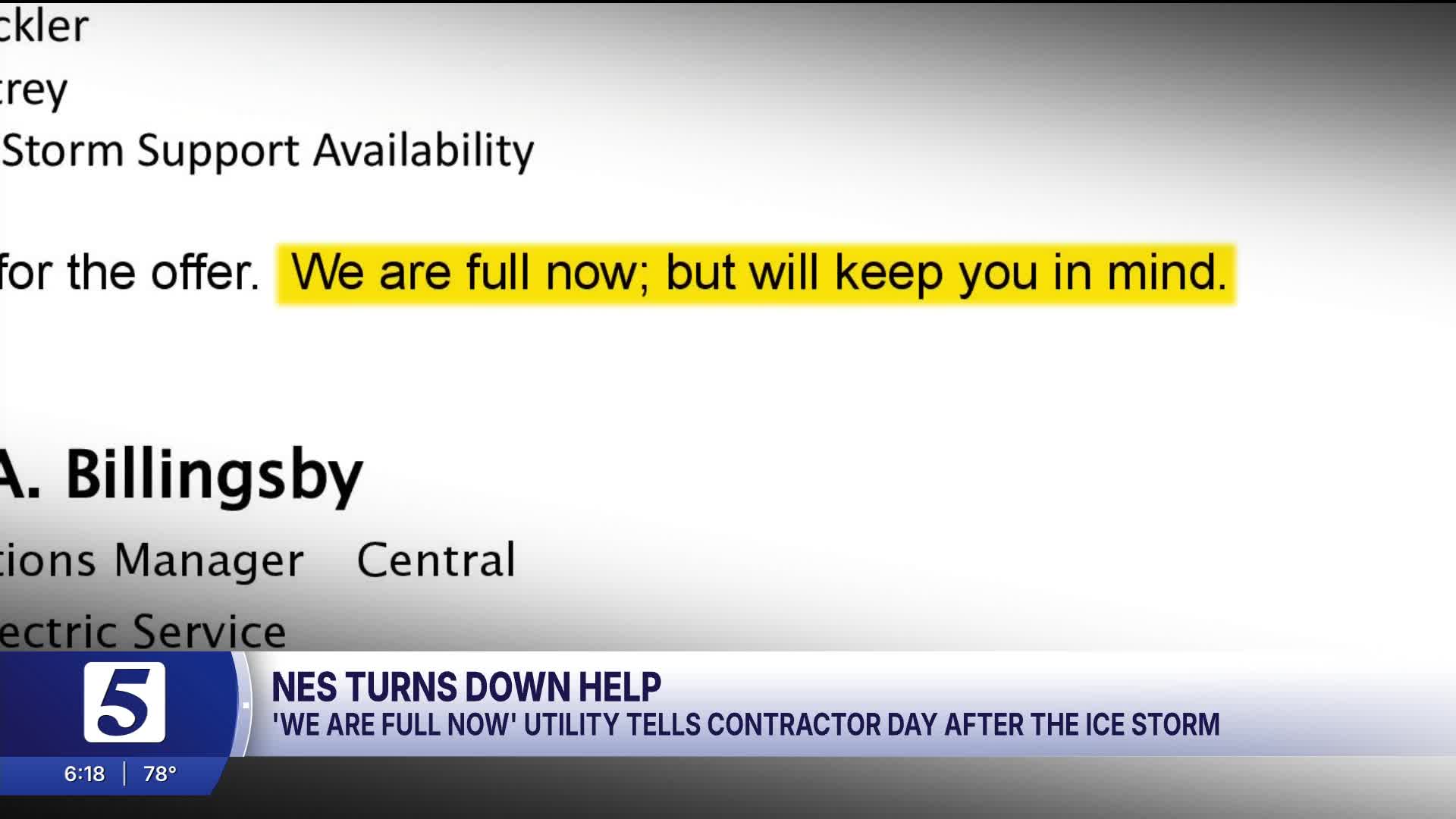
Hours after their offer on Monday, January 26, an NES manager responded:
"Thank you for the offer. We are full now; but will keep you in mind," the NES manager wrote.
Internal emails show that at least one board member did not think they were "full."
On Tuesday, Jan. 27, that board member, Casey Santos, questioned CEO Teresa Broyles-Aplin about the utility's response to the storm.
"How many additional crews have we added and are more coming... Have we left any rock unturned," Santos wrote in an email.
Broyles-Aplin responded minutes later that the headcount for current crews "had not met her expectations."
"I have told them they are not to turn away potential assistance," Broyles-Aplin replied.
However, hours later, text messages involving NES vice president Brent Baker show him agreeing to turn down 10 line crews and two vegetation management crews staged in West Tennessee.
The text thread with Baker included an individual confirming that NES was going to turn down the assistance, with one message that read, "We don't need him now."
The crews were from JJM, another reputable line company. The owner of JJM said he did not know why NES turned them down.
When asked about turning down JJM, NES responded with a statement:
"The after action review will assess crew deployment and overall effectiveness. Decisions about individual crews reflect one moment in time during storm response and provide very little insight without the full context of the after action review," NES said.
NES also wrote:
"As part of NES's after-action work, the utility is formalizing a pre-arranged contractor framework with extended agreements for line, vegetation, and damage assessment resources — so that future events begin with crews already credentialed, pre-integrated into NES's Incident Command structure, and scalable by storm category rather than assembled in real time."
On Friday, January 30, as pressure built on NES to get power back on, Emily reached out again to provide services via Linewerx.
"Our offer still stands. We see that your outages are still high," Emily wrote.
"We didn't see the [power outage] numbers moving at all," Emily told NewsChannel 5. "And that was the biggest shock for us. It's like y'all's numbers aren't moving and we're here."
"We definitely know they didn't have enough resources. Duke Power called in thousands. Dominion Energy called in off-property contractors for Virginia, and Nashville Electric had less than 200 pre-staged? So, their numbers were way off for the system they were facing," Brandon said. "And if you don't have those pre-staged resources or have a plan to bring contractors in after an event like that, you know, a very detailed plan, it just creates major delays."
Ultimately, Brandon and Emily's crews left the area when it seemed clear their offer wasn't going to be accepted.
Emails show on Sunday, Feb. 1, a week after the storm hit, the NES CEO asked about Linewerx.
"Since we are still looking crews, can we leverage these guys?" Broyles-Aplin wrote.
It was too late; their crews had moved on.
Here is the full statement sent by NES in response to our questions about adding contractors before and during the ice storm:
"Winter Storm Fern required NES to scale its workforce from a normal operating complement to a peak of roughly 1,900 lineworkers plus vegetation, damage assessment, and support personnel — the largest restoration mobilization in the utility's history. Managing that scale-up is an onboarding and deployment capacity question as much as a headcount question. Every crew that works on the NES system must be credentialed, safety-briefed, paired with an NES supervisor, and assigned to a work packet before being deployed — a process that takes hours per crew and runs in parallel with active restoration.
Over the course of the event, NES received many offers of assistance and accepted the crews that fit the specific operational need at the time the offer was received — line versus vegetation, bucket versus digger-derrick, crew-composition and supervisor ratios, and available onboarding capacity at the staging areas. Timing mattered: a crew offered on one day may not have been the right match for the work profile in front of us that day, and some crews demobilized before NES's changing needs aligned with their availability.
As part of NES's after-action work, the utility is formalizing a pre-arranged contractor framework with extended agreements for line, vegetation, and damage assessment resources — so that future events begin with crews already credentialed, pre-integrated into NES's Incident Command structure, and scalable by storm category rather than assembled in real time."
