

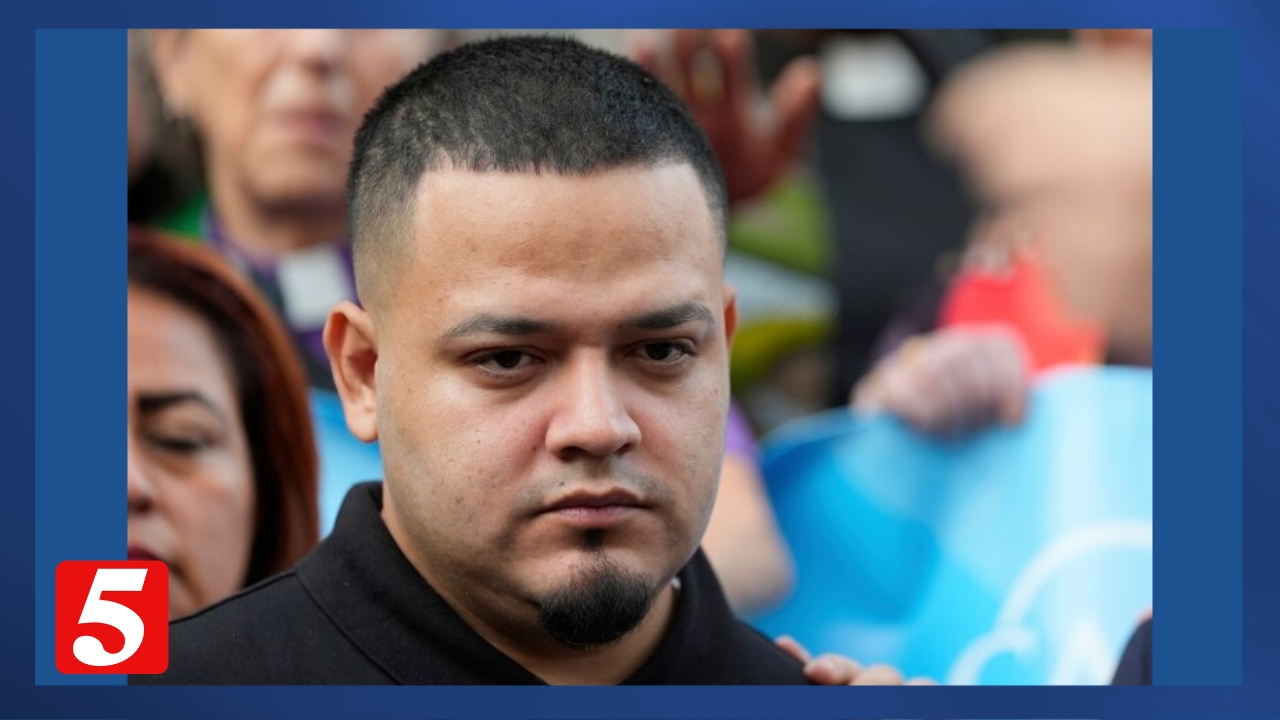


NASHVILLE, Tenn. (WTVF) — Will there or will there not be a trial? That’s the question facing Kilmar Abrego Garcia as he returned to a Nashville federal courtroom for one of the most consequential hearings in his case.
U.S. District Judge Waverly Crenshaw heard arguments on whether to dismiss the human smuggling charges against the El Salvador native after defense attorneys say he was the victim of vindictive prosecution.
Abrego Garcia, who was previously wrongfully deported to an El Salvador prison before the U.S. Supreme Court ordered the Trump administration to facilitate his return, appeared in court surrounded by his wife and family.
Thursday’s hearing centered less on footage from the 2022 Tennessee traffic stop that sparked the charges and more on internal communications between Nashville prosecutors and the Department of Justice.
Retired Special Agent in Charge, Rana Saoud, of Homeland Security's Nashville office, was the first to take the stand.
Saoud testified that she first learned who Abrego Garcia was last year after reading an article in the TN Star about his traffic stop. She later learned that Abrego Garcia was still in El Salvador.
Saoud told the court that she contacted U.S. Attorney Robert McGuire immediately and launched an investigation into an incident that happened several years prior. She claimed no one ever told her to make sure the case progressed toward prosecution.
"If the facts did not add up, then we would cease to move forward, but unfortunately the facts continued to add up," Saoud said.
Crenshaw asked how Saoud got the article from the TN Star and Saoud said she couldn't recall if it was a coworker or friend.
McGuire, who took the stand, was questioned about emails exchanged after Abrego Garcia became a national flashpoint in the immigration debate.
McGuire testified that he first learned about Abrego Garcia from Saoud in April of last year. He received an email that same day from associate deputy attorney general Aakash Singh, who claimed he already had a witness willing to testify that Abrego Garcia was involved in a human smuggling operation.
Singh later sent emails asking for updates on if McGuire planned on pursuing an indictment and what the timeline would be for charging Abrego Garcia.
"I wasn't asking Mr. Singh's permission. I was telling him what was happening," McGuire said.
In one message, Singh described the case as a “high priority for us.”
McGuire testified he did not know who “us” referred to or whether the communications were shared with anyone in the Trump administration. He maintained that the decision to seek an indictment was his alone.
In one email response, McGuire wrote that he was “hammering away” as quickly as possible to ensure “higher command” was aware of developments before anything became public. He testified that his urgency stemmed from concerns about public scrutiny tied to a high-profile case.
"If I believed that Mr. Abrego didn't commit a crime or I couldn't prove it, or if there was some reason I shouldn't pursue a charge, I would've said that," McGuire said.
Defense argues political pressure
Defense attorneys argued the emails demonstrate pressure from Washington, D.C., to prosecute Abrego Garcia quickly after the administration was forced to return him to the United States.
They contend the charges were brought to save face following what the government has described as an administrative error in deporting him to El Salvador despite a prior court order barring his removal there.
Defense attorneys asked McGuire about a memo sent by U.S. Attorney General Pam Bondi where it was suggested that all attorneys that attorneys could be subject to discipline if they did not act as the president's lawyer and defend his policies.
One attorney asked if this meant that government attorneys are the president's lawyers. McGuire said that's how he interpreted the memo. He also understood that several attorneys had been removed from their positions for failing to pursue cases the Trump administration prioritized or prioritizing the wrong cases.
Crenshaw has already ruled there is a “realistic likelihood” that Abrego Garcia was the target of vindictive prosecution, a finding that shifted the burden to the government to provide objective, on-the-record explanations for bringing the charges.
If the court determines prosecutors acted vindictively, Crenshaw could dismiss the human smuggling charges.
Attorneys have no more than 30 days to submit written briefs for the judge to consider while he considers the motion.
CASA Legal Director Ama Frimpong spoke on behalf of Abrego Garcia's family where she reminded others that Abrego Garcia is innocent until proven guilty.
"Obviously we heard many, many times that over the past year that Kilmar will never be a free man in this country ever again right and what happened to day? Kilmar walked inside that courtroom a free man and Kilmar is walking out of that courtroom a free man. It's because of the continuous fight we've been pushing for almost a year now," Frimpong said.
Abrego Garcia pleaded not guilty to human smuggling charges stemming from a 2022 Tennessee traffic stop. Tennessee Highway Patrol troopers suspected he was transporting undocumented people between state lines, but let him go after discovering he had a deportation hold and was allegedly told that detaining him wasn't necessary.
A judge had previously determined that while Abrego Garcia entered the U.S. unlawfully in 2011, he couldn't be deported back to El Salvador, where he feared for his life.
Despite this ruling, Abrego Garcia was deported to an El Salvador prison in what the Trump administration described as an "administrative error." The U.S. Supreme Court later ruled that the Trump administration had to facilitate his return.
