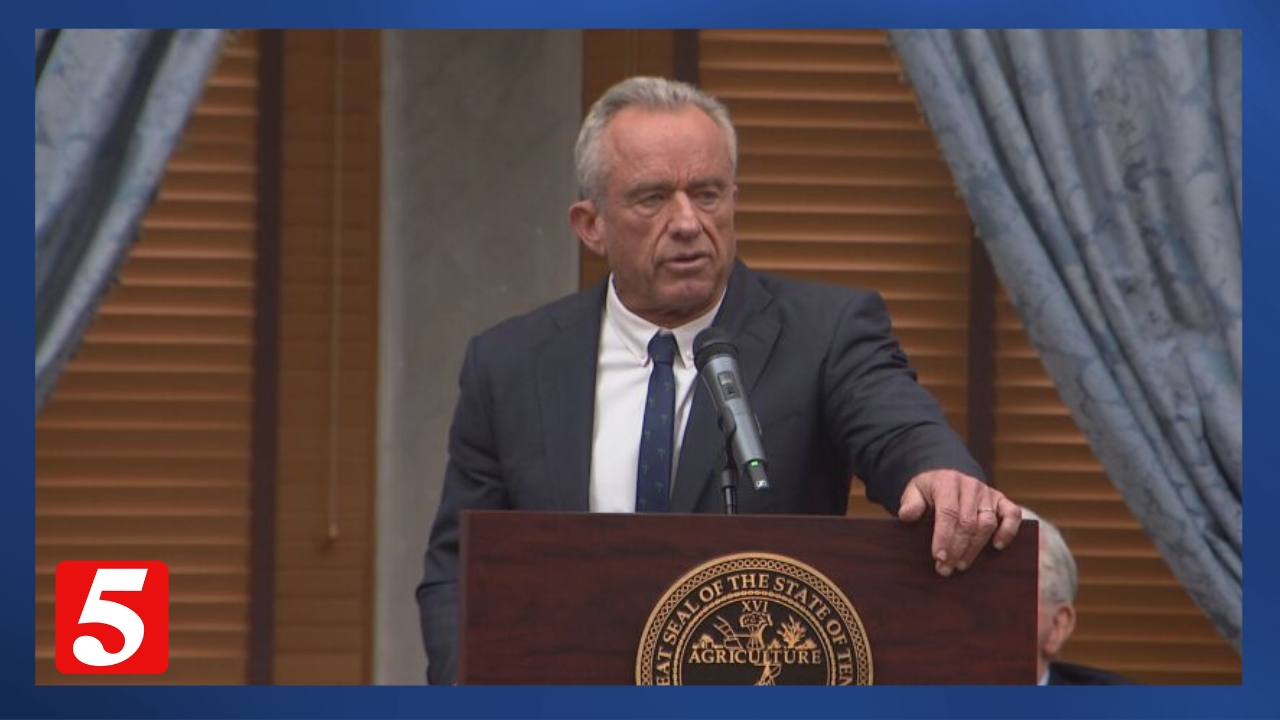


NASHVILLE, Tenn. (WTVF) — U.S. Health and Human Services Secretary Robert F. Kennedy Jr. visited the Tennessee State Capitol as part of a nationwide tour promoting the Trump administration's health initiatives, drawing both support and criticism from lawmakers and medical professionals.
Kennedy addressed an invite-only audience, focusing heavily on dietary recommendations and healthcare transparency measures. He outlined several key policy proposals, including prescription drug pricing reforms. "Whatever the lowest price they're selling anywhere in the world, we will get that price or lower," Kennedy said promoting the Trump RX program.
Kennedy also emphasized the administration's push for transparent healthcare pricing. "Every hospital in the country is now going to have to publish their prices," Kennedy said.
Much of Kennedy's remarks centered on nutrition and food choices, encouraging Americans to focus on whole foods while maintaining personal freedom. "We're asking people now -- eat real food. Eat protein," Kennedy said."If you want to drink a Coca-Cola or eat a Krispy Kreme doughnut, you live in America, you ought to be able to do that. But we're going to tell you what the cost is."
When asked about vaccines, Kennedy said he wasn't directly involved with state-level efforts to end vaccine requirements for school-aged children but voiced support for parental and personal choices in vaccination decisions.
"If people want to get a vaccine, they can get them and they can get insurance for them. I think that's a personal choice that people should make with our physicians and they should make with their families," Kennedy said.
The visit drew protests from healthcare advocates concerned about Kennedy's positions on vaccines and public health policy. Dr. Katrina Green, a Nashville emergency room physician and healthcare advocate with Protect My Care, protested Kennedy's appearance and expressed concerns about potential increases in vaccine-preventable diseases. "It's gone from the fringe to the places of power that are making decisions," Green said.
Green warned about the potential consequences of reduced vaccination rates. "I'm an emergency physician, I have yet to diagnose a case of measles in my ER but it's coming and that terrifies me," Green said.
The secretary's office controlled the question-and-answer session, limiting which reporters could ask questions. NewsChannel 5 was not one of the outlets selected to ask a question.
After the event, Kennedy appeared to have plenty of time to take photos with lawmakers and lobbyists inside the Governor's office.
Tennessee lawmakers expressed mixed reactions to Kennedy's visit. State Rep. Justin Jones, D-Nashville, voiced concerns about the secretary's positions after listening to his presentation. "A lot of things I heard were very alarming and are a danger to our public health," Jones said.
Healthcare initiatives in the legislature
The visit comes as several healthcare related initiatives are expected to come up this year in the Tennessee General Assembly. House Democratic Caucus Chairman John Ray Clemmons, D-Nashville, shared some of his ideas before session began this year. "Capping the costs of insulin, and those types of drugs are certainly within the jurisdiction of the state," Clemmons said.
State Sen. London Lamar, D-Memphis, outlined her priorities for improving maternal health services. "I want to pass legislation that is addressing maternal health around still birth, Doula care, getting TennCare to cover more services," Lamar said.
House Speaker Cameron Sexton, R-Crossville, has previously indicated interest in creating basic healthcare plan options from private insurance companies, similar to minimum car insurance coverage. "You hear a lot of time from people I shouldn't be bankrupt from my health plan. That's correct, but we don't really offer those types of plans, or market those plans or say that's a basic plan," Sexton said.
Other legislative priorities include reducing healthcare regulations and expanding rural healthcare access. State Sen. Jack Johnson, R-Franklin, discussed potential reforms to Certificate of Need requirements and efforts to encourage healthcare providers to serve rural communities. "We want to make sure those who are capable and willing, and it's an economically viable model for them to go into a rural area to provide healthcare are able to do so," Johnson said.
Tennessee will also be the recipient of $200 million in grants each year for the next five years from the Trump administration to bolster rural healthcare.
Kennedy's visit comes as the Trump administration works to implement its healthcare agenda across the country, with state-level cooperation playing a crucial role in many proposed reforms.
Do you have more information about this story? You can email me at Chris.Davis@NewsChannel5.com.

September 11, 2001 is a day most associate with terror and tragedy. Austin Pollack shares a story from that day about hope and persistence: the effort to save a little girl’s life – with an organ donation. The problem? The young patient was in Houston, and her life-saving liver here in Nashville. With the grounding of all civilian aircraft, how could it be done? “Nobody ever said this isn’t possible.”
- Rhori Johnston