
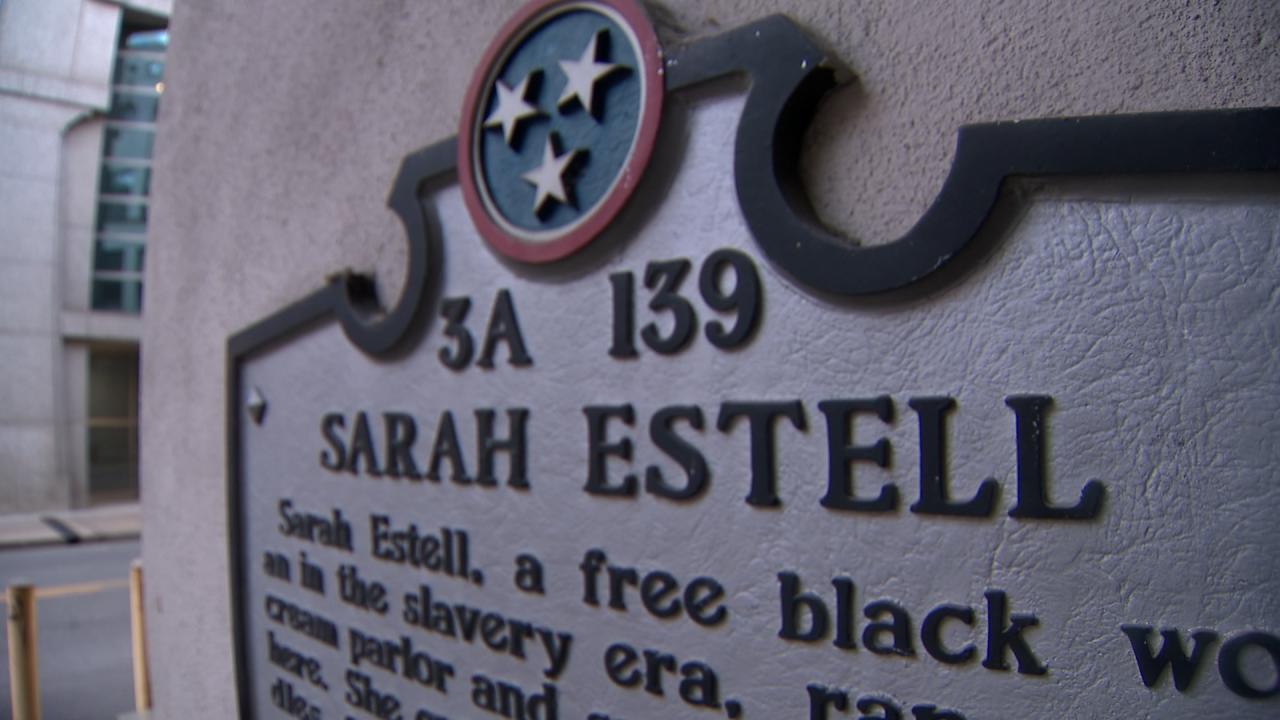


NASHVILLE, Tenn. (WTVF) — For a long time, I've been interested in this historical marker on Rep. John Lewis Way N. for a woman named Sarah Estell. Estell lived long before there there could be any old footage or pictures of her, and there's relatively little even written about her. Yet, perhaps no one has a story like Estell's.
I needed to have a quick visit with chef Lokelani Alabanza.
"I was in shock, because I could not believe that this woman existed," she said.
It was 2019. Alabanza was working for a local creamery when a message was sent in from the Tennessee Historical Commission. They were sharing the story of Estell, the owner of a downtown Nashville ice cream saloon who was a free Black woman before the Civil War.
"I was just like, 'who is this person?'" Alabanza remembered. "This is Antebellum South, the 1840s. It's 20 years before the Civil War."
Estell's ice cream saloon would have been in what's today 4th Ave. N. In her time, it was called Cherry St.
At the Tennessee State Museum, an 1859 painting by John F. Wagner captures Nashville in Estell's time. Across the country, only 11 percent of the Black population was free.
"And to know she was a business owner, an entreprenuer is massive!" Alabanza said. "Black hands have been touching ice cream for a lot longer than people anticipated."
Among Estell's customer base was the congregation of the McKendree United Methodist Church, then in an older building.
"People would come out from the choir cause her shop was right next it," Alabanza said.
Ice cream in Estell's time would not have been the neapolitan vanilla, chocolate, strawberry we know today. Alabanza said Estell likely served some more savory flavors.
"You probably would have seen something like parmesan, which I think the oldest recorded recipe is from the late 1700s," Alabanza said.
It's uncertain how Estell got started. Betsy Phillips has written for the Nashville Scene that Estell's mother was a slave of wealthy businessman and slave trader Harry R. W. Hill.
"Possibly that's how she got the money to run this establishment," Alabanza nodded. "I think that's an open ended question of how she got the money."
Whatever the case, Estell's ice cream saloon was successful for years.
"You can tell the war's coming, but she's still there doing banquets, still making ice cream, catering for confederate soldiers, for families, for everyone," Alabanza said. "I think the tragedy is not knowing what happened after the war hit. Was the business destroyed? Did she go somewhere? There are a lot of people who were born and raised here, and they do not know who she is. To give her something is one of the least things I can do for her legacy."
A party was held at a Nashville Loeffler Randall store. Alabanza made ice cream as people shared their ice cream stories. It was a celebration of a book release.
"Ice Cream Queen. Flavors from Black America's Past, Present, and Future," Alabanza said. "My debut cookbook."
Alabanza's put in 100 ice cream recipes and stories of Black ice cream makers. Included is the story of Estell and a parmesan ice cream recipe dedicated to her.
"I'd just like to say it's her ghost that kinda haunted me to persevere through and gather that information," Alabanza said. "Kindred spirits, definitely kismet. I'll always believe that forever. People were just enamored by her, which really did make her the queen of ice cream of Nashville. I love that her story's being told 180 years later."
Do you have a positive, good news story? You can email me at forrest.sanders@newschannel5.com.

September 11, 2001 is a day most associate with terror and tragedy. Austin Pollack shares a story from that day about hope and persistence: the effort to save a little girl’s life – with an organ donation. The problem? The young patient was in Houston, and her life-saving liver here in Nashville. With the grounding of all civilian aircraft, how could it be done? “Nobody ever said this isn’t possible.”
- Rhori Johnston