
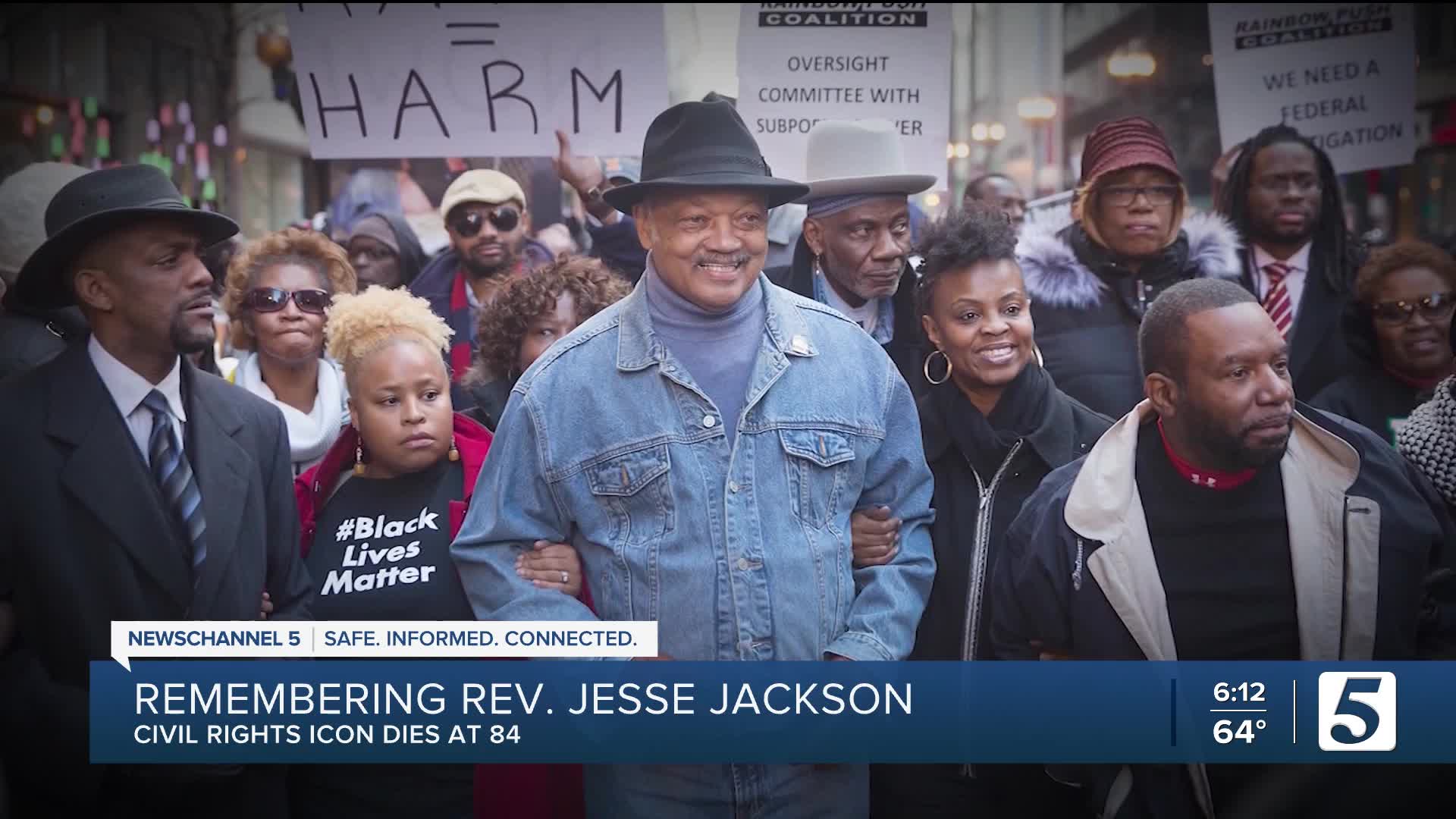


NASHVILLE, Tenn. (WTVF) — Reverend Jesse Jackson, a towering figure in the modern Civil Rights Movement and two-time presidential candidate, has died at 84.
Jackson died Tuesday, surrounded by family at his home. A cause of death has not been released. He had previously been diagnosed with progressive supranuclear palsy, a rare neurological disorder that causes symptoms similar to Parkinson’s disease.
For decades, Jackson advocated for racial and economic equality, building on the work of Martin Luther King Jr. and expanding the movement’s focus nationwide.
“He lived 84 years and 60 of them, at a minimum, he was out there fighting for equality,” said Learotha Williams Jr., a Tennessee State University professor of African American history and Davidson County’s newly appointed historian.
Williams, who was appointed by Nashville Mayor Freddie O'Connell and confirmed by the Metro Council in January, said Jackson served as a bridge between generations of civil rights leaders.
“A brother who bridged the gap from MLK to my generation,” Williams said.
After King’s assassination in 1968, Williams said Jackson helped shift the national conversation beyond desegregation.
“Folks were thinking prior to this about lunch counters and access, but now Jesse is saying no — there’s another thing we need to consider. We need to consider economic justice as well,” Williams said.
Jackson’s command of issues such as economics and politics elevated him to the national stage during his presidential campaigns in 1984 and 1988. Though he did not win, Williams said those runs laid important groundwork for future leaders, including President Barack Obama.
“He encouraged us first to register to vote, right, but then also to run for public office. He encouraged us to think internationally,” Williams said.
Jackson’s influence also reached college campuses, including Fisk University in Nashville.
George Walker III, a former Fisk student and freelance photographer, documented Jackson during visits to local prisons, where he advocated for reform.
“I traveled with him through the prison and made a number of photographs of him talking to prisoners,” Walker said. “I understand it much better now than I did when I made it.”
Williams said Jackson helped evolve the Civil Rights Movement from a fight centered on desegregation to one aimed at dismantling deeper systems of economic and social inequality.
While tributes continue to pour in nationwide, Williams believes Jackson’s legacy will endure through the people he inspired.
“His life and work is an example that the struggle belongs to all of us,” Williams said. “Might be a young man or woman who has a head full of dreadlocks, or a person wearing a dashiki, or whatever, or might be a person with a Latino accent.”
For Williams, Jackson’s death marks the end of an era — but not the end of the fight.
“The struggle doesn’t end with him,” Williams said. “It continues through those he inspired.”
This story was reported by journalist Aaron Cantrell and has been converted to this platform with the assistance of AI. Our editorial team verifies all reporting on all platforms for fairness and accuracy

September 11, 2001 is a day most associate with terror and tragedy. Austin Pollack shares a story from that day about hope and persistence: the effort to save a little girl’s life – with an organ donation. The problem? The young patient was in Houston, and her life-saving liver here in Nashville. With the grounding of all civilian aircraft, how could it be done? “Nobody ever said this isn’t possible.”
- Rhori Johnston