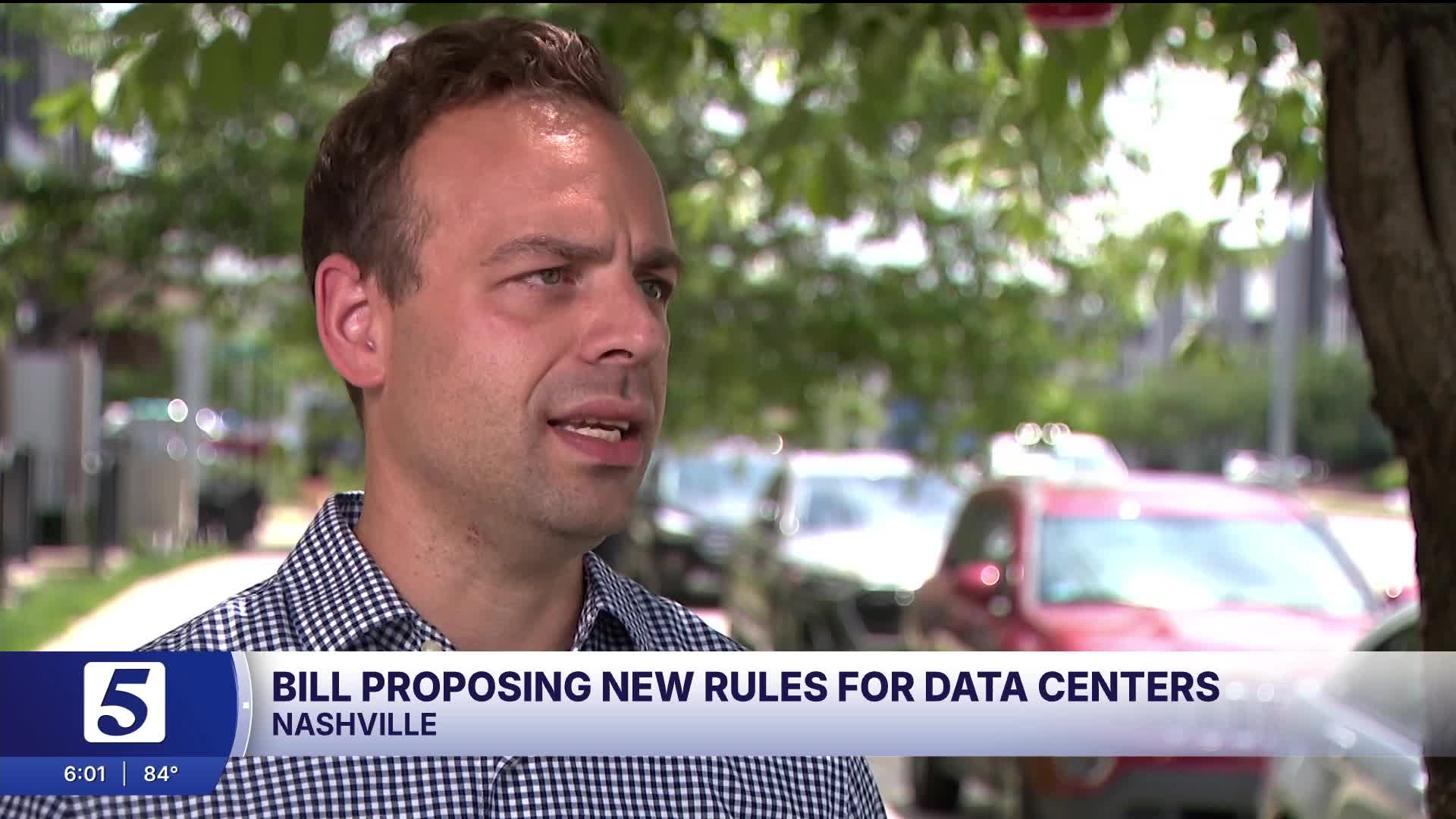


NASHVILLE, Tenn. (WTVF) — A Metro Council member wants to get ahead of data center development by setting rules on size, location, and water use before more facilities arrive in Nashville.
District 20 Council Member Rollin Horton is pushing for new zoning restrictions that would regulate where data centers can be built and how they operate across Davidson County, including one planned for Fisk University.
Horton said the proposal comes after he discovered the city has no existing rules governing data center development.
"I looked to see what types of regulations we had in place in Nashville, and the answer was none," Horton said.
Under the proposal, data centers would be categorized as small, medium, and large, with restrictions tied to zoning districts and proximity to neighborhoods, schools, daycares, parks, and the zoo.
"Large data centers, more than 500,000 square feet — roughly the size of 9 football fields — these hyperscale data centers going up across the country, including in Memphis, those are banned in Nashville if this legislation passes," Horton explained.
The bill would also require data centers to use closed-loop cooling systems.
"So they're not continually drawing more water out of the system and dumping polluted water into the community, but has to use a contained system on sight," Horton said.
Tennessee is home to 61 data centers, according to Data Center Map. Data centers help power web applications, cloud services, and artificial intelligence.
MTSU economics professor Dan J Smith said data center development can create major economic opportunities, but acknowledged the tension communities face.
"Everyone is for something, but we just don't want it in my backyard," Smith said.
Smith said delaying the technology carries its own risks.
"If across America we delay this technology, it's going to set us back compared to other nations, so we need to embrace it, but the problem is no one wants it in their backyard," Smith said.
Smith said it will be up to city leaders to balance economic growth with neighborhood concerns.
Horton said his proposal is designed to do exactly that.
"This legislation provides the opportunity for communities to be informed about a proposed data center as well as provide input to make sure any proposed data center is what they want for themselves," Horton said.
More than a dozen council members have signed on as co-sponsors of the bill. A first reading is set for Tuesday, June 2.
This story was reported on-air by a journalist and has been converted to this platform with the assistance of AI. Our editorial team verifies all reporting on all platforms for fairness and accuracy.

September 11, 2001 is a day most associate with terror and tragedy. Austin Pollack shares a story from that day about hope and persistence: the effort to save a little girl’s life – with an organ donation. The problem? The young patient was in Houston, and her life-saving liver here in Nashville. With the grounding of all civilian aircraft, how could it be done? “Nobody ever said this isn’t possible.”
- Rhori Johnston