


COLUMBIA, Tenn. (WTVF) — Concerns rise with report of 70% failure rate for HVAC inspections pt. 2 (pt. 1 follows below)
A NewsChannel5 investigation has uncovered problems with HVAC inspections in a Columbia neighborhood, where 70% of homes that underwent state re-inspections have failed safety checks.
The investigation began after resident Joshua Moore raised concerns about potential fire risks in his Taylor Landing neighborhood, even before neighbor Chrissy Wiley's home caught fire in December.
Moore said he discovered that about a third of the homes in his neighborhood lack records showing they received final HVAC inspections. When he brought these concerns to the state Fire Marshal's office, they responded by offering voluntary electrical safety inspections for all homes — months before Wiley's family lost everything in the fire.

Data obtained from the state fire marshal's office reveals troubling statistics for the 299-home Taylor Landing neighborhood. Of the 88 homes that have undergone state re-inspections, only 26 passed. The remaining 62 failed, representing a 70% failure rate.
The state says the most common deficiencies found in the failed homes are the kilowatt rating not being marked as required, preventing the State Fire Marshal's Office from verifying wire size, and overfusing of the condenser.
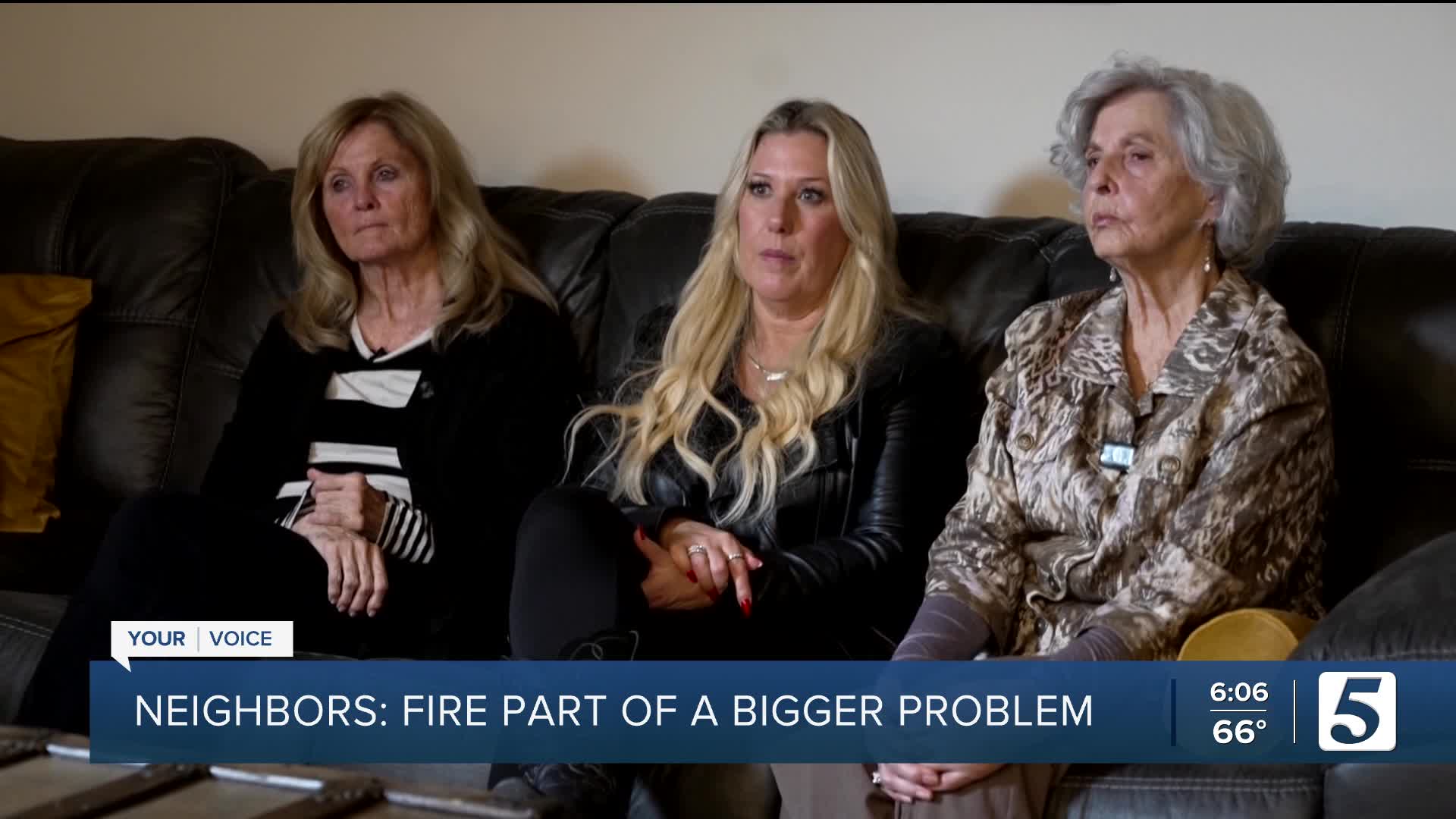
Among those that failed was the house next to Wiley's burned home, belonging to 81-year-old Georgia McCaleb.
"Called the state, and they came out, and mine failed," McCaleb said.
She was told her disconnect box was completely melted and ready to catch fire.
Residents Christy Daus and Pat Sawatzki also experienced failures during their inspections.
"When the inspector came out, he said that the unit was not properly stickered, and in addition, the ampage on the breaker was incorrect," Daus said.
"Mine was kind of that way. It wasn't labeled correctly, I mean, at all. So we know that it didn't pass," Sawatzki said.
Permit records show some homes passed electrical inspections without first passing required final HVAC inspections, violating the state's own guidelines.
"140 homes had their HVAC inspected after the final electrical was passed. That's not supposed to be possible, but that was possible, and because of that practice that enabled 90 homes to be missed," Moore said.
Adding to the concerns, some homes that passed their original HVAC inspections in 2021 failed the recent re-inspections.


Moore said he believes these problems occurred because inspections were conducted separately rather than together.
"When they ordered their state electrical inspections, they split the standard electrical from the HVAC so there so all the standard electrical was on one permit, and then the HVAC was on another permit," Moore said.
The state says the builder is responsible for ensuring contractors request all necessary inspections to meet code requirements. In this case, that builder is Meritage Homes.
Residents worry about the potentially dangerous implications of these inspection gaps.
"Possible life-threatening issues, you know, with structure fires and neighboring walls and smoke inhalation, I mean, that's that's not something that a new homeowner should have to deal with," Daus said.
NewsChannel 5 has contacted Meritage Homes three times since December 19, emailing their operations coordinator, Vice President of Land Development, and a legal representative. As of this publication, the station has not received a response.
The State Fire Marshal's Office confirmed it conducts all electrical inspections in the City of Columbia, including HVAC-related electrical inspections if requested by contractors or builders through the state's permitting system. By policy, these HVAC electrical inspections are part of the process for final electrical approval, and the State says it would not pass a final electrical unless the HVAC electrical inspection had been completed.
State officials clarified their HVAC inspections do not cover the mechanical unit itself — only the wiring from the HVAC unit to the home.
The City of Columbia says it handles mechanical inspections of HVAC systems under its building codes but does not inspect any electrical wiring or breaker components. At the time Taylor Landing was built, the City says it verified electrical approval by looking for a pass sticker placed on the home's meter base — but that visual check would not have revealed if a separate HVAC electrical inspection was skipped.
City officials say they now require contractors to provide digital copies of all State electrical finals, including HVAC electrical permits, before the City schedules its own final building inspection. That change comes with the State's online inspection records system.
PART 1:
A devastating house fire that destroyed a Columbia family's home during the holiday season has validated what one neighbor had already discovered could be a widespread safety problem affecting dozens of homes in the Taylor Landing subdivision.
Kristen 'Chrissy' Wiley and her family lost everything when their rental house on Holland Court caught fire on December 14, 2025.
"Just seeing everything go up in smoke is something you don't want to experience," Wiley said.
Fire investigators determined the blaze started in the attic from "an arc or spark from operating equipment."
NewsChannel5 has reached out to the City of Columbia asking for clarification on which operating equipment they are referring to in the report but has not received a response.
Joshua Moore, an engineer who lives in the neighborhood, had been researching HVAC equipment issues since February 2025, nearly 10 months before Wiley's fire occurred. Through his neighborhood Facebook group, Moore discovered that residents had been reporting burnt disconnect boxes.
"I started searching our Facebook group, our neighbors Facebook group, and discovered that people have been reporting these burnt disconnect boxes for the last two or three years," Moore said.
Moore found more than 16 neighbors who reported melted disconnect boxes, with some even catching fire.
"I could see that there were two or three of these incidents where people have these attic fires every year, nothing was being done about it, and it was an obvious pattern," Moore said.
Moore had taken these concerns to Columbia's fire marshal in February 2025, who told him in an email on February 28, 2025, that he would pass the information to the state fire marshal's office. However, Moore says many of these incidents were difficult to verify because most neighbors handled the issues themselves without calling the fire department.
"They couldn't verify that what I was telling them, because there were no fire marshal calls," Moore said.

Moore's investigation led him to search the state's HVAC and Electrical inspections database for all 299 homes in Taylor Landing, where he made a concerning discovery: many homes, including what would later be Wiley's fire-damaged rental, were missing final HVAC inspections.
"The state could not produce the inspection records for 1/3 of the homes for HVAC. And that's very concerning," Moore said. "Because if 1/3 of the homes aren't inspected for HVAC, then you could have 1/3 of the homes that are a fire hazard and that could catch on fire, just like Chrissy Wiley's home did."
Specifically, Moore found that 90 of the 299 homes in the neighborhood were missing documentation of their final HVAC inspections.
Moore used the state's Electrical Permits & Inspections Search Tool, an online database available to the public. For homes where he couldn't find permits, he filed a public records request.
This data was compiled by Joshua Moore after searching the state's HVAC and Electrical Inspections database, detailing homes in the Taylor Landing neighborhood that he says were missing a final HVAC inspection. NewsChannel 5 removed address numbers and other personal identifying information from this document to protect the privacy of those neighbors.


NewsChannel 5 made the same request to the State Fire Marshal's office.
When Wiley's fire occurred on December 14, 2025, it intensified Moore's fears about the potential dangers.
"I think that there are fire hazards in some of these homes that maybe still haven't been caught, because not all the homes have been inspected yet," Moore said.
On December 16, 2025, the day after Wiley's story aired, four residents from the same neighborhood emailed NewsChannel 5 with similar safety concerns, validating Moore's earlier research.
A spokesperson for the State Fire Marshal’s Office clarified that the City of Columbia is an exempt residential jurisdiction and is responsible for conducting residential mechanical building inspections and issuing Certificates of Occupancy. The State of Tennessee is the authority having jurisdiction to conduct electrical inspections — including HVAC-related electrical inspections — as requested by contractors and builders for permits purchased through the SFMO website.
The spokesperson confirmed that in new residential construction, an HVAC inspection is part of the SFMO’s electrical program and must be completed before a final electrical pass/fail is issued.
The State Fire Marshal’s Office said it does not inspect the HVAC units themselves; rather, it inspects only the wiring from the HVAC units to the homes.
According to the SFMO, it remains the City of Columbia’s responsibility under Municipal Code 12‑105 to ensure all required inspections — including the State‑run electrical inspections — are completed before a Certificate of Occupancy is granted.
Columbia Mayor Chaz Molder responded to the residents' concerns in this statement to NewsChannel 5:
"As a result of recent complaints by residents of the Taylor's Landing subdivision, the City of Columbia participated in an audit by the State Fire Marshal's Office which found no deficiencies in the inspection program and process, and in fact, the audit resulted in complimentary remarks of our processes and procedures," Molder said. "The City of Columbia has no record of missing inspections for Columbia permits for these homes or any homes that have been issued Certificates of Occupancy. I understand certain residents of this subdivision may be unhappy with the developer relative to certain deficiencies which may have resulted post-inspection and post moving in to their home, and I would encourage those homeowners and the developer to come together to resolve the issues, at least to understand both sides' position. However, any deficiencies which may have arisen upon move-in do not relate to the permitting or minimum requirements to pass inspection and obtain Certificates of Occupancy."
The investigation continues as multiple parties including the state, the city, the builder Meritage Homes, and the contractors are involved in the inspection process, making it difficult to identify any responsibility for any of the issues.
Do you have more information about this story? You can email me at Patsy.Montesinos@Newschannel5.com

September 11, 2001 is a day most associate with terror and tragedy. Austin Pollack shares a story from that day about hope and persistence: the effort to save a little girl’s life – with an organ donation. The problem? The young patient was in Houston, and her life-saving liver here in Nashville. With the grounding of all civilian aircraft, how could it be done? “Nobody ever said this isn’t possible.”
- Rhori Johnston