
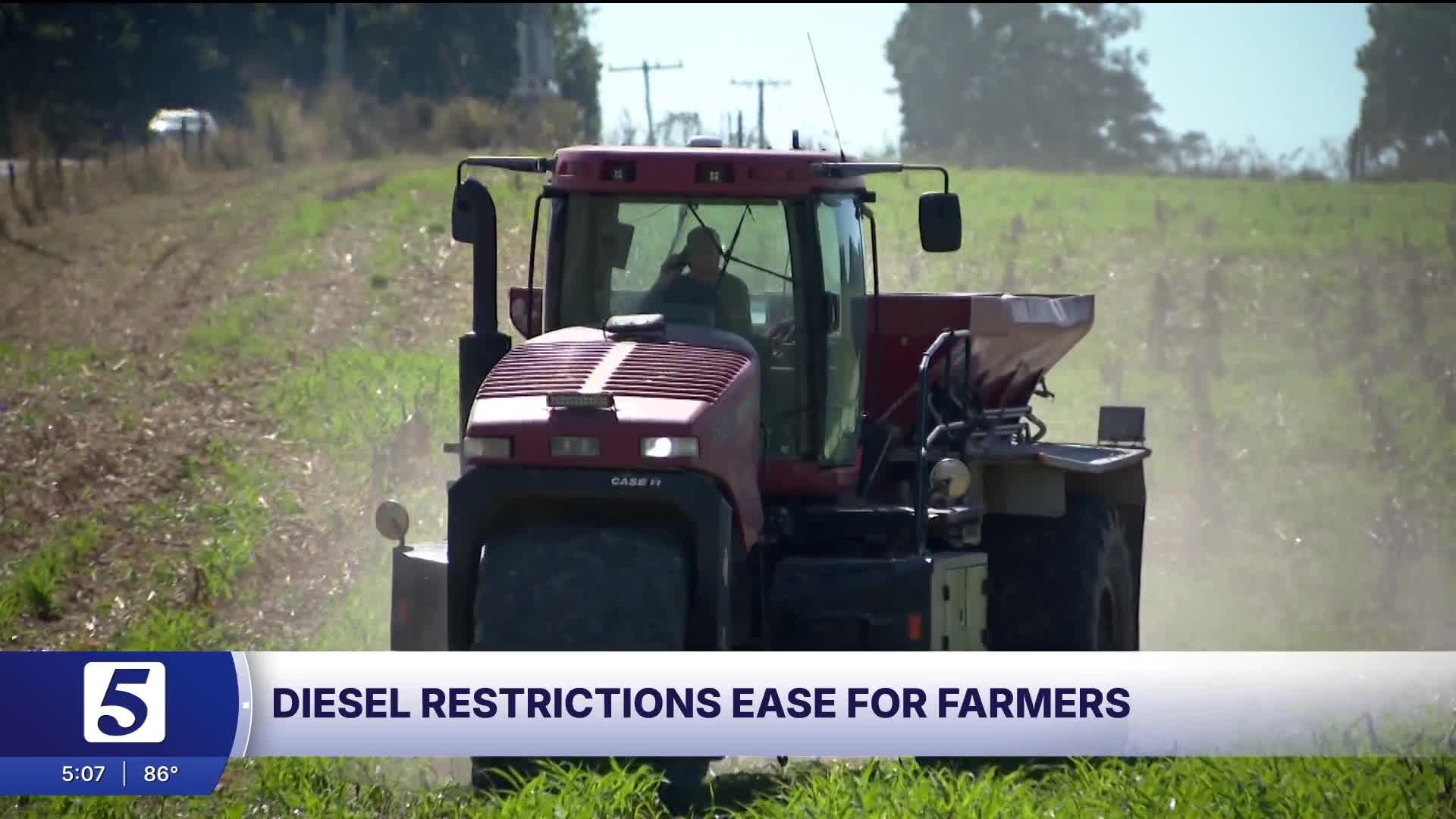


ROBERTSON COUNTY, Tenn. (WTVF) — Farming is a family tradition for Bill Pearson.
"My grandfather lived in the house on top of the hill," Pearson said. "Then my dad lives a couple miles down the road and my uncle a few miles also."
The Robertson County farmer said he's a seventh-generation farmer, continuing a legacy that stretches back generations.
While farming has always come with challenges, this year's soaring fuel prices have created a new obstacle.
"We're 77% higher than last year," Pearson said. "There's always challenges that come up and we have to deal with it, but this is something different here."
Some temporary changes announced by President Donald Trump and Tennessee Gov. Bill Lee are designed to help.
Traditionally, farmers receive a lower tax rate on diesel fuel used in tractors and other equipment operated on the farm.
However, when they buy diesel that’s used in trucks traveling on public roads, farmers are typically required to pay standard taxes for the fuel they use.
Under the temporary policy change, farmers will be allowed to use lower-taxed agricultural diesel fuel for a wider variety of purposes, effectively expanding an existing fuel tax break.
The fuel, commonly known as "red dyed diesel," is dyed red so regulators can track how it is being used.
Pearson said the change could save him about 51 cents per gallon when hauling crops after harvest.
"We're going to have all this product in the grain vans that we'll have to get to the facilities where they're going to actually be going to the end user," Pearson said. "So that's where this will benefit us the most."
Even with those savings, Pearson said the tax break won't erase the financial strain caused by higher diesel prices, but it’s a help.
"It's something… It's not going to completely eliminate it because it doesn't make the price of diesel cost less," he said. "It just reduces the tax on it."
The temporary change could provide meaningful savings for farmers during one of the busiest parts of the year, but questions remain about how the policy will work in practice.
There are still logistical details that need to be addressed, including how enforcement will be handled by regulators, whether some taxes may need to be paid later, and how long the red dye remains in vehicle fuel systems once the temporary program ends.
Click here for information about the executive order signed by President Trump.
With so many details yet to be determined, NATSO, a trade group representing truck stops, and SIGMA, whose members are fuel marketers, released the following guidelines to their members.
Trump Executive Order on Dyed Diesel
Last night, President Trump signed an executive order on Emergency Tax Relief on Diesel Fuel. The executive order stipulates the following for dyed diesel sold or used on highways from Oct. 5 through Dec. 31:
Waives Penalties — In normal times, when dyed diesel is placed in highway vehicles, not only is a tax owed for that fuel, but there is an additional penalty for using the dyed fuel in this unlawful way. The executive order waives those penalties for both selling and using dyed diesel in highway vehicles.
Defers (but does not waive) the excise tax — The executive order says the Administration intends to delay the federal excise tax owed when dyed diesel is used on the highway until after this year. But it does not waive those payment obligations at the future date when they come due (to be clarified in future guidance). Although the president is empowered to delay collection of the tax in times of emergency, it requires an act of Congress to waive or otherwise change the excise tax scheme. Congress is highly unlikely to do this. Waiving the deferred tax would require Congress to replace the lost Highway Trust Fund revenue, and no offsetting revenue-raiser has been publicly discussed. The executive order does say the Trump Administration will “explore avenues, including legislation, to eliminate the obligation," though we do not believe those avenues are likely to be viable.
Encouraging States to Follow Suit — The executive order directs the White House and USDA to encourage states to adopt matching relief. At least ten states have already acted, for periods of one to four months, but the relief varies: Some have suspended state fuel taxes outright, while others have only waived penalties for using dyed diesel on highways.
The executive order is mainly a farm-hauling measure. It lets agriculture and other related businesses with their own bulk dyed storage put that fuel into trucks and haul commodities or equipment during harvest. This will be particularly impactful in states that have also waived their own penalties (though, like the President’s executive order, most states aren’t waiving the tax obligation, but rather waiving penalties for using dyed diesel on the highway).
The White House appears to be trying to encourage the supply chain to move toward selling dyed fuel in non-traditional ways. We do not expect most reputable diesel retailers and fuel marketers to do this. First, the tax is still owed, so there’s limited upside to selling dyed fuel into highway vehicles in order to defer a tax bill that will come due unless Congress acts. Second, the logistical challenges outweigh any visible upside: Residual dye lingers in tanks and fuel systems. Even trace amounts in clear diesel can bring IRS and state penalties outside the waiver window or in states that haven’t undertaken their own penalty waivers.
Selling dyed fuel at scale requires dedicated equipment and enough dyed supply at the rack. Neither marketers nor commercial trucking companies are eager for the supply chain to reconfigure itself in order to accomplish this. Truck drivers travel through multiple states in a given day; untaxed fuel purchased in one state doesn’t mean the driver can avoid liability in states that do not waive enforcement. Ultimately, for most marketers, the liability and customer risk outweigh any temporary, uncertain benefit. It’s a lot of risk for compliance departments to absorb over the potential for a $0.24 deferral on diesel that is retailing for more than $6.00 per gallon in many parts of the country.
Do you have more information about this story? You can email me at robb.coles@newschannel5.com.

September 11, 2001 is a day most associate with terror and tragedy. Austin Pollack shares a story from that day about hope and persistence: the effort to save a little girl’s life – with an organ donation. The problem? The young patient was in Houston, and her life-saving liver here in Nashville. With the grounding of all civilian aircraft, how could it be done? “Nobody ever said this isn’t possible.”
- Rhori Johnston