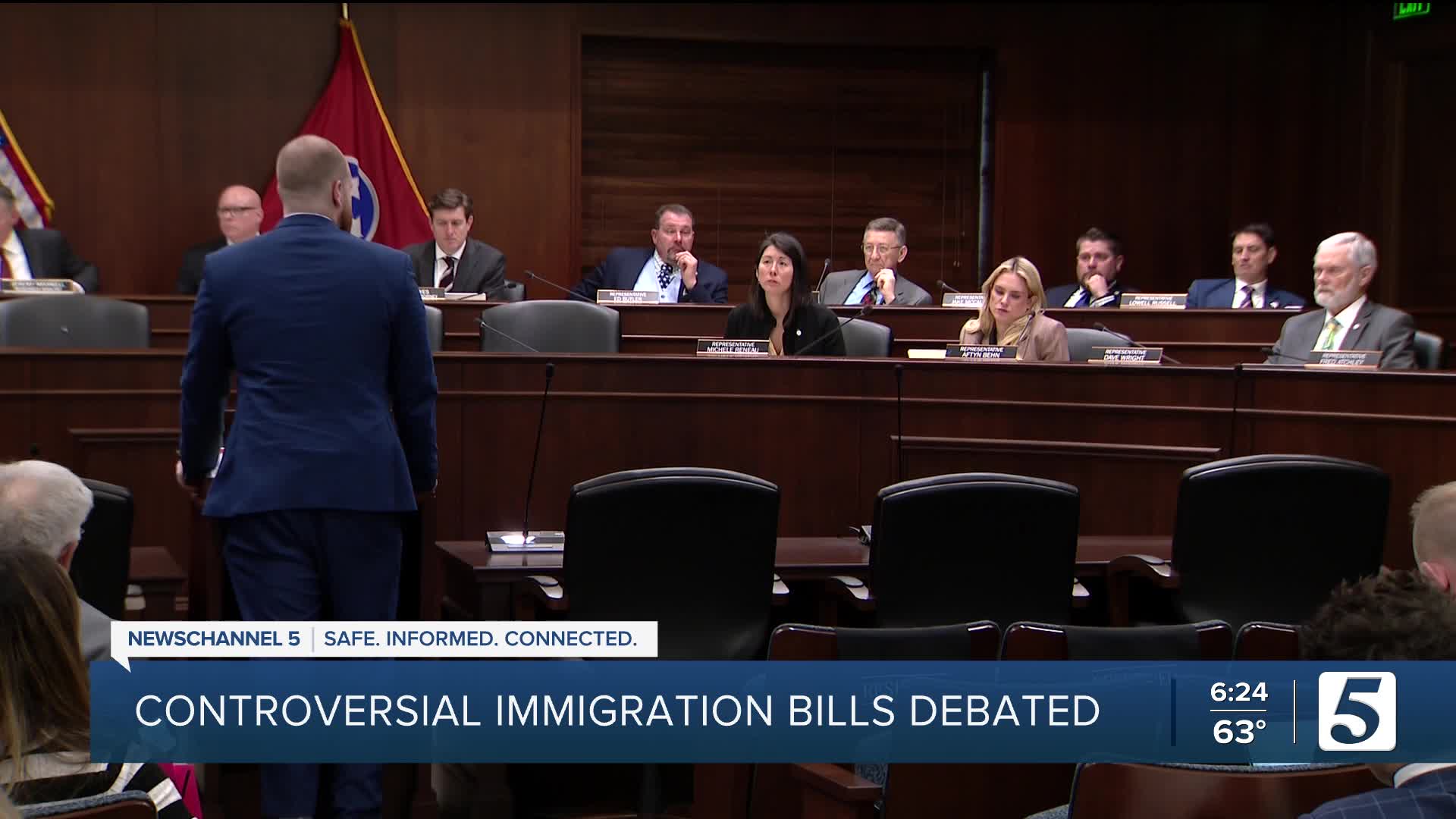


NASHVILLE, Tenn. (WTVF) — Three controversial immigration bills advanced through Tennessee House subcommittees today along party lines, marking the first time these bills have been debated. They're a part on a larger legislative package of nine Republican-sponsored immigration measures crafted with input from the Trump Administration.
The bills would significantly impact how undocumented immigrants access public services and obtain driving privileges in Tennessee.
Reporting requirements for public entities
House Bill 1711 would require public entities, including school districts, colleges, prisons, social services and healthcare providers to report the number of undocumented immigrants using their services to the state. The legislation also mandates reporting individuals to ICE if they broke any laws. "It's a reporting bill, so all we're looking at is numbers, so we can determine how our dollars are being spent," State Rep. Elaine Davis, R-Knoxville, said during subcommittee debate.
Democratic lawmakers raised concerns about the potential consequences of the reporting requirements. "This is my fear -- that people would die after injury because they're afraid to go to our hospitals, and we don't want to create a state where people are worried to receive the services we provide for everyone," State Rep. Jesse Chism (D-Memphis) said.
Davis defended the measure, arguing it addresses misuse of taxpayer resources. "If people are here taking advantage of services and dollars we have specifically set aside for our citizens, for our communities, that to me is a violation of our laws," Davis said.
The committee proceedings were briefly interrupted by protesters singing before they were removed by the sergeant-at-arms.
Commercial driving restrictions
A second bill, House Bill 1706, would make it illegal for undocumented immigrants to operate commercial vehicles and would allow people to sue if an undocumented driver caused an accident. "It ensures in code that it is illegal with an illegal with a [Commercial Driver's License,]" Rep. Jason Zachary said.
State Rep. Aftyn Behn criticized the measure, arguing it targets immigration status rather than driving safety. "If someone has met federal safety standards, has passed CDL exams, is operating safely, then the conduct we're criminalizing is not unsafe driving, it's immigration status," Behn said.
Driving test language restrictions
The third bill, House Bill 1708, would significantly change the state's driving test requirements. People who cannot understand English would receive only one opportunity to take a driving test in their native language, but would receive a restricted license allowing travel only to work, school or the hospital. The restricted license would expire after one year.
To obtain an unrestricted license, drivers would need to pass the test in English without assistance. "Driving is a privilege, not a right. You have to earn the privilege to drive in the state of Tennessee," Rep. Kip Capley said.
Capley defended the English requirement. "All of our signs are in English, all of our traffic commands are given in English. If the THP pulls you over, guess what he's speaking? English," Capley said.
Behn expressed frustration with the legislation's focus on immigrant families."This continues to be an abhorrent use of our time to be castigating immigrant families who are just trying to participate in our economies and go to work and care for their kids, just like you and the rest of us in this building," Behn said.
All three bills advanced along party lines and will move forward in the legislative process.
Other Immigration Bills under consideration
House Bill 1704 would make it a state-level offense if someone received a "valid final" deportation order and remained in Tennessee. This bill also hopes to directly challenge the Supreme Court decision Arizona vs. United States, which sets barriers to how extensively states can prosecute illegal immigration cases.
House Bill 1705 requires state and local governments to use the E-Verify program for every hire. Governments that don't comply could lose all their state funding, including sales tax revenues.
House Bill 1707 speeds up how quickly local governments must comply with court orders dealing with immigration enforcement.
House Bill 1709 deals with state professional licenses across numerous industries, from practicing law as an attorney to working as an aeronautics instructor. This also includes dentists, social workers, insurance agents, nurses and other professions that would now have to have their legal status checked before submitting applications.
House Bill 1710 requires local governments to check the legal status of those receiving SNAP benefits or public housing. Local governments that don't cooperate could lose all their state funding. "At the end of the day, taxpayer money should go to those who are here legally and lawfully, period," Sexton said.
There is a ninth bill in the immigration package, but it's not new. It's a controversial bill from 2025 that requires school districts to verify a child's legal status, and if they're considered unlawfully present, their parents would have to pay tuition.
The Senate passed its own version of the bill last session, but talks stalled in the House when uncertainty arose over whether the law could jeopardize $1 billion of Tennessee's federal education funding.
Do you have more information about this story? You can email me at Chris.Davis@NewsChannel5.com.

September 11, 2001 is a day most associate with terror and tragedy. Austin Pollack shares a story from that day about hope and persistence: the effort to save a little girl’s life – with an organ donation. The problem? The young patient was in Houston, and her life-saving liver here in Nashville. With the grounding of all civilian aircraft, how could it be done? “Nobody ever said this isn’t possible.”
- Rhori Johnston