
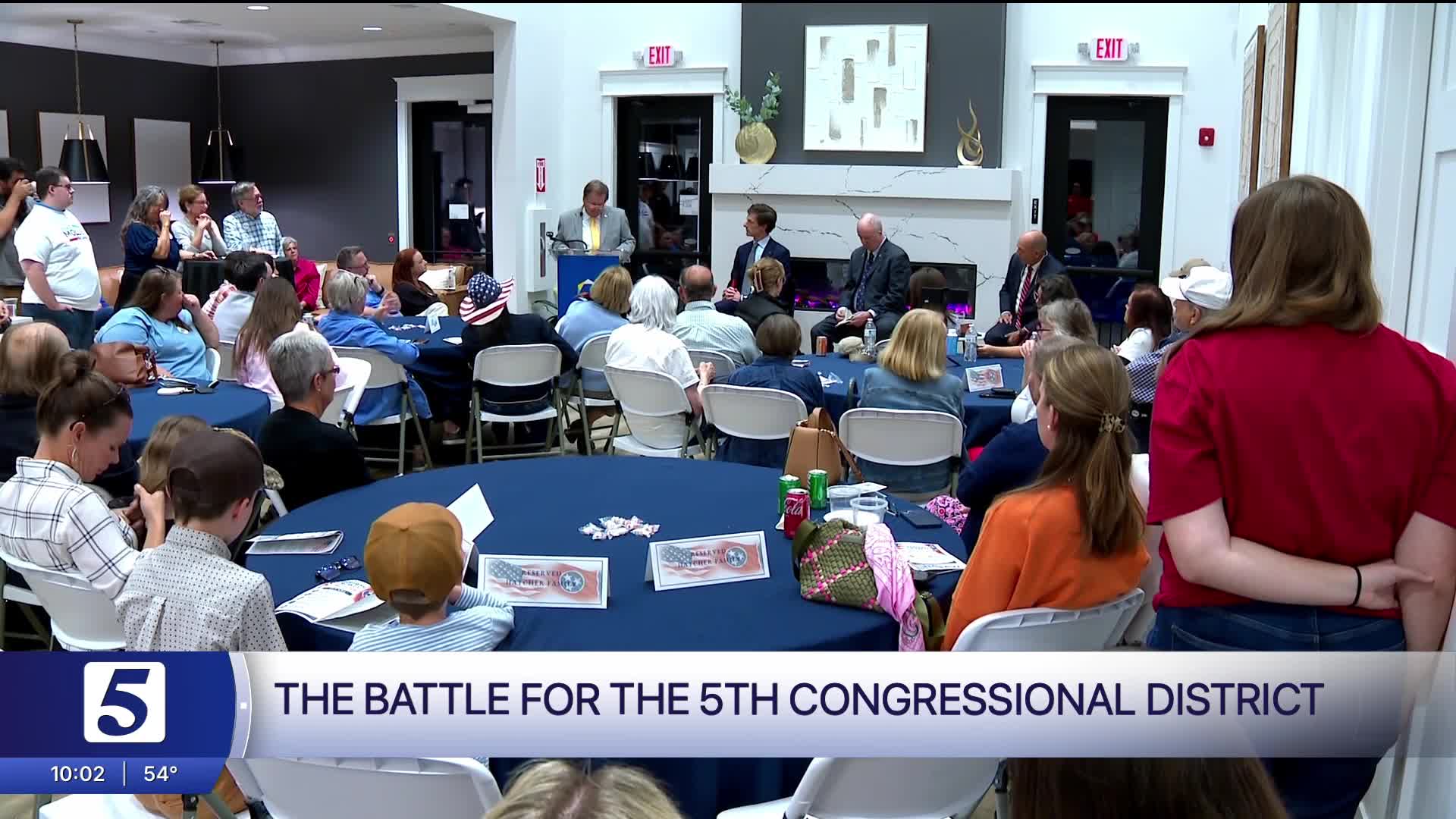


SPRING HILL, Tenn. (WTVF) — Three candidates seeking to represent Tennessee’s newly redrawn 5th Congressional District made their case directly to voters Wednesday night, outlining different approaches to the cost of living, tariffs, infrastructure and how they would represent a district stretching across Middle and West Tennessee.
Republican Charlie Hatcher, Democrat Chaz Molder and independent Micheál O’Leary appeared together at a candidate forum in Spring Hill. Hatcher is a former Tennessee agriculture commissioner and dairy farmer, Molder is the mayor of Columbia, and O’Leary is an Irish-born businessman and former local elected official in California.
A fourth candidate, independent James Johnson, is also on the Nov. 3 ballot but did not participate in Wednesday night’s forum.
Cost of living among top priorities
When asked what they would prioritize in Congress, Hatcher and Molder both pointed to the cost of living but offered different approaches. O’Leary focused instead on how he would operate in Congress as an independent.
“The number one priority would be cost of living,” Hatcher said.
Hatcher pointed to rising costs at his family’s dairy farm, saying production expenses have increased since the COVID-19 pandemic. He said his longer-term approach would include increasing American energy production and refining capacity.
Molder also identified affordability as an immediate priority.
“What I want to get to work immediately on is working to reduce the cost of living,” Molder said. He told voters that he regularly hears from people whose costs continue to rise and who are struggling to keep up.
Molder said getting rid of tariffs would be part of his approach, arguing tariffs are taking money out of consumers’ wallets.
O’Leary used the question to emphasize his independence from both major parties.
“As an independent, I will have that independent voice,” O’Leary said. He argued that not being tied to party leadership would allow him to make decisions based on the district rather than instructions from Republican or Democratic leaders.
Candidates differ on tariffs
Tariffs produced some of the clearest policy differences among the candidates.
Hatcher defended the strategic use of tariffs, arguing they can protect American industries and help bring other countries to the negotiating table. He also acknowledged that farmers can be among the first to feel their effects.
“Tariffs are a tool; they can be used effectively, sometimes badly,” Hatcher said.
He pointed to agriculture and steel as examples of industries where he believes tariffs can be used to support American producers.
Molder took a more critical position.
“They are wrong, and they are at the wrong time. It’s causing costs to go up at a time when people are hurting,” Molder said.
Molder also argued tariffs create uncertainty for businesses and that the additional costs can ultimately be passed on to consumers.
O’Leary described tariffs as a tool intended to encourage manufacturers to bring production back to the United States, but argued that consumers ultimately bear much of the cost.
“We pay the brunt of it,” O’Leary said. He said manufacturers generally do not absorb the entire additional cost of tariffs and instead pass some of that cost on through higher prices.
Growth and infrastructure
The candidates also addressed how growing communities can handle increased demands on roads, water and wastewater infrastructure.
Hatcher pointed to water concerns in Columbia, wastewater capacity in Spring Hill and traffic across Middle Tennessee. He said infrastructure projects should be prioritized based on how many people they affect and their overall value, with coordination among local, state and federal governments.
Molder drew from his experience as Columbia mayor, discussing the city’s wastewater infrastructure and the methods used to pay for expanding capacity.
“We relied on impact fees so that growth can pay for growth instead of burdening our current residents who are already here with those costs,” Molder said.
He also pointed to state low-interest loans and federal assistance as other sources used for the project.
O’Leary focused on data centers and their potential impact on local water, electricity and utility rates. He said communities need to balance economic investment with how new development may affect costs for existing residents.
How would they serve such a large district?
The candidates were also asked how voters should measure their effectiveness if elected.
The newly redrawn 5th District no longer includes Nashville and stretches from Williamson and Maury counties through rural portions of West Tennessee and into part of Memphis.
Hatcher said constituent services would be a major focus of his office and suggested the size of the district could require about three field offices.
“You need to have regular meetings with all stakeholders, from lawmakers to business leaders, to chambers, regular communication, because that’s going to be a key litmus test,” Hatcher said.
Molder similarly called constituent services a top priority. He said representing the district would require traveling throughout Middle and West Tennessee and making his congressional office accessible to residents.
“And constituent services has got to be the number one priority,” Molder said. “I wanna make sure our office has hours available for folks to be able to come talk about their needs and on how the congressman can help them on a daily basis.”
O’Leary said voters should judge him by his record in Congress. He said that when facing an issue where he was unsure how people in the district felt, he would return to voters through town halls.
“I’m running to represent you. You are going to be grading my report card,” O’Leary said.
Other issues discussed
The forum also included questions about technical education, workforce development and the role of the federal government in supporting local communities.
Hatcher pointed to Tennessee’s investments in technical education and said he supports using federal funding to build on career and technical training programs. He also highlighted agriculture and forestry as industries that need trained workers.
Molder emphasized community colleges and technical education, saying students should know there are career opportunities that do not require a four-year degree. He said he would support bringing federal funding back to community colleges and technical-training facilities.
O’Leary argued the pipeline into skilled trades needs to be strengthened. He also connected workforce shortages to immigration policy and proposed using targeted temporary visas to help fill jobs.
Molder also raised healthcare during the forum, saying he supports rural hospitals and arguing that access to healthcare should not depend on where someone lives.
Throughout the night, all three candidates emphasized different approaches to moving beyond partisan politics. Molder described himself as an “independent-minded voice,” O’Leary emphasized that he would not answer to a party whip, and Hatcher said he would collaborate and reach across the aisle without compromising his values.
Early voting continues through Thursday, Oct. 29. Election Day is Tuesday, Nov. 3.
Do you have more information about this story? You can email me at Patsy.Montesino@NewsChannel5.com

September 11, 2001 is a day most associate with terror and tragedy. Austin Pollack shares a story from that day about hope and persistence: the effort to save a little girl’s life – with an organ donation. The problem? The young patient was in Houston, and her life-saving liver here in Nashville. With the grounding of all civilian aircraft, how could it be done? “Nobody ever said this isn’t possible.”
- Rhori Johnston