

NASHVILLE, Tenn. (WTVF) — More and more of us are turning to artificial intelligence for medical advice.
A recent poll from the Kaiser Family Foundation reveals that about 1/3 of adults in the United States have used a chatbot to learn about their health.
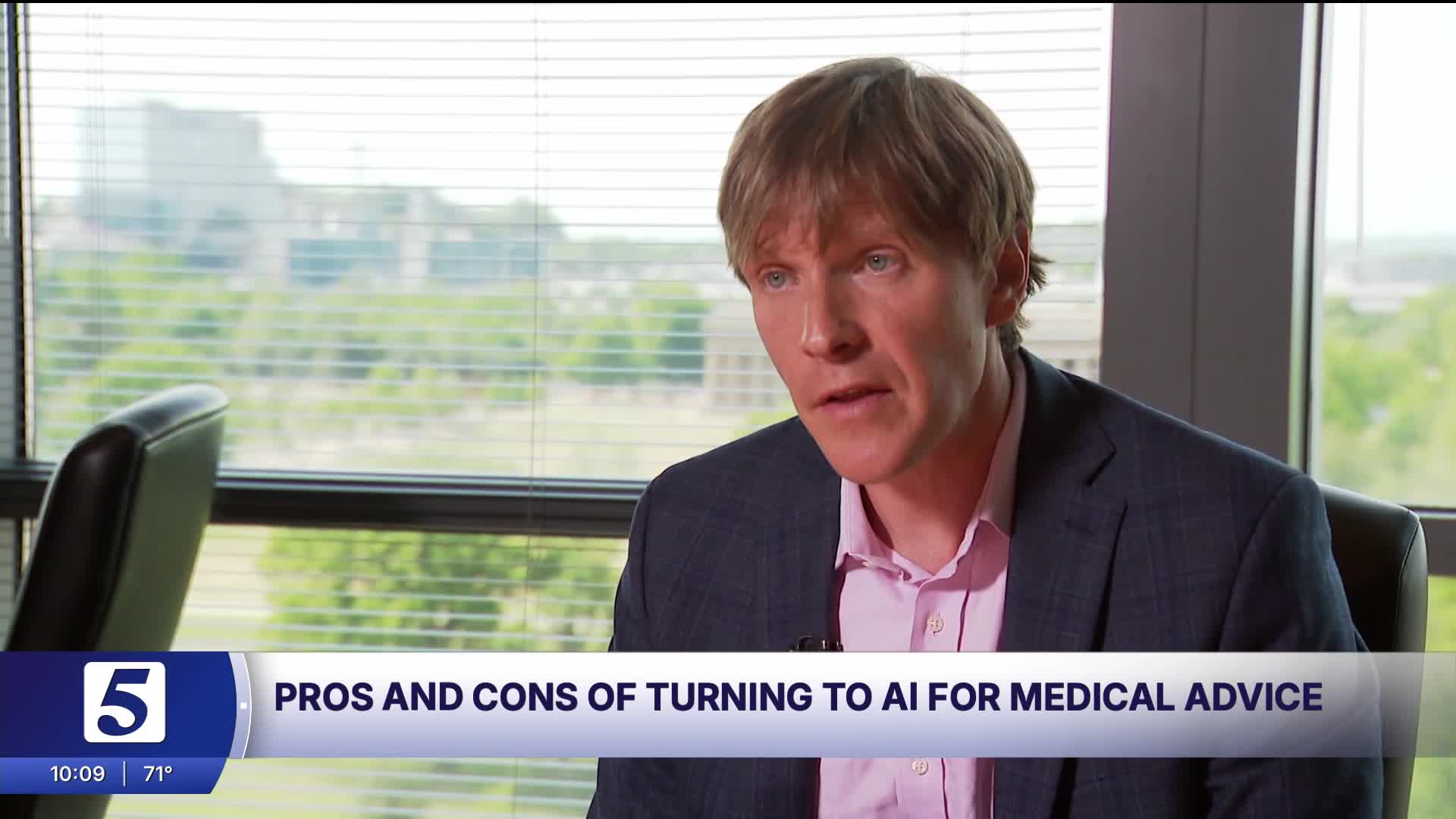
Dr. Colin Walsh is an associate professor of biomedical informatics, medicine & psychiatry at Vanderbilt University Medical Center, as well as a primary care physician.
He studies how technology interacts with health and confirmed that a growing number of users are turning to AI for medical advice.
"There are ways in which it's a benefit, and there are ways in which it might worry me," he started.
"I think it's absolutely reasonable for people to want to reach out to get the best tools at their fingertips, to learn more about their own health, but just to remember that those tools are very powerful, and sometimes they're powerful in ways that can be misleading."
Pooling decades of knowledge in seconds, Dr. Walsh says tools like ChatGPT can be a good starting point — with several caveats.
Primarily, AI follows your lead. How you ask a question can lead to a specific kind of answer.
"The way we ask it, and if we're excited about what it's saying and we're positive...if we're more negative about what it's saying, it's gonna read that, and those answers [are] gonna change," explained Dr. Walsh.
AI can also oversimplify. While it makes its best guess, it doesn't have your medical history, and it can't assess your symptoms in person.
"Think of these tools like a medical librarian that's read every medical textbook but has never actually seen a patient," said Dr. Walsh.
Wednesday afternoon, we tried our hand at AI's medical advice together, first running the program through a common cold scenario and asking what to do. It turns out ChatGPT can be pretty good at identifying a virus like this one.
"For the common cold, which is, by its name, common, this kind of common advice could be useful," said Dr. Walsh.
When we asked about a more dangerous symptom — chest pain — Dr. Walsh said it succeeded in bringing up the most likely cases and advised the patient to see a doctor.
While AI could adequately give base-level advice, without personal context or follow-up with a professional, Dr. Walsh warned it may not tell the whole story.
"If these tools are leading someone to a diagnosis and that's it, they're satisfied, and they don't then reach out to verify that with a professional, that could put people at risk," he said.
The bigger picture? AI cannot replace a professional, especially when context is key or if you need immediate help. Dr. Walsh says that what it can be is a great learning tool.
"So be willing to dig and think and ask questions, and use it as an opportunity to really become more engaged in our own health," he suggested.
Dr. Walsh added that privacy may be at risk when you use an AI platform, as it often uses data to train other models. He advises you to consider what personal and medical information you share online because you may not know exactly where it could end up.
Do you have more information about this story? You can email me at nikki.hauser@newschannel5.com.

September 11, 2001 is a day most associate with terror and tragedy. Austin Pollack shares a story from that day about hope and persistence: the effort to save a little girl’s life – with an organ donation. The problem? The young patient was in Houston, and her life-saving liver here in Nashville. With the grounding of all civilian aircraft, how could it be done? “Nobody ever said this isn’t possible.”
- Rhori Johnston