

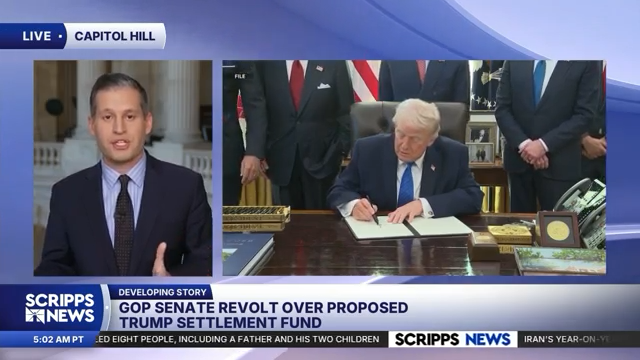


President Donald Trump is reconsidering whether to move forward with a $1.8 billion fund meant to compensate his allies, a person familiar with his thinking said Monday, as the Justice Department said it would temporarily pause its implementation to comply with a court order.
The potential retreat is a recognition of the legal setbacks the fund has encountered since it was announced two weeks ago as well as a mounting political backlash from Republicans concerned by a perceived lack of oversight of the money disbursement and the potential for payouts to participants in the Jan. 6, 2021, riot at the U.S. Capitol.
The Trump administration had defended the $1.776 billion "Anti-Weaponization Fund," established to resolve Trump's lawsuit against the Internal Revenue Service over the leak of his tax returns, as an appropriate corrective measure to make up for what officials insist was weaponized law enforcement during the Biden administration.
RELATED STORY | Judge temporarily blocks payouts from Trump's $1.8B 'anti-weaponization' settlement fund
Though some Trump supporters — including participants in the Capitol riot — celebrated the announcement of the fund, the reaction among Republicans in Congress has been decidedly more hostile. The fund was one of the issues the president spoke about with House Speaker Mike Johnson, whom he met with Monday, according to a person who was granted anonymity to discuss a private discussion.
On Monday, a person familiar with the matter who insisted on anonymity to discuss the president's thinking, said Trump was reconsidering whether to move forward with the fund. The Justice Department said separately that it would comply with a ruling by a federal judge in Virginia on Friday that halted plans for the fund pending additional arguments later this month, even as it noted that it "disagrees strongly" with that decision.
Lawmakers have raised concerns about the lack of oversight of the money and pushed the administration to either impose limits on the fund or scrap it altogether. It especially complicated matters in the Senate, where Republicans defiantly left town 10 days ago without passing legislation to fund Trump's immigration enforcement agencies.
Republicans who returned to Washington on Monday said they won't have the votes to pass the Homeland Security spending bill until the White House works with them to place parameters on the fund.
Senate Majority Leader John Thune indicated Monday that he hoped the White House would move to drop the fund.
"I do think the best way to handle it is if the administration decides to shut it down themselves," Thune told reporters.
Senators pressed acting Attorney General Todd Blanche over the fund at a closed-door gathering last month that Sen. Ted Cruz of Texas called one of "the roughest meetings I've seen in my entire time in the Senate."
The fund's future was called into question Friday by a pair of court rulings.
In Virginia, U.S. District Judge Leonie Brinkema temporarily halted its formation and scheduled a June 12 hearing for arguments on whether to extend her order barring the government from moving forward with the fund while pending litigation challenges it.
The Justice Department said Monday it would abide by the ruling but noted in a statement the "fund was open to anybody who was so weaponized, targeted, or persecuted, whether they were Democrat, Republican, Conservative, Independent, or otherwise."
Separately, the federal judge in Florida overseeing Trump's lawsuit against the IRS ordered Trump's attorneys to respond to "grievous allegations" by settlement critics that the president abandoned his claims to avoid the court's scrutiny of an illegal deal. U.S. District Judge Kathleen Williams gave them until June 12 to respond in writing to allegations of collusion and whether the case should be reopened because the court was the "victim of a fraud."
