

NASHVILLE, Tenn. (WTVF) — Donna Rowell doesn't go out much anymore. Life is low-key these days — mostly staying home with her husband and their dog, Loki. It's a quiet life, and an intentional one. Every dollar counts.
After being diagnosed with a slow-growing form of lymphoma that isn't easily cured, Rowell retired. She and her husband do everything they can to save money. But one bill keeps climbing no matter what they do.
Her health insurance.
Rowell pays $530 a month for coverage through the Affordable Care Act Marketplace. Her first year of coverage in 2023 cost just $41 a month.
"It's frustrating that our government has put a lot of people in this situation," Rowell said.
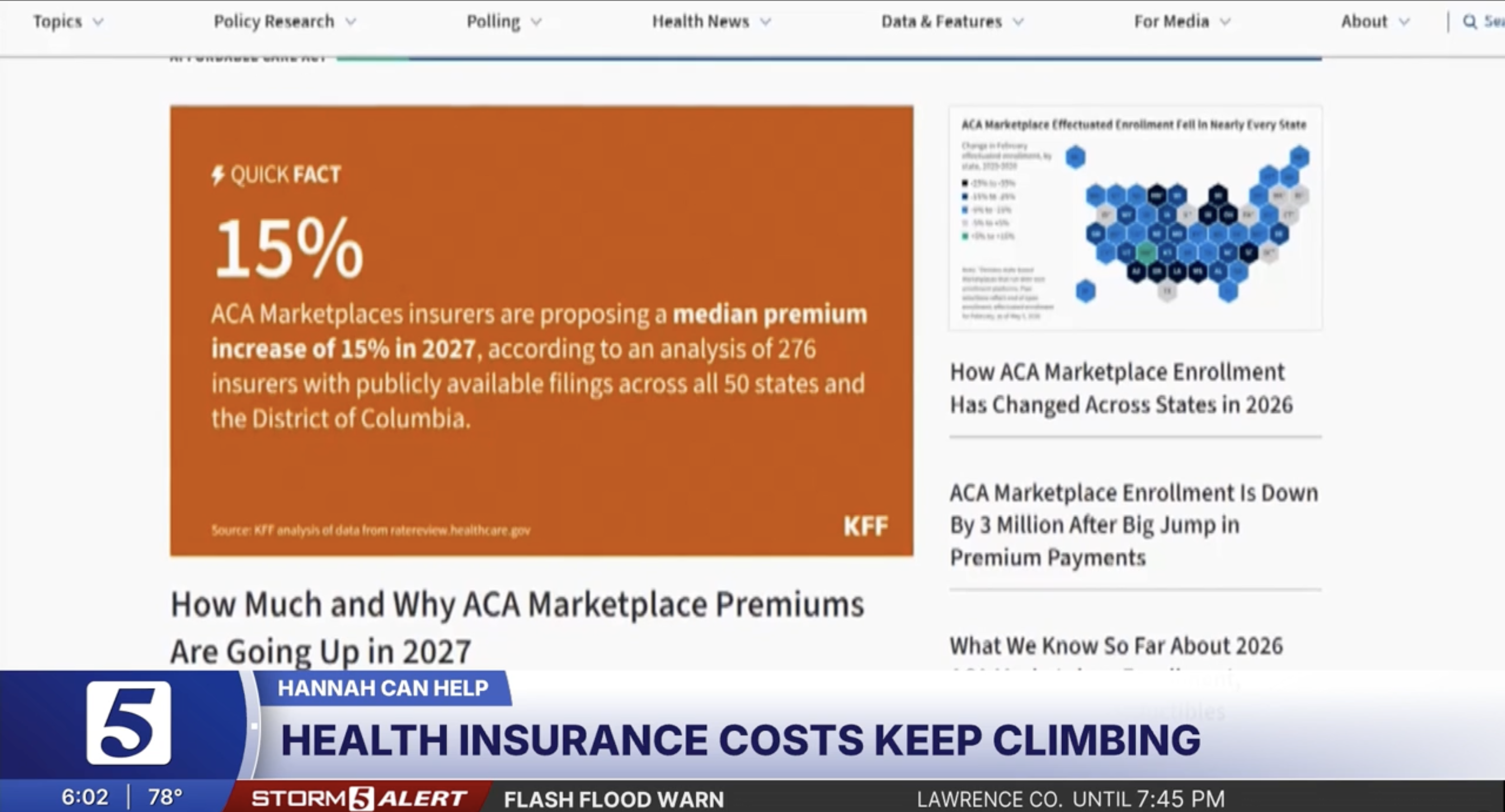
And it may be about to get worse. KFF, a health policy research organization, says insurers are proposing a median premium increase of 15% for 2027 — which would push Rowell's monthly cost to $610.
According to federal rate filing data, Tennessee’s major Affordable Care Act Marketplace insurers are proposing premium increases ranging from about 10% to nearly 29%.
| Insurer | 2027 Requested Rate Change |
|---|---|
| Alliant Health Plans, Inc. | 23.31% |
| BlueCross BlueShield of Tennessee | 10.36% |
| Celtic Insurance Company | 11.01% |
| Oscar Insurance Company | 18.72% |
| UnitedHealthcare Insurance Company | 28.68% |
She's not alone. Fourteen percent of Tennesseans who paid for ACA coverage last year dropped out this year, priced out of a system they once relied on.
The sharp increase in costs traces back to a policy decision in Washington. In 2021, Congress used money in its budget to help keep monthly ACA premiums low. Lawmakers did not continue that funding in 2025, driving costs up sharply.
KFF researchers say those who leave the ACA marketplace are unlikely to find another option.
"We would expect this year the people who peel off of the ACA marketplaces because they're being priced out, those are going to be people who are probably going to become uninsured — the vast majority of them," Matt McGough, a KFF policy analyst, said.
Rhonda Clark ditched her ACA marketplace coverage.
Clark lives on her own with cerebral palsy and owns a small business. She dropped her ACA coverage after the cost became too high — and says she has no regrets, even though the coverage she had wasn't enough to begin with.
"And I was one of these people who made sure every one of my doctors was in-network," Clark said.
But even that diligence didn't help.
"And I thought I couldn't survive without it. Well, I couldn't survive with it because nothing was covered," Clark said.
The plan she had didn't cover enough of the care she actually needs, including her complex rehabilitation equipment.
"For me, I was limited to 20 PT visits. Well, 20 PT visits with spastic cerebral palsy who wants to continue to live independently is just getting started," Clark said.
Today, Clark pays out of pocket. An orthopedic visit with X-rays alone costs roughly $900. She plans carefully for the care she needs while hoping she doesn't face a major medical emergency.
"Somebody said well, what if you have a heart attack or something? I said well you deal with it, I mean I deal with my life everyday," Clark said.
For Rowell, that kind of gamble isn't possible. She needs her insurance.
"If I get sick in the middle of all of this and I need a treatment of some sort or a transfusion or anything like that, I have to have insurance. My treatments were very expensive," Rowell said.
Despite the uncertainty, Rowell says she plans to keep living her life, even as the costs keep climbing.
"They make it so hard to want to keep living out of your... the rest of the years you have..." Rowell said.
KFF researchers say the forces driving up ACA premiums may not be limited to the individual market, suggesting the same pressures could affect employer-sponsored coverage, which is how the majority of Americans get their insurance.
"A lot of the factors that are driving the changes in premiums in the ACA marketplaces are not necessarily unique to the individual market," McGough said. "The increases in the underlying cost of health care, hospital consolidation, labor shortages in the health sector, increased use in GLP-1s and the cost of specialty drugs — these are all things that are not just happening in the individual market. They're also happening for people who have employer coverage."
This story was reported on-air by a journalist and has been converted to this platform with the assistance of AI. Our editorial team verifies all reporting on all platforms for fairness and accuracy.

September 11, 2001 is a day most associate with terror and tragedy. Austin Pollack shares a story from that day about hope and persistence: the effort to save a little girl’s life – with an organ donation. The problem? The young patient was in Houston, and her life-saving liver here in Nashville. With the grounding of all civilian aircraft, how could it be done? “Nobody ever said this isn’t possible.”
- Rhori Johnston