
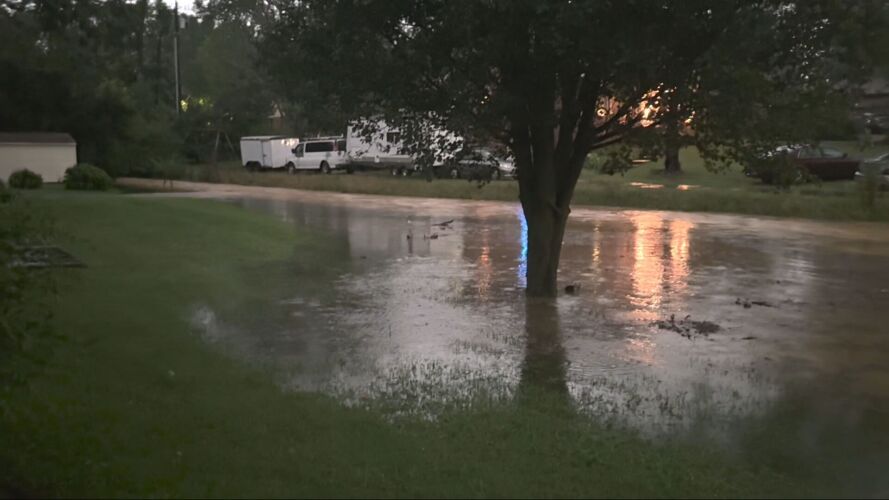


SPRINGFIELD, Tenn. (WTVF) — Flash flooding in Springfield's Stonegate neighborhood came dangerously close to homes Tuesday night, with an overflowing drainage ditch at the center of the problem.
One neighbor, Jason, had a question after watching water creep toward his back patio: whose job is it to make sure that doesn't happen again?
When it rains, water needs somewhere to go. In residential neighborhoods, drainage easements are designed to help channel stormwater away from homes. But when they get blocked or clogged with storm debris, the question of who is responsible for clearing them is not always straightforward.
Jason emailed the newsroom a video showing water overflowing from the drainage area behind his house and a photo of the flooding coming "uncomfortably close" to his back patio. I took both to officials in Springfield.

By Wednesday morning, when I visited the property, the water had receded, but the ground was still soggy, and the grass was still matted down by the force of the water.
Visiting the property gave me a better understanding of his confusion. The drainage easement behind Jason's property serves the entire cul-de-sac. He sits at the lowest point in the neighborhood.
According to Springfield officials, owners of properties with drainage easements are responsible for making sure nothing blocks the flow of water. The easement provides a path for water to flow through the area, but does not transfer ownership or maintenance responsibility.
The answer may not be what many homeowners expect: if you own a property with a drainage easement, you could be responsible for maintaining an area of your property you do not necessarily benefit from.
Other communities
Across Middle Tennessee, local governments generally say drainage easements remain the responsibility of the property owner.
Murfreesboro says public drainage easements are the responsibility of the landowner, while the city retains the right to regulate what happens within them. For example, the city warns homeowners not to place sheds, pools, garages, and other similar construction.
Williamson County similarly says it does not maintain drainage easements outside of the County Road Rights-of-Way.
Metro Nashville tells property owners to keep drainage easements clear, as building structures or altering the paths inside the easement is strictly regulated and enforced.
Franklin’s guidance states property owners generally maintain the land surface, like grass or landscaping, inside their easement, while the city oversees the public stormwater infrastructure impact.
Additionally, Clarksville, Hendersonville, Gallatin and Columbia all prohibit permanent structures or obstructions inside drainage easements through local zoning or stormwater regulations, while Rutherford County notes that drainage easements are intended to preserve runoff paths and access for stormwater management rather than transfer ownership to the government.
Do you think Hannah Can Help? Email hannah.mcdonald@newschannel5.com.
This story was reported on-air by a journalist and has been converted to this platform with the assistance of AI. Our editorial team verifies all reporting on all platforms for fairness and accuracy.

September 11, 2001 is a day most associate with terror and tragedy. Austin Pollack shares a story from that day about hope and persistence: the effort to save a little girl’s life – with an organ donation. The problem? The young patient was in Houston, and her life-saving liver here in Nashville. With the grounding of all civilian aircraft, how could it be done? “Nobody ever said this isn’t possible.”
- Rhori Johnston