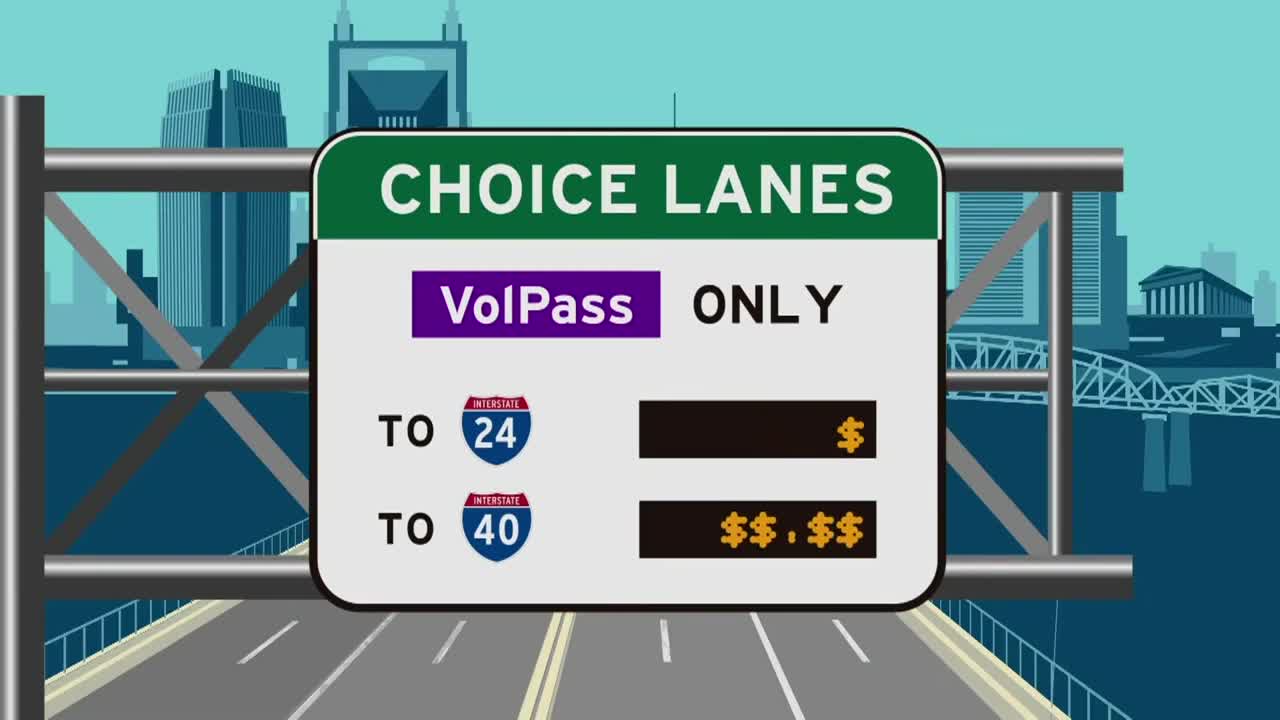


NASHVILLE, Tenn. (WTVF) — The Tennessee Department of Transportation continues moving forward with its I-24 Southeast Choice Lanes project, a plan state leaders believe could ease congestion between Nashville and Murfreesboro while giving drivers the option to pay for a faster, more reliable trip.
WATCH: TDOT commissioner defends I-24 Choice Lanes project, addresses tolls, property impacts
But questions remain about the project's tolling model, its impact on nearby neighborhoods and why the state isn't simply adding more general-purpose lanes.
In an exclusive interview with NewsChannel 5, Will Reid, commissioner of the Tennessee Department of Transportation, said the Choice Lanes project is designed to provide drivers with a more predictable commute. "What they get for that user fee is guaranteed travel time reliability," Reid said.
The project would add two new Choice Lanes in each direction along roughly 26 miles of Interstate 24. Drivers who choose to use the lanes would pay a fee, while the existing general-purpose lanes would remain free to use.
One of the biggest questions surrounding the project is why Tennessee isn't simply widening the interstate and adding more traditional lanes. "If we could do a general widening of the interstate like we traditionally would, we would do that," Reid said.
According to Reid, the answer comes down to funding.
Tennessee is one of only a handful of states that relies on a "pay as you go" approach for transportation projects rather than issuing debt or bonds. Reid says paying for the I-24 widening using the state method would eat up four years of TDOT's total constrution budget, which isn't fair to the other 94 counties in Tennessee.
Under the Choice Lanes model, a private consortium would pay for construction up front and then recover its investment through fees collected from drivers who choose to use the lanes. "At the end of the day, we're getting a $9.2 billion piece of infrastructure that we would not have been able to afford otherwise," Reid said.
Concerns about neighborhood impacts
For some residents, the concerns extend beyond tolls and traffic.
The state has notified a small number of homeowners and businesses with "Right-of way letters," letting them know that their property will be impacted by the project in some way.
"The department will continue to be in contact with property owners throughout the balance of this year and into next year. TDOT recognizes the public’s concerns about right-of-way and potential property impacts and will follow all applicable state and federal laws and regulations governing right-of-way acquisition, relocation assistance and property owner rights to ensure a fair and lawful process following the Uniform Relocation Assistance and Real Property Acquisition Policies Act of 1970," said Rebekah Hammonds, TDOT's Public Private Partnership Communications Officer.
"I live in Glencliff and we are an affected community," South Nashville resident Allen Dyer said during a TDOT community meeting last month. "We're losing 25 or 30 homes."
Reid acknowledged those concerns and said TDOT has modified aspects of the project in response to public feedback. "Our goal is to minimize those impacts as much as we can," Reid said.
He pointed to areas such as Noble Place Townhomes and the Pan Asian Market as examples where TDOT asked developers to consider ways to reduce impacts during the design process.
However, Reid acknowledged that minimizing impacts does not necessarily mean eliminating them altogether. "That could be acquiring some easement," he said. "If we're widening a roadway and a slope gets over on somebody's property, that's not taking a home or a business, but it's still an impact to their property and they deserve to be compensated for that."
TDOT says the final footprint of the project has not been finalized. Reid added that additional public meetings will be held and property owners will be notified as plans continue to develop. "We're going to have more public meetings. We're going to have more opportunities for people to have their voice heard," Reid said. "We don't want folks to be surprised."
Why TDOT says everyone could benefit
While some drivers may never choose to pay to use the Choice Lanes, Reid argues they could still see benefits.
He said shifting a portion of traffic into the toll lanes could improve traffic flow in the existing lanes as well. "You can begin to see what we call laminar flow, or actually smooth flow in the general-purpose lanes because some of the traffic has decided to use the Choice Lanes," Reid said.
Reid said these lanes won't operate like the lanes just north of Atlanta, that change direction depending on the time of day. Since there are two lanes in each direction, he believes the I-24 lanes will get more use.
TDOT also notes that public transit vehicles, including WeGo buses, would be able to use the Choice Lanes without paying a fee.
The timeline
While TDOT has identified DriveTN, a consortium of several companies, as a finalist, the deal isn't finalized. Reid expects to commercially close by next month and financially close by Spring 2027. Then the route will be finalized and land acquisition will begin.
Under the final agreement, DriveTN will finance, design, build, operate and maintain the Choice Lanes. TDOT will establish the project requirements, oversee performance, coordinate governmental responsibilities and hold the selected partner accountable.
Drivers won't be using the new lanes anytime soon. Reid said the project is still years away, with the Choice Lanes expected to open in the early 2030s.
Do you have more information about this story? You can email me at Chris.Davis@NewsChannel5.com.

September 11, 2001 is a day most associate with terror and tragedy. Austin Pollack shares a story from that day about hope and persistence: the effort to save a little girl’s life – with an organ donation. The problem? The young patient was in Houston, and her life-saving liver here in Nashville. With the grounding of all civilian aircraft, how could it be done? “Nobody ever said this isn’t possible.”
- Rhori Johnston