



NASHVILLE, Tenn. (WTVF) — You’ll notice on the way to the president’s office a massive wall of photos paying tribute to past leaders of Tennessee State University (TSU).
Dwayne Tucker’s photo was placed at the very top just in the past few weeks, but what he’s done over the last year has transformed the university that was once on the brink of financial collapse.
The career businessman, known for turning around Fortune 500 companies, took on what many considered an impossible task when he assumed leadership of the beloved HBCU.
"I would say it's the beginning of our transformational change at Tennessee State University," Tucker said.
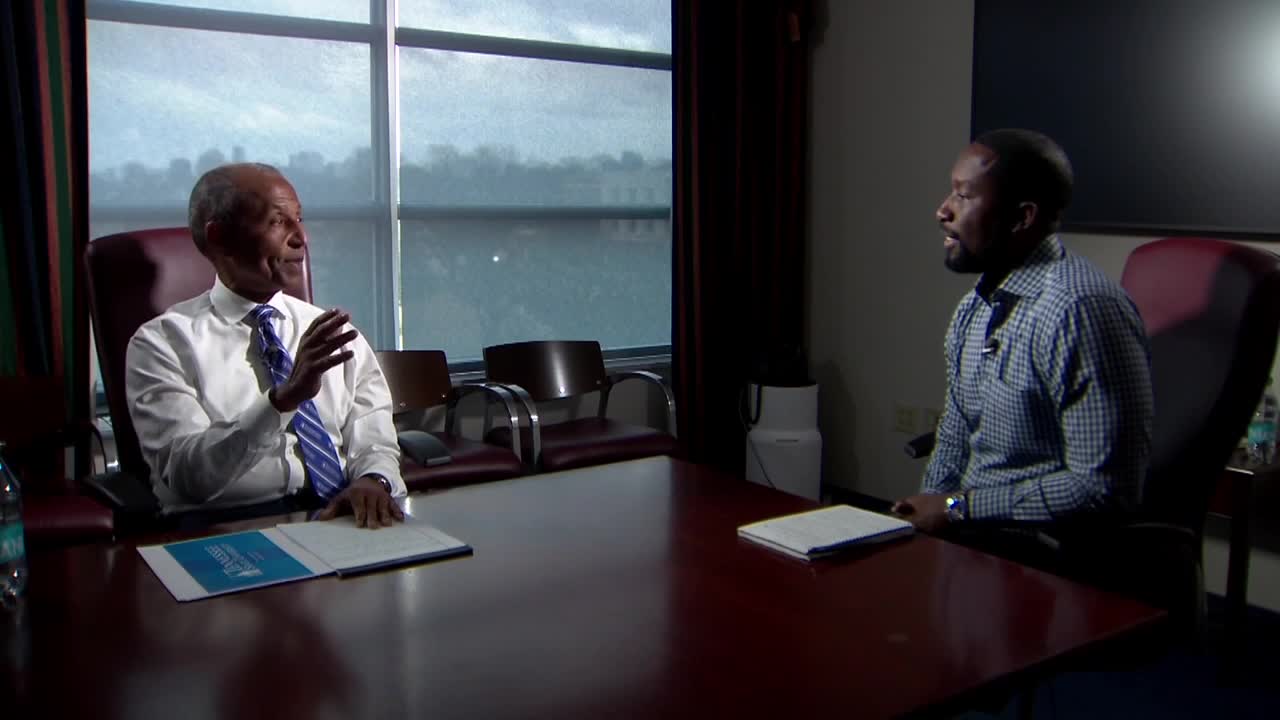
This is not our first interview with a TSU president, but it was our first with Tucker, who spent most of his first year explaining how we got here.
“That’s the number one thing I heard when I first got here. It’s like, how did it happen? Because nobody saw it coming,” Tucker said.
TSU discovered in December that it was out of money, with some concerned the institution wouldn't survive past summer. Years of questionable spending under previous administrations had led to situations like students starting the semester in hotel rooms.
The university eliminated ads at the Nashville International Airport, cut band trips to away football games, and nixed the football team staying at a hotel near the Tennessee Titans stadium before home football games.
The state provided an $11 million budget advance and a $32 million infusion just to keep the university operating in 2023-2024.
Tucker said morale was at its lowest point, and public perception of the university was equally discouraging.
"What a difference a year makes," Tucker said.
TSU will end the year $13.2 million better than forecasted, with a graduation rate up 10% and plans for constructing new dormitories.
Since June, the university has hired key leadership positions, including a VP of Enrollment Management, VP of Human Resources, VP of Institutional Advancement, Director of Fundraising, Controller, Chief Financial Officer, and Chief Operating Officer.
"I'm sure people are out there thinking, 'Wait a minute, is this the same TSU we were just talking about where we had no idea if it was even going to have the doors open?'" I asked.
"Yeah, I think we have made some amazing progress working together," Tucker replied.
The key phrase is "working together" – not only between TSU and its new Board of Trustees, but with state leaders who had been calling for accountability. Tucker met several times with Comptroller Jason Mumpower, and mending relationships with the state paid off almost immediately.


After the university's most recent audit found serious financial mismanagement, Mumpower wrote a letter clarifying that the findings were based on actions of past leadership.
"The audit's findings are unquestionably serious and reflect a pattern of financial mismanagement, operational breakdowns and federal compliance failures that accumulated over many years. These issues resulted from systemic weaknesses and mismanagement by the former Board of Trustees, a former president and prior university leadership teams. Their failure to maintain effective internal controls created the error-prone environment documented in the audit report."
"But more importantly, it's amazing how things work when you just tell people the truth and be transparent about what the challenges are at the university," Tucker said.
Tucker said one misconception had to do with the idea of selling the Avon Williams campus, which TSU received as part of a 40-year lawsuit with the state over equally funding both TSU and UTK.
He said after speaking with Mumpower and others, it became clear that selling wasn't the priority as much as finding ways to monetize the property.
"All they were saying was are you rationalizing your assets and see if you can monetize some of those, which means that you don't have to sell the lot," Tucker said.
TSU later reached a deal in June that freed up $96 million to help run the university from the $250 million the state once said could only be used on maintenance. This money was allocated after the state acknowledged it had underfunded the university by more than half a billion dollars over decades.
Rep. Harold Love Jr., a TSU alumnus who was among those who pointed out the underfunding, hopes the legislature will consider an additional $250 million installment in the next budget.
"Now that we know, state lawmakers, that you feel a bit more comfortable with the administration at the university – what's it look like to circle back around and put money back in the university when it comes to programs?" Love said.
Tucker said the underfunding figure has ranged from $500 million to $2.1 billion, depending on the audience.
Tucker understands some want TSU to fight for this money in court, but points to Florida A&M as a cautionary example. Florida A&M challenged the state of Florida in court to recover roughly $1 billion in underfunding, only to lose and likely damage relationships with state leaders who could have offered some relief.
"It makes no sense to sue the state in which you operate, that's providing the funding when you need some cash in order to pay your bills," Tucker said.
Getting promised funding hasn't been easy. TSU first had to prove it was willing to make cuts to scholarship programs, let go of more than 100 employees, renegotiate contracts, and recover millions in lost tuition from international learning programs.
"We achieved those, and we didn't run out of money in April or May," Tucker said.
As momentum shifts toward the possibility of more students, I asked how this growth will differ from the expansion that led to the financial trouble they now have to overcome.
"I think when people see that you have their best interests in mind about the decisions that you make, it's easy for them to make this transition that we're making now," Tucker said.
He added that the university should not take students if it doesn't have the capacity or beds to accommodate them.
"So, putting a couple thousand students into a hotel won't happen under this leadership," Tucker said.
Tucker said he's committed to building new facilities to modernize TSU's campus, including dormitories. He's acknowledged that funding these transformational changes will be challenging, but hopes to collaborate with alumni chapters where some dues could be paid directly to TSU.
"What we really want to do is have that money come straight to the university so that it helps raise alumni giving rate and then could allow other donors to give more because they see alumni donating," Tucker said.
One year ago, TSU was told to take it down to the studs and build from there.
The message was clear for Tucker, who says transparency is now the foundation, and this is just the beginning.
