

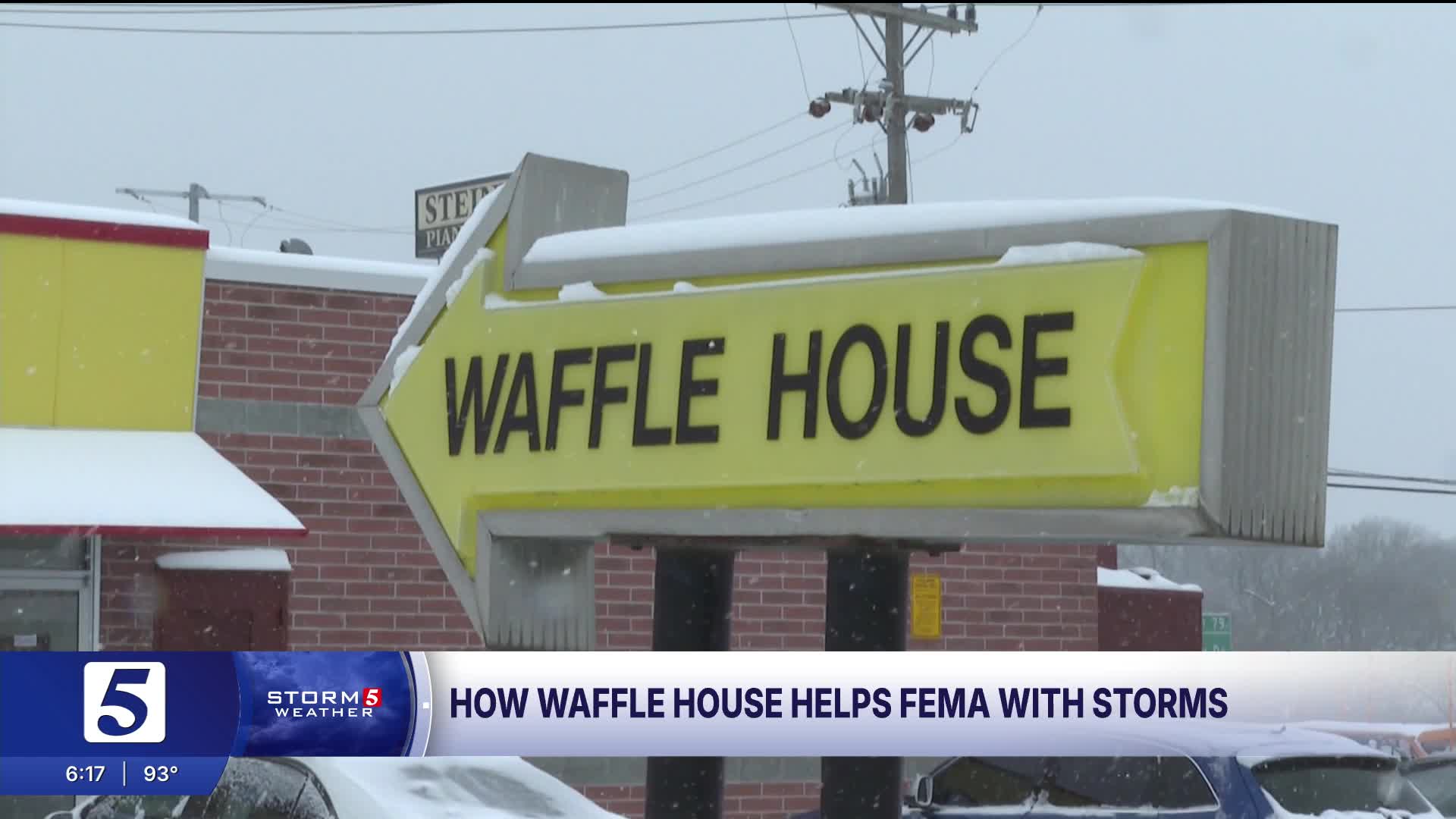


NASHVILLE, Tenn. (WTVF) — For more than 20 years, one of FEMA's most reliable tools for measuring hurricane damage has had nothing to do with satellites or Doppler radar. It involves waffles.
It's called the Waffle House Index, and it works for more than just hurricanes — even ice storms like the one Middle Tennessee saw in January.
Former FEMA Director Craig Fugate said the index was created in 2004.
"It came about in 2004 during the four hurricanes that hit Florida," Fugate said.
Fugate said the index was developed as a way to speed up the agency's disaster response.
"We were trying to get faster response and not wait for the local governments to make requests… in many cases, just go to where the storm hit," Fugate said.
Here's how it works: Waffle House has a reputation for staying open no matter what — holidays, ice storms, even hurricanes.
If a location in an impacted area is fully open with a full menu, that's a Green Zone.
If a location is open but serving a limited menu — perhaps because of power outages or reduced supplies — that's a Yellow Zone.
If a Waffle House is closed entirely due to damage, no power, or no deliveries, that's a Red Zone — and for FEMA, that means emergency crews need to get moving.
Fugate said the chain's around-the-clock business model is what makes it such an accurate indicator.
"The reason that works is Waffle House is open 24 hours a day, 7 days a week. Their response to disasters is probably one of the best in the nation," Fugate said.
Fugate said how quickly Waffle House can reopen after a storm makes the chain a surprisingly accurate measure of how a community's infrastructure is holding up.
"Show up… get open! That provides, for a company in hurricane-prone regions, a lot of experience getting open quickly — serving customers — and indirectly became a good indicator of the infrastructure of a community," Fugate said.
So the next time a Waffle House is lit up after a storm, it's more than just breakfast. It's a sign that recovery is already underway.
