

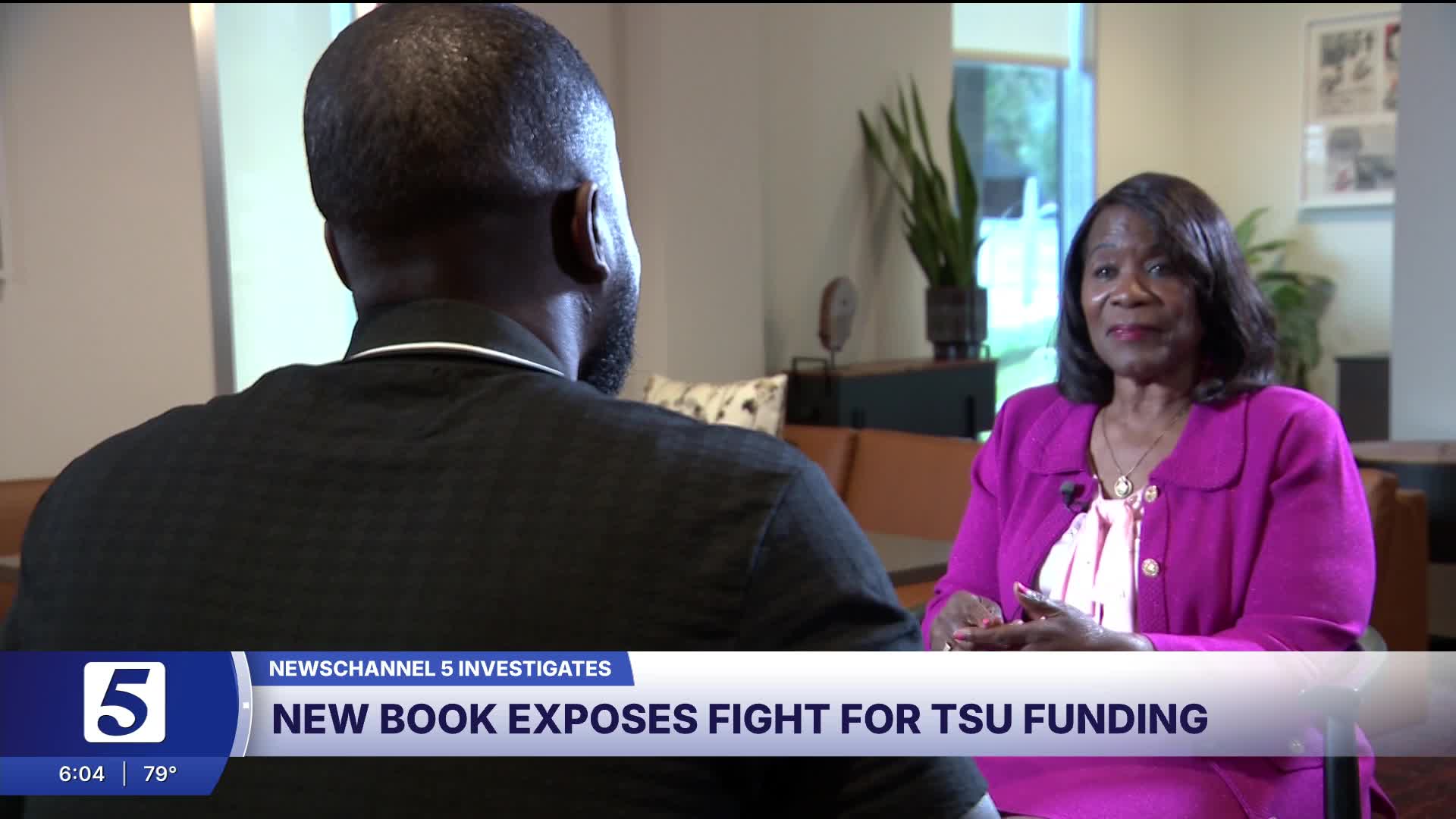


NASHVILLE, Tenn. (WTVF) — A new book promises to expose how underfunding Tennessee State University amounted to the "greatest financial injustice in Tennessee history."
The book, titled "How Dare You," is less about former TSU President Dr. Glenda Glover's life and more about how lawmakers reacted the moment she started questioning why the HBCU had been underfunded $544 million over decades — a number the Biden administration later said was closer to $2.1 billion.
No matter how much has changed since almost two years ago when we last sat across from one another, Glover's goal is the same now as it's ever been: fight for what's owed.
"If anybody takes anything away from this book, I want you to take away that the debt is still not paid," Glover said.
“But why a book? Why now,” I asked.
“Well, I wanted to make sure that the truth was part of the record,” Glover replied.
From her early days in Memphis as the daughter of a civil rights leader, Glover wrote how she grew up learning to embrace challenges. She asked her TSU classmates what the toughest major was, and the answer overwhelmingly came back as mathematics.
Glover soon earned her degree in mathematics before pursuing an MBA at Clark Atlanta University, a doctorate in business from George Washington University, and a law degree from Georgetown University. At the time, she became just one of two African American women in the country to hold a Ph.D.-CPA-JD.
Glover's book briefly reflects on her past before going on to explain in exhaustive detail how Tennessee matched federal land grant funding for the University of Tennessee while ignoring TSU.
"And we found out to our surprise, UT was getting two, three, four, and five times the match," Glover said.
When she presented those findings to state lawmakers, Glover said there was little interest in what was owed. Instead, she says people like Comptroller Jason Mumpower spent valuable time spinning their own narrative to avoid paying and placed blame on the now former president.
"Who has made out like a bandit while leaving only a legacy of dysfunction," Mumpower said.
Mumpower may have been one of the harshest critics of TSU at the time, but Glover wrote in her book that he may have also been the least qualified to make such damning remarks.
"It's important to know who Jason Mumpower is, and I know who he is," Glover said.
Glover spent entire chapters on how she was shocked to learn the man questioning TSU's spending habits was not a certified accountant and only had a bachelor's degree in economics.
She says had his Republican colleagues not stepped in after his failed bid for speaker, Mumpower may have never qualified for the job.
"I did say that when you compare him to the others, he didn't measure up, and he didn't," Glover said.
“You did a lot more than say that. You called it white privilege,” I responded.
“I called it white privilege then, and I call it white privilege now,” Glover said.
Glover says making matters worse was knowing the audits by Mumpower's office, claiming TSU both overcharged and undercharged students, were far from complete.
A December 2025 audit found that between 2024 and fall of 2023, there were 1,053 errors that led to more than $250,000 overcharged to students, while other students were undercharged by more than $870,000.
"No one looked at anything in finance. We had the financial statements. We had the bank reconciliations all ready for them," Glover said.
When I asked where those numbers came from, Glover said she didn't know.
"I don't know where the numbers actually came from in that report," Glover said.
We reached out to Mumpower's office for comment and Mumpower offered the following response:
Glenda Glover is no more relevant than a man in the moon. This book and its inaccurate assertions don't deserve a response. This is her attempt to return to the spotlight rather than advancing the interests of Tennessee State University.
Our Office's work has always been guided by the facts and by our responsibility to students, taxpayers, and the university. The concerns we raised during Glenda Glover's tenure have since been supported by reviews conducted by the university's own consultants and financial experts.
The real story today is TSU's future. The university is making great progress, and that progress deserves the public's attention.
As for how TSU was left with hardly enough money to cover payroll by the end of her tenure, Glover revealed that part of the reason had to do with the state forcing her to accept a no-bid contract meant to beautify the campus.
"They didn't say how much it would cost, but when we got into it, it ended up being over $13 million," Glover said.
When I asked if that was a surprise expense, Glover was direct.
"It absolutely was," Glover said.
By then, the university had already paid out millions in scholarships and grant money, expecting to be reimbursed by the Tennessee Higher Education Commission (THEC), only to be told that TSU required an audit of its finances.
Glover said this became just another barrier meant to make TSU look as poorly managed as possible, so the state could justify not immediately paying what was owed.
"TSU had a cash flow problem. There's no getting around that, but the cash flow problem came from what the state forced us to do," Glover said.
Glover takes responsibiliy for certain mistakes, like not having housing straightened out sooner after a 2021-2022 surge that saw enrollment increase by 1,141 students, but she maintains the deck was always stacked against her.
TSU is now once again projected to see one of its biggest incoming classes in years, and Glover says she is hopeful the university's financial turnaround means it is on the right track.
"I respect the new administration. I like the board members. I think the president, I like his approach. I'm hearing good things," Glover said.
When asked how she would like to be remembered, Glover's answer was the same as it has ever been: someone who fought for what was owed.
"You know, and that's how I want to be remembered. That I cared about the faculty. That I worked on behalf of the students and I worked on behalf of TSU to make TSU better," Glover said.
Glover says she is planning other books, but part of her legacy now involves the creation of an advocacy organization called Fair Funding, where she helps other HBCU presidents across the country claim money their institutions were owed.
As of last year, lawmakers freed up $96 million for TSU's operating expenses over the next 3 years, but there is still no clarity on when the university can expect any new funding.
